How Cells' Internal Recycling System Can Both Prevent and Fuel Cancer
Autophagy clears cellular damage before cancer starts, but the same process can help established tumors survive stress and treatment.

Key Takeaways
- •Autophagy is a conserved process where cells break down and recycle damaged components through the lysosome, especially during stress like nutrient shortage.
- •Mouse studies show that losing a working copy of the autophagy gene Beclin-1 increases tumor formation, supporting a tumor-suppressive role for autophagy.
- •Autophagy helps maintain genomic stability; impaired autophagy has been linked to increased chromosomal instability, a feature that can promote cancer development.
- •Two opposing signals, mTOR and AMPK, control whether autophagy switches on or off depending on nutrient and energy availability.
- •In established tumors, autophagy may shift from protective to supportive, helping cancer cells survive low oxygen, scarce nutrients, and treatment stress.
- •Hydroxychloroquine has been studied experimentally as an autophagy-blocking cancer treatment, but it remains unapproved outside clinical trials.
- •Autophagy's effect on cancer is context-dependent and cannot be labeled simply helpful or harmful.
- •There is no established lifestyle method, such as fasting or specific diets, proven to safely control autophagy for cancer treatment in humans.
Every cell occasionally accumulates damaged parts: misfolded proteins, worn-out internal structures, bits of machinery that no longer work. Cells have a built-in way of dealing with this mess. What makes it worth understanding for anyone touched by cancer is how differently this process behaves depending on timing. In the earliest stages of cancer, it tends to act like a guard. In an established tumor, it can switch sides.
How Cells Recycle Their Own Debris
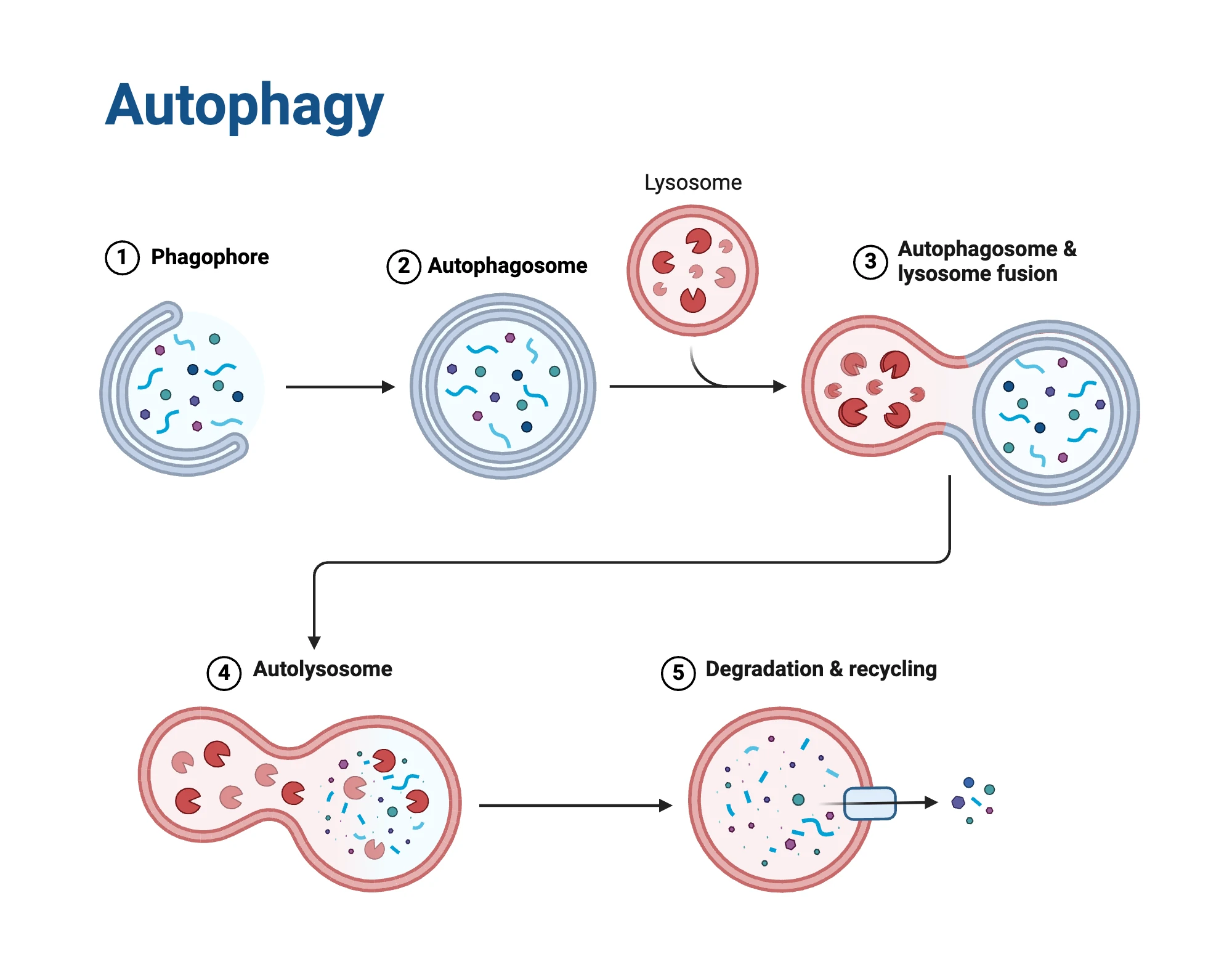
The process is called autophagy, a word that literally means "self-eating." It is ancient, found in yeast, plants, and animals alike, which tells researchers it does something fundamentally important for survival.
Here is how it works. A cell wraps damaged material inside a temporary double-walled bubble called an autophagosome — think of a trash bag forming around clutter in a room. That bag then travels to the lysosome, a compartment packed with digestive enzymes that acts like a recycling center. Inside, the material is broken down into basic building blocks the cell can reuse, including amino acids and sugars.
This matters most under stress. During nutrient deprivation, when food is scarce, autophagy ramps up so the cell can live off its own non-essential parts. It operates quietly in nearly every tissue, most of the time without anyone noticing it at all.
A Guard Against Early Cancer
For years, researchers wondered whether this recycling system had anything to do with cancer. Evidence from genetically engineered mice gave a clear answer: losing autophagy capacity makes tumors more likely to form.
One of the key proteins required to start autophagy is called Beclin-1. Mice engineered to carry only one working copy of the Beclin-1 gene, instead of the usual two, developed tumors at a higher rate than normal mice, even though one copy might be expected to still function adequately. This kind of result, where a single working copy isn't fully protective, is called haploinsufficiency. The Beclin-1 study, a landmark piece of work associated with Beth Levine's research group, was one of the clearest demonstrations of it in a tumor-suppressor gene.
Follow-up research helped explain why losing autophagy genes raises cancer risk. Cells with impaired autophagy accumulate more genetic errors over time, including chromosomal instability — broken or rearranged chromosomes that can push a normal cell toward malignant change. Without the recycling system clearing out this damage, cells are more likely to pick up the kind of genomic errors that cancer can build on. In that sense, autophagy functions like a quality-control inspector, removing raw material that cancer could otherwise exploit.
The Switch That Turns Recycling On and Off
Autophagy isn't always running at full speed. It is tightly controlled by two opposing signals that act like a thermostat for cellular housekeeping.
One signal, a protein called mTOR, senses when nutrients are abundant. When fuel is plentiful, mTOR suppresses autophagy, since there is no need to recycle when supplies are fresh. The other signal, AMPK, senses when the cell is running low on energy. When fuel gets scarce, AMPK flips the switch toward autophagy, prompting the cell to break down its own components to stay afloat.
This switch helps explain why autophagy ramps up under starvation, low oxygen, or other forms of cellular stress — conditions tumors often create for themselves as they outgrow their own blood supply.
When the Same System Starts Helping Tumors
Here is where the story gets more complicated. Once a tumor has already formed, the same recycling process that once guarded against malignancy can start working in the tumor's favor instead.
Established tumors often grow faster than their blood vessels can support, creating pockets of low oxygen and scarce nutrients deep inside the mass. Cancer cells in these conditions can lean on autophagy for fuel, somewhat like a stranded hiker rationing a dwindling food supply. Autophagy has also been studied as a way cancer cells cope with the stress imposed by chemotherapy and radiation, potentially blunting treatment effectiveness in some settings.
This evidence comes mostly from cell culture and animal studies rather than confirmed outcomes in cancer patients. How much it matters likely depends on tumor type, stage, and treatment. That context-dependence is exactly why autophagy resists a simple "good" or "bad" label — the same mechanism that holds off early cancer can later become something a tumor exploits to survive.
Could Blocking Autophagy Be a Cancer Treatment?
If tumors sometimes depend on autophagy to survive, could shutting it down starve them out? That idea has motivated a line of experimental research.
Hydroxychloroquine, a drug long used to treat malaria and autoimmune conditions, blocks the lysosome's ability to break down material, effectively jamming the recycling system partway through. It has been tested in cancer trials as an autophagy inhibitor, often alongside other treatments. Results so far have been mixed, and hydroxychloroquine remains experimental in oncology rather than an approved standard treatment. Whether blocking autophagy reliably helps, and in which cancers, is still being worked out.
One sign that autophagy has slowed inside a cell is the buildup of a protein called p62, which is normally cleared out along with the material it tags for recycling. When autophagy stalls, p62 piles up, and growing evidence suggests this buildup may itself add to cellular stress — another reason switching autophagy off is not a guaranteed win.
What Remains Unclear
Autophagy does not only operate inside cancer cells. It also happens in the surrounding tumor microenvironment, the mix of blood vessels, immune cells, and signaling molecules that interacts with a tumor. How autophagy inside immune cells shapes the body's ability to recognize and attack cancer is an active area of investigation, but the picture there is still forming rather than settled.
That open question sits alongside a broader one: at what point, in a given cancer, does autophagy stop protecting and start helping the tumor instead? Researchers do not yet have a precise answer that applies across cancer types.
The Takeaway for Patients
Autophagy is neither a villain nor a guardian in any absolute sense. It is a flexible process that behaves differently depending on timing, cell type, and surrounding conditions. In healthy tissue, it likely helps prevent cancer from starting. In an established tumor, it can sometimes become a tool for survival instead.
None of this translates into a lifestyle intervention patients can reliably use to manipulate autophagy for cancer treatment today. Fasting, specific diets, and supplements that influence autophagy in lab settings have not been shown to control cancer in humans, and autophagy-targeting drugs remain confined to clinical trials. What the research does offer is a clearer picture of how cells manage damage and survival — and why that same system can end up on either side of the fight against cancer.
Common Questions
References
- Noboru Mizushima, Masaaki Komatsu (2011). Autophagy: Renovation of Cells and Tissues
- Xueping Qu, Jie Yu, Govind Bhagat, Norihiko Furuya, Hanina Hibshoosh, Andrea Troxel, Jeffrey Rosen, Eeva-Liisa Eskelinen, Noboru Mizushima, Yoshinori Ohsumi, Giorgio Cattoretti, Beth Levine (2003). Promotion of tumorigenesis by heterozygous disruption of the beclin 1 autophagy gene
- Robin Mathew, Sameera Kongara, Brian Beaudoin, Cristina M. Karp, Kevin Bray, Kurt Degenhardt, Guanghua Chen, Shengkan Jin, Eileen White (2007). Autophagy suppresses tumor progression by limiting chromosomal instability
Team Review: This article has been reviewed by Canceria Research Team