Why Cancer Causes Severe Weight Loss and Muscle Wasting That Food Can't Fix
Inside cancer cachexia, the inflammatory and hormonal signals that drain muscle and appetite even when patients are eating enough
Key Takeaways
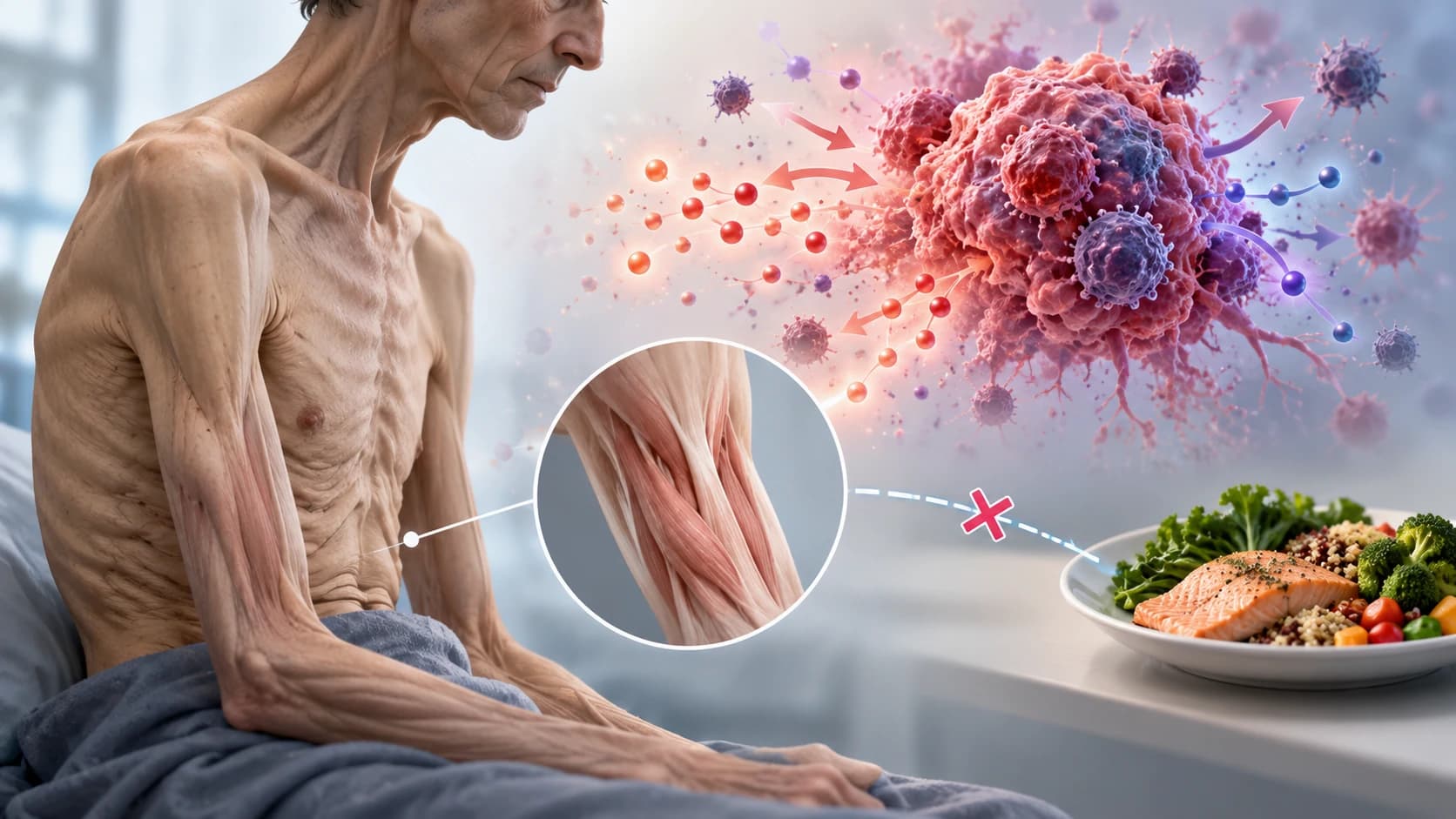
- •Cancer cachexia is a distinct, multifactorial syndrome, not simply a consequence of eating too little.
- •Unlike ordinary starvation, cachexia-related muscle loss often cannot be fully reversed through nutrition alone.
- •Persistently elevated inflammatory cytokines such as IL-6 and TNF-alpha help drive the metabolic changes seen in cachexia.
- •Muscle wasting involves an overactive cellular disposal system, the ubiquitin-proteasome system, that breaks down muscle protein faster than it can be replaced.
- •In preclinical studies, blocking myostatin/activin signaling through the ActRIIB receptor reversed muscle wasting and extended survival in mice.
- •The tumor-derived protein GDF15 acts on the brain to suppress appetite, and blocking it reversed cachexia-like symptoms in animal models.
- •Fat loss in cachexia involves both increased fat breakdown and a 'browning' process that raises energy expenditure.
- •Cachexia independently worsens treatment tolerance, quality of life, and survival, separate from tumor burden itself.
Many people picture cancer-related weight loss as a simple matter of eating less. A patient feels nauseated, skips meals, and the pounds come off. For many cancer patients, though, something far more complex is happening inside the body. It's a biological process called cancer cachexia, and it keeps consuming muscle and fat even when calories are available and even when people are eating normally. Understanding why this happens explains some of the most frustrating and dangerous parts of cancer care.
A Syndrome, Not Simple Hunger
Doctors and researchers reached an international consensus in 2011, led by clinician-researcher Kenneth Fearon and colleagues, on what actually defines cancer cachexia. By that definition, cachexia is an ongoing loss of skeletal muscle mass, the lean tissue that makes up the body's muscles, with or without a loss of fat. Crucially, it cannot be fully reversed through conventional nutritional support alone.
That last point separates cachexia from ordinary starvation. A person who simply isn't eating enough will usually regain lost weight once food intake returns to normal. A person with cancer cachexia often won't, even with adequate calories and protein. The muscle loss keeps progressing because the problem isn't a shortage of fuel. It's a shift in how the body processes the fuel it has.
The Body's Immune Response Turns Metabolism Against Itself
Much of that shift traces back to inflammation. Tumors and the immune system's response to them release small signaling proteins called cytokines, including IL-6 and TNF-alpha, that normally help coordinate the body's defenses against infection or injury. In cancer cachexia, these cytokines circulate at persistently elevated levels and travel well beyond the tumor itself.
They reach the liver, the brain, and skeletal muscle, where they push metabolism into a wasting state: more tissue breakdown, less tissue building, and higher resting energy use. This is why cachexia is often described as a whole-body, systemic process rather than something confined to the area where the tumor happens to be growing.
How Muscle Breaks Down From the Inside
Muscle is in constant turnover. Cells are continually building protein and breaking it down, and healthy muscle maintains a rough balance between the two. In cancer cachexia, that balance tips sharply toward breakdown. A cellular disposal system called the ubiquitin-proteasome system, which normally tags and clears out damaged or unneeded proteins, becomes overactive in muscle tissue. It starts dismantling healthy muscle proteins faster than the body can replace them, like a recycling crew told to work overtime on material that isn't actually waste.
A separate but related pathway adds to the problem. Myostatin and activin are signaling molecules that normally put a natural brake on muscle growth, acting through a receptor called ActRIIB. When this pathway becomes overactive, it reinforces the breakdown signal and suppresses the muscle's ability to rebuild. In mice with cancer, blocking the ActRIIB receptor reversed muscle wasting and extended survival, a striking result from a 2010 preclinical study. That finding doesn't mean the same strategy works in human patients. It does, however, point to specific steps in the wasting process that might eventually be worth targeting.
Why Appetite Fades
Muscle wasting alone wouldn't explain why so many cancer patients also lose interest in eating, even foods they once enjoyed. Part of the answer lies with a tumor-produced protein called GDF15, also known as MIC-1. GDF15 travels through the bloodstream and acts on a receptor in the brain's appetite-control center, effectively telling the body that it's already full.
In animal studies, blocking this signal, either by removing GDF15 or interfering with its receptor, reversed appetite loss and the cachexia-like weight loss that went with it. Like the ActRIIB work, these findings come from animal models rather than confirmed human treatments. They still help explain why appetite loss in cancer isn't simply psychological, or only a side effect of treatment. It can be driven directly by a molecule the tumor itself is producing.
Fat Tissue Doesn't Just Shrink, It Changes
Fat loss in cachexia isn't only a matter of fat cells emptying their stores, though that does happen through an accelerated process called lipolysis, which breaks stored fat down into fatty acids the body can burn for fuel. In some patients, the fat tissue itself appears to change character.
White fat, which normally just stores energy, can take on properties of heat-generating "brown" fat, a process researchers call browning. Browning tissue burns more energy than ordinary fat, even at rest, which adds to the overall energy deficit driving weight loss. Combined with heightened inflammation, these adipose tissue changes mean cachexia drains the body's energy reserves from more than one direction at once.
Why Cachexia Changes the Course of Treatment
Cachexia isn't simply a symptom that trails alongside cancer. Clinical evidence shows it independently affects how well patients tolerate treatment, how they feel day to day, and how long they survive, separate from the effects of the tumor itself. Patients with significant muscle loss often tolerate lower doses of treatment, experience more complications, and report a lower quality of life than patients with similar tumors but without cachexia.
This is part of why clinicians increasingly look at muscle mass, not just tumor size or stage, as a meaningful marker of how a patient's illness might unfold.
Attempts to Treat Cachexia Directly
If appetite loss and muscle breakdown have identifiable molecular drivers, it's natural to ask whether drugs that target them could help. One approach tested in clinical trials uses a ghrelin receptor agonist, a drug designed to mimic the hunger-stimulating hormone ghrelin. A drug called anamorelin was studied in two large randomized phase 3 trials in patients with lung cancer and cachexia.
It increased appetite and body weight compared with placebo, but it didn't reliably improve muscle strength or function, and its effects on longer-term outcomes were limited. The trials illustrate a broader pattern in cachexia research: interventions addressing just one piece of the puzzle, whether appetite, inflammation, or muscle breakdown, rarely resolve the syndrome on their own, because multiple pathways are usually active at the same time.
Living With Cachexia While the Science Continues
None of this means nutrition is irrelevant to someone with cancer. Adequate protein and calories remain important for comfort, strength, and tolerating treatment. But the evidence here means unexplained weight loss or muscle wasting in a cancer patient isn't a problem food alone can solve, and it shouldn't be treated as a failure of diet or willpower.
It's a biological syndrome with its own drivers, several of which researchers have only mapped in detail within the past two decades. Anyone noticing unexplained weight loss or weakness during cancer treatment should raise it with their oncology care team, since recognizing cachexia early may open up more options than waiting until it becomes advanced. The mechanisms described here, inflammatory signaling, muscle protein turnover, appetite-suppressing tumor signals, and changes in fat tissue, are now reasonably well mapped. Translating that map into therapies that reliably help patients remains an open and active challenge.
Common Questions
References
- Kenneth Fearon, Florian Strasser, Stefan D Anker, Ingvar Bosaeus, Eduardo Bruera, Robin L Fainsinger, Aminah Jatoi, Charles Loprinzi, Neil MacDonald, Giovanni Mantovani, Mellar Davis, Maurizio Muscaritoli, Faith Ottery, Lukas Radbruch, Paula Ravasco, Declan Walsh, Andrew Wilcock, Stein Kaasa, Vickie E Baracos (2011). Definition and classification of cancer cachexia: an international consensus
- William J. Evans, John E. Morley, Josep Argilés, Connie Bales, Vickie Baracos, Denis Guttridge, Aminah Jatoi, Kamyar Kalantar-Zadeh, Herbert Lochs, Giovanni Mantovani, Daniel Marks, William E. Mitch, Maurizio Muscaritoli, Armine Najand, Piotr Ponikowski, Filippo Rossi Fanelli, Morrie Schambelan, Annemie Schols, Michael Schuster, David Thomas, Robert Wolfe, Stefan D. Anker (2008). Cachexia: A new definition
- Josep M. Argilés, Sílvia Busquets, Britta Stemmler, Francisco J. López-Soriano (2014). Cancer cachexia: understanding the molecular basis
- Michael J. Tisdale (2009). Mechanisms of Cancer Cachexia
- Kenneth C.H. Fearon, David J. Glass, Denis C. Guttridge (2012). Cancer Cachexia: Mediators, Signaling, and Metabolic Pathways
- (2010). Reversal of cancer cachexia and muscle wasting by ActRIIB antagonism leads to prolonged survival.
- Heiko Johnen, Shu Lin, Tamara Kuffner, David A Brown, Vicky Wang-Wei Tsai, Asne R Bauskin, Liyun Wu, Greg Pankhurst, Lele Jiang, Simon Junankar, Mark Hunter, W Douglas Fairlie, Nicola J Lee, Ronaldo F Enriquez, Paul A Baldock, Eva Corey, Fred S Apple, MaryAnn M Murakami, En-Ju Lin, Chuansong Wang, Matthew J During, Amanda Sainsbury, Herbert Herzog, Samuel N Breit (2007). Tumor-induced anorexia and weight loss are mediated by the TGF-β superfamily cytokine MIC-1
- Rowena Suriben, Michael Chen, Jared Higbee, Julie Oeffinger, Richard Ventura, Betty Li, Kalyani Mondal, Zhengyu Gao, Dina Ayupova, Pranali Taskar, Diana Li, Shelley R. Starck, Hung-I Harry Chen, Michele McEntee, Subhash D. Katewa, Van Phung, Marilyn Wang, Avantika Kekatpure, Damodharan Lakshminarasimhan, Andre White, Andrea Olland, Raj Haldankar, Mark J. Solloway, Jer-Yuan Hsu, Yan Wang, Jie Tang, Darrin A. Lindhout, Bernard B. Allan (2020). Antibody-mediated inhibition of GDF15–GFRAL activity reverses cancer cachexia in mice
- Michele Petruzzelli, Erwin F. Wagner (2016). Mechanisms of metabolic dysfunction in cancer-associated cachexia
- Vickie E. Baracos, Lisa Martin, Murray Korc, Denis C. Guttridge, Kenneth C. H. Fearon (2018). Cancer-associated cachexia
- (2016). Anamorelin in patients with non-small-cell lung cancer and cachexia (ROMANA 1 and ROMANA 2): results from two randomised, double-blind, phase 3 trials.
Team Review: This article has been reviewed by Canceria Research Team