KRAS Mutations in Cancer: How a Once 'Undruggable' Gene Became a Drug Target
Scientists spent three decades trying to block a cancer-driving gene before a hidden pocket on one mutant form finally made it possible.
Key Takeaways
- •KRAS is one of the most frequently mutated oncogenes in human cancer, with especially high rates in pancreatic, colorectal, and lung tumors.
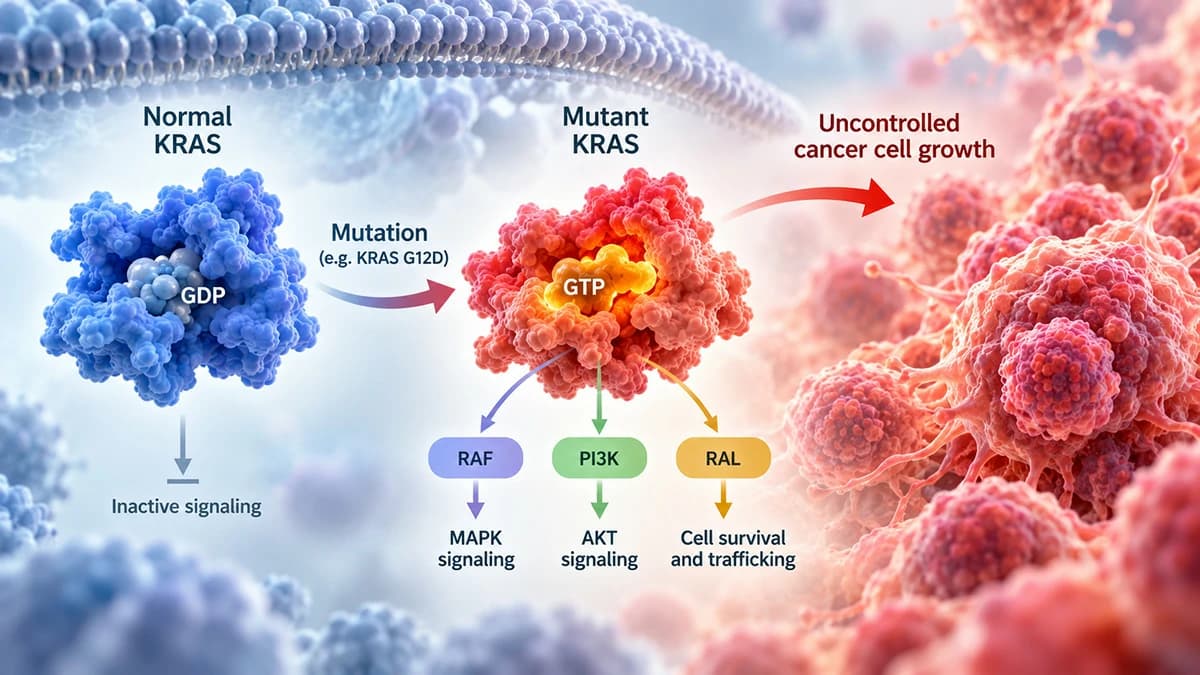
- •Normally, KRAS acts as a molecular switch that turns itself off after triggering a growth signal, but cancer-causing mutations lock it in the 'on' position.
- •A stuck-on KRAS protein continuously drives two major growth pathways inside the cell, pushing it to divide without the usual restraints.
- •For more than three decades, KRAS was considered undruggable because its smooth surface and extremely strong grip on its fuel molecule left no good place for a drug to bind.
- •The 2013 discovery of a hidden pocket next to the G12C mutation opened the door to the first drugs able to directly block mutant KRAS.
- •Sotorasib and adagrasib, two KRAS G12C inhibitors, have shown meaningful tumor responses in clinical trials of non-small cell lung cancer.
- •Many tumors eventually become resistant to KRAS G12C inhibitors, either through new mutations in KRAS or by rerouting growth signals around the blocked protein.
- •Mutations other than G12C, such as G12D and G12V, remain much harder to target directly, driving research into broader pan-KRAS strategies.
Inside nearly every human cell sits a protein called KRAS. It behaves like a tiny switch, flipping between "on" and "off" in response to signals arriving from outside the cell. When it's on, it tells the cell it's safe to grow and divide. The switch works by holding onto one of two small fuel-like molecules, called GTP when it's active and GDP once it has shut itself off again. In a healthy cell, KRAS clicks back to its off position within moments, a built-in brake that keeps growth signals brief and controlled.
KRAS belongs to a family of genes called oncogenes, genes that can push a cell toward cancer when something changes their normal behavior. The trouble starts when a mutation alters KRAS's shape just enough that it loses the ability to switch itself off. Its usual trick is to burn through its own fuel molecule as a way of shutting down, but mutant versions keep using that fuel without ever flipping the switch back. It's a bit like a gas pedal stuck to the floor. Once locked "on," KRAS keeps firing two major internal chains of command, known as the RAF-MEK-ERK and PI3K-AKT pathways, that normally tell a cell to grow only when truly needed. With the switch jammed, those signals never stop, and the cell keeps dividing long after it should pause.
A Common Culprit Across Cancers
KRAS is one of the most frequently mutated oncogenes found across human cancer. It shows up especially often in pancreatic, colorectal, and lung cancers, where a substantial share of tumors carry some form of KRAS mutation. Interest in RAS genes goes back to the early 1980s, when researchers discovered that mutated viral versions of these genes could transform ordinary cells into cancer-like ones. That work made RAS genes among the very first human oncogenes ever identified, and it set off a search for ways to block the mutant protein directly, a search that would take far longer than anyone expected.
Why KRAS Resisted Drugs for Decades
Despite being identified as a cancer driver so early, KRAS earned a reputation as an "undruggable" target, a disease-causing protein that medicine simply couldn't reach. For more than thirty years, that reputation held. Two features of the protein were mostly to blame. First, its surface is smooth and rounded, without the deep pockets or grooves that most drugs need to latch onto, like trying to get a grip on a marble with no handle. Second, KRAS binds its fuel molecule with extraordinary strength, and that fuel is abundant inside cells. Any drug trying to compete for the same spot stood almost no chance of winning.
The Hidden Pocket That Changed the Picture
The breakthrough came in 2013, from a research group led by Kevan Shokat, which identified a pocket on KRAS that nobody had seen before. It existed only next to one specific mutation, known as G12C, where the building block at position 12 of the protein is swapped for one that creates a new, chemically reactive spot. That swap opens up a nearby groove, an allosteric pocket, tucked away from the protein's main business end, that isn't present on the healthy version of KRAS at all. Because the pocket exists only beside the mutant spot, a drug built to fit it could grab onto cancer-causing KRAS while leaving the normal protein in healthy cells alone.
Turning the Discovery Into Medicine
That structural insight eventually led to real drugs. The first, sotorasib, shrank tumors carrying the G12C mutation in laboratory studies, and part of its effect came from an unexpected source: it appeared to wake up the immune system, drawing cancer-fighting immune cells into the tumor alongside its direct effect on KRAS. Those findings carried over into people. In patients with non-small cell lung cancer whose tumors carried the G12C mutation, sotorasib produced meaningful tumor shrinkage in a clinically significant share of participants, evidence strong enough to support its use as a targeted therapy, a treatment aimed at the specific molecular fault driving a tumor rather than at all dividing cells broadly.
A second drug working through a similar mechanism, adagrasib, showed comparable activity in both laboratory models and patients with G12C-mutated cancers. Together, the two drugs proved that direct KRAS inhibition, once considered impossible, could actually work in the clinic, at least for this one mutation in this one disease setting.
When Tumors Fight Back
Neither drug eliminates the cancer for good. Over time, many tumors treated with G12C inhibitors develop acquired resistance, evolving a way around the drug that once controlled them. Some pick up brand-new mutations in KRAS itself that stop the drug from binding in the first place. Others leave KRAS alone and instead reactivate the same downstream growth signals through a different route, almost like traffic finding a detour around a closed road. Which path a given tumor takes, and why, is still being worked out.
Beyond G12C: The Unfinished Chapter
G12C accounts for only a portion of all the KRAS mutations found in cancer. Other common variants, including G12D and G12V, reshape the protein differently and don't create the same drug-friendly pocket, which makes targeting them directly much harder. That gap has pushed research toward pan-KRAS inhibitors, drugs designed to block several mutant forms at once, along with combination strategies that pair KRAS-blocking drugs with treatments aimed at other parts of the same growth-signaling network. None of these approaches has yet produced the level of clinical evidence seen with the G12C inhibitors.
The KRAS story is really a story about a target that looked permanently out of reach until its structure revealed one unexpected weakness. What has been proven so far in the clinic is narrow: one mutation, strongest evidence in one cancer type. Whether other KRAS mutations, or other genes once written off as undruggable, will yield to the same kind of structural surprise is still an open question.
Common Questions
References
- Ian A. Prior, Paul D. Lewis, Carla Mattos (2012). A Comprehensive Survey of Ras Mutations in Cancer
- Dhirendra K. Simanshu, Dwight V. Nissley, Frank McCormick (2017). RAS Proteins and Their Regulators in Human Disease
- C J Der, T G Krontiris, G M Cooper (1982). Transforming genes of human bladder and lung carcinoma cell lines are homologous to the ras genes of Harvey and Kirsten sarcoma viruses.
- Adrienne D. Cox, Stephen W. Fesik, Alec C. Kimmelman, Ji Luo, Channing J. Der (2014). Drugging the undruggable RAS: Mission Possible?
- Jonathan M. Ostrem, Ulf Peters, Martin L. Sos, James A. Wells, Kevan M. Shokat (2013). K-Ras(G12C) inhibitors allosterically control GTP affinity and effector interactions
- (2019). The clinical KRAS(G12C) inhibitor AMG 510 drives anti-tumour immunity.
- Ferdinandos Skoulidis, Bob T. Li, Grace K. Dy, Timothy J. Price, Gerald S. Falchook, Jürgen Wolf, Antoine Italiano, Martin Schuler, Hossein Borghaei, Fabrice Barlesi, Terufumi Kato, Alessandra Curioni-Fontecedro, Adrian Sacher, Alexander Spira, Suresh S. Ramalingam, Toshiaki Takahashi, Benjamin Besse, Abraham Anderson, Agnes Ang, Qui Tran, Omar Mather, Haby Henary, Gataree Ngarmchamnanrith, Gregory Friberg, Vamsidhar Velcheti, Ramaswamy Govindan (2021). Sotorasib for Lung Cancers with KRAS p.G12C Mutation
- Jill Hallin, Lars D. Engstrom, Lauren Hargis, Andrew Calinisan, Ruth Aranda, David M. Briere, Niranjan Sudhakar, Vickie Bowcut, Brian R. Baer, Joshua A. Ballard, Michael R. Burkard, Jay B. Fell, John P. Fischer, Guy P. Vigers, Yaohua Xue, Sole Gatto, Julio Fernandez-Banet, Adam Pavlicek, Karen Velastagui, Richard C. Chao, Jeremy Barton, Mariaelena Pierobon, Elisa Baldelli, Emanuel F. Patricoin, Douglas P. Cassidy, Matthew A. Marx, Igor I. Rybkin, Melissa L. Johnson, Sai-Hong Ignatius Ou, Piro Lito, Kyriakos P. Papadopoulos, Pasi A. Jänne, Peter Olson, James G. Christensen (2020). The KRASG12C Inhibitor MRTX849 Provides Insight toward Therapeutic Susceptibility of KRAS-Mutant Cancers in Mouse Models and Patients
- Pasi A. Jänne, Gregory J. Riely, Shirish M. Gadgeel, Rebecca S. Heist, Sai-Hong I. Ou, Jose M. Pacheco, Melissa L. Johnson, Joshua K. Sabari, Konstantinos Leventakos, Edwin Yau, Lyudmila Bazhenova, Marcelo V. Negrao, Nathan A. Pennell, Jun Zhang, Kenna Anderes, Hirak Der-Torossian, Thian Kheoh, Karen Velastegui, Xiaohong Yan, James G. Christensen, Richard C. Chao, Alexander I. Spira (2022). Adagrasib in Non–Small-Cell Lung Cancer Harboring a KRAS G12C Mutation
- Mark M. Awad, Shengwu Liu, Igor I. Rybkin, Kathryn C. Arbour, Julien Dilly, Viola W. Zhu, Melissa L. Johnson, Rebecca S. Heist, Tejas Patil, Gregory J. Riely, Joseph O. Jacobson, Xiaoping Yang, Nicole S. Persky, David E. Root, Kristen E. Lowder, Hanrong Feng, Shannon S. Zhang, Kevin M. Haigis, Yin P. Hung, Lynette M. Sholl, Brian M. Wolpin, Julie Wiese, Jason Christiansen, Jessica Lee, Alexa B. Schrock, Lee P. Lim, Kavita Garg, Mark Li, Lars D. Engstrom, Laura Waters, J. David Lawson, Peter Olson, Piro Lito, Sai-Hong I. Ou, James G. Christensen, Pasi A. Jänne, Andrew J. Aguirre (2021). Acquired Resistance to KRAS G12C Inhibition in Cancer
- Neil Vasan, Julie L. Boyer, Roy S. Herbst (2014). A RAS Renaissance: Emerging Targeted Therapies for KRAS-Mutated Non–Small Cell Lung Cancer
Team Review: This article has been reviewed by Canceria Research Team