How Cells Decide When to Grow: The Science Behind mTOR and Cancer
Inside the nutrient-sensing switch that normally restrains cell growth, and what happens when cancer disables it
Key Takeaways
- •mTOR acts as a central signaling hub that integrates nutrient availability, energy status, and growth factor signals to control whether a cell grows.
- •mTOR exists in two distinct complexes, mTORC1 and mTORC2, with mTORC1 being far better understood and more directly tied to cancer biology.
- •mTORC1 senses amino acid availability through Rag GTPase proteins that dock it onto the lysosome before it can activate.
- •AMPK monitors cellular energy status and restrains mTORC1 when energy is scarce, partly through the TSC1 and TSC2 tumor suppressor proteins.
- •Insulin and IGF-1 activate the PI3K-AKT pathway, linking hormonal and metabolic signals from the whole body to mTOR activation inside cells.
- •Loss of tumor suppressor genes such as PTEN, TSC1, and TSC2 can leave mTOR signaling stuck in an active state, contributing to cancer growth.
- •Active mTORC1 suppresses autophagy, the cell's internal recycling process, and this suppression lifts when mTORC1 activity drops.
- •Rapamycin-derived drugs are approved cancer therapies used under medical supervision, while fasting and diet-based effects on mTOR remain preclinical and are not proven cancer treatments.
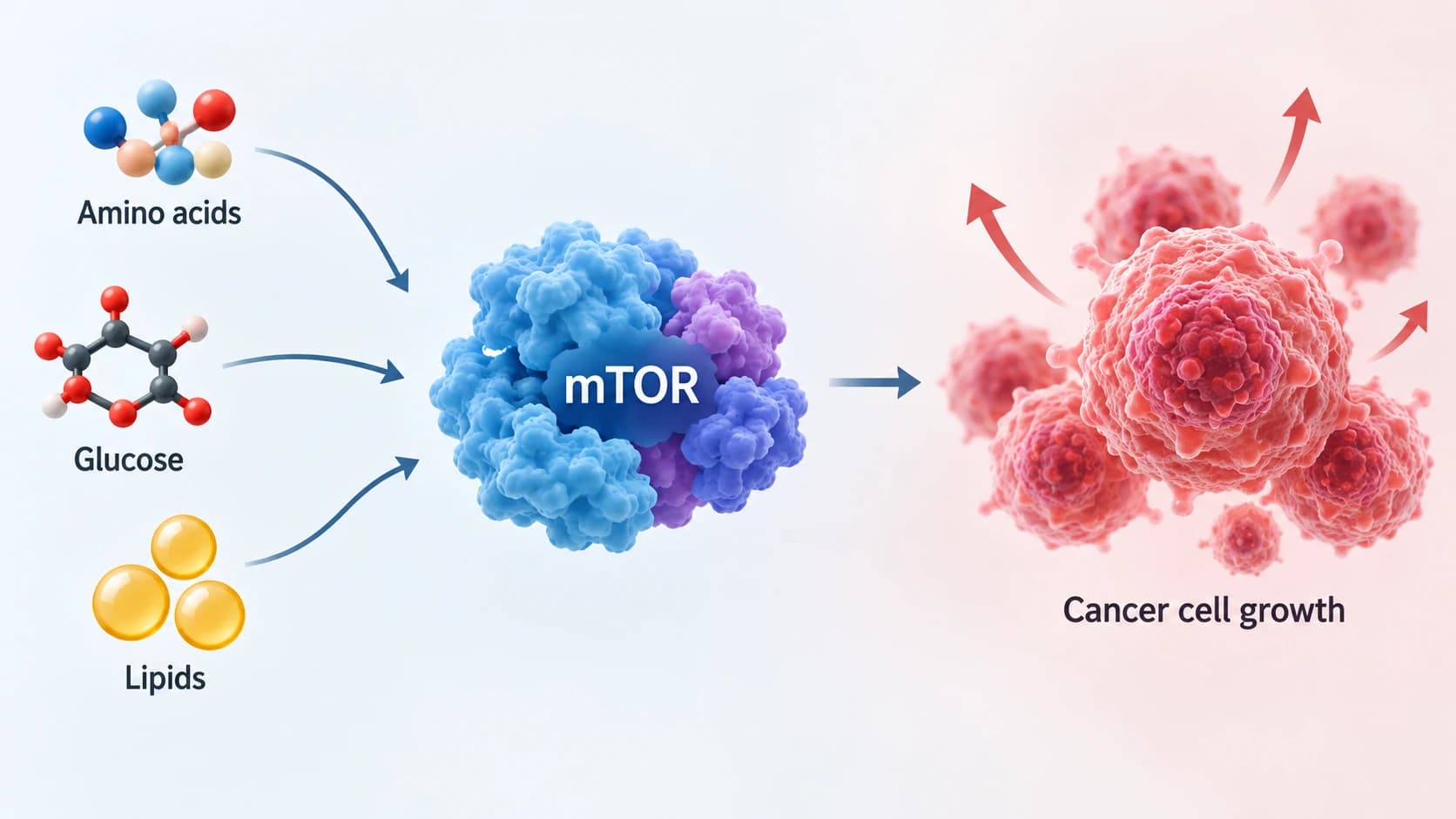
Every cell faces a basic decision many times a day: grow and divide, or hold still and conserve resources. That choice isn't random. It runs through a single signaling hub called mTOR, short for mechanistic target of rapamycin. mTOR works like a dispatcher, checking conditions before giving a cell permission to grow. Nutrient levels, energy reserves, and growth signals from outside the cell all feed into this one decision point.
This matters enormously in cancer. Tumor cells need huge amounts of raw material to keep dividing. Many cancers find ways to keep mTOR locked in the "go" position, regardless of whether conditions actually support growth. Understanding how mTOR normally reads the cell's environment, and how that reading system can break down, helps explain why it has become one of the most studied targets in cancer biology.
One Protein, Two Different Jobs
mTOR doesn't work alone. It operates inside two distinct protein assemblies, called mTORC1 and mTORC2, and the distinction matters. Both complexes contain the mTOR protein itself, but they partner with different proteins and respond to different signals.
mTORC1 is the better understood of the two. It directly decides whether a cell builds new proteins, grows in size, or instead recycles its own components. mTORC2 is involved more in cell survival and in shaping the cell's internal structure, and its regulation is still less completely mapped. Most of what is known about mTOR's role in cancer, and nearly every drug built to block it, centers on mTORC1.
Reading the Pantry: How mTOR Senses Amino Acids
Before mTORC1 can switch on, it has to be in the right place first. A group of small proteins called Rag GTPases act as the cell's inventory check for amino acids, the building blocks proteins are made from. When amino acids are plentiful, the Rag proteins recruit mTORC1 to the surface of the lysosome, a compartment inside the cell that doubles as a nutrient-sensing hub. Work from David Sabatini's laboratory helped establish that this physical docking step, not just a chemical signal, is what allows mTORC1 to become active.
Think of a factory manager who won't approve a new production run until standing at the loading dock and confirming the raw materials actually arrived. Only once mTORC1 reaches the lysosome, with amino acids confirmed present, can it respond to the growth signals that switch it fully on.
Running Low on Fuel: The Energy Brake
Amino acids aren't the only thing mTOR tracks. A separate protein called AMPK monitors the cell's energy supply and steps in when that supply runs low. When energy is scarce, AMPK restrains mTORC1, partly by activating a brake protein encoded by the TSC1 and TSC2 genes, and partly by acting directly on mTORC1 itself. Either way, the result is the same: growth pauses until energy reserves recover.
This energy-sensing system and the amino-acid-sensing system both feed into the same decision point. That's why mTOR is often described as an integrator rather than a simple on-off switch. It weighs several signals at once, the way a thermostat accounts for both outdoor temperature and how many people are in a room.
Growth Signals from Outside the Cell
Nutrients inside the cell are only part of the picture. mTOR also responds to hormonal signals from elsewhere in the body, most notably insulin and a related growth factor called IGF-1. These hormones activate a relay chain known as the PI3K-AKT pathway, which carries the signal inward and ultimately switches mTORC1 on. This connection ties mTOR not just to a single cell's immediate surroundings, but to the body's broader metabolic state, which is part of why insulin and growth-factor signaling have long interested cancer researchers.
When the Brakes Fail: mTOR in Cancer
Normally, tumor suppressor genes, including PTEN and the paired genes TSC1 and TSC2, keep this entire system in check. They act as brakes, preventing mTOR from staying active when it shouldn't. In many cancers, these genes are mutated or lost. Without them, mTOR signaling becomes stuck in the "on" position. The cell behaves as though nutrients and growth signals are always abundant, even when they aren't, and that mismatch can drive the uncontrolled growth seen in tumors.
This is a recurring pattern in cancer biology. The disease rarely invents an entirely new growth mechanism. Instead, it disables the controls meant to keep an existing one in check.
Suppressing the Cell's Recycling System
One consequence of constantly active mTORC1 is that it suppresses autophagy, the process cells use to break down and recycle their own damaged components. mTORC1 does this by chemically modifying a protein that would otherwise kick the recycling process into gear. When mTORC1 activity drops, whether from nutrient scarcity or other stress, that suppression lifts and autophagy ramps up. Cancers with overactive mTOR often show suppressed autophagy as well, and researchers are still working out what that combination means for how tumors behave over time.
Blocking the Switch: Rapamycin and Its Relatives
Because mTOR sits at such a central point in this network, it became an obvious drug target. Rapamycin, originally identified as a product of soil bacteria, inhibits mTOR directly. Related drugs called rapalogs have since been developed and approved for use in certain cancers, prescribed and monitored by physicians. These are regulated prescription therapies tested in clinical settings. They work very differently from anything a person could replicate through diet or lifestyle alone.
Diet, Fasting, and mTOR: What the Evidence Actually Shows
Because mTOR responds to nutrient availability, it's reasonable to wonder whether fasting, calorie restriction, or specific diets might affect its activity in ways relevant to cancer. Laboratory and animal studies have shown that such interventions can change mTOR signaling. That evidence, though, comes almost entirely from controlled lab and animal research, not from established human cancer treatment. Fasting and ketogenic diets are not approved or clinically validated cancer therapies, and current research does not support using them as a substitute for medical treatment.
What Remains Unclear
mTOR's role as a nutrient and growth integrator is well established, but questions remain. mTORC2 in particular is still only partly understood, despite being built from the same core protein as its better-studied counterpart. How autophagy suppression interacts with other effects of mTOR overactivation in human tumors is still being worked out. So is how durable the benefits of mTOR-blocking drugs are across different cancers. What is clear is that mTOR sits at a genuine crossroads of metabolism and growth, which is exactly why disrupting its normal checks can have such outsized consequences for a cell's fate.
Common Questions
References
- Mathieu Laplante, David M. Sabatini (2012). mTOR Signaling in Growth Control and Disease
- Robert A. Saxton, David M. Sabatini (2017). mTOR Signaling in Growth, Metabolism, and Disease
- (2008). The Rag GTPases bind raptor and mediate amino acid signaling to mTORC1.
- Ken Inoki, Tianqing Zhu, Kun-Liang Guan (2003). TSC2 Mediates Cellular Energy Response to Control Cell Growth and Survival
- Michael Pollak (2008). Insulin and insulin-like growth factor signalling in neoplasia
- Brendan D. Manning, Lewis C. Cantley (2007). AKT/PKB Signaling: Navigating Downstream
- Joungmok Kim, Mondira Kundu, Benoit Viollet, Kun-Liang Guan (2011). AMPK and mTOR regulate autophagy through direct phosphorylation of Ulk1
Team Review: This article has been reviewed by Canceria Research Team