Why Chemotherapy Damages Nerves, and Why the Tingling Sometimes Never Fully Goes Away
The biology behind chemotherapy-induced peripheral neuropathy, from drug-specific injury to why some nerve damage heals and some doesn't
Key Takeaways
- •Chemotherapy-induced peripheral neuropathy (CIPN) is common during treatment, and a meaningful portion of patients still have symptoms six months or longer after chemotherapy ends.
- •Sensory neuron cell bodies in the dorsal root ganglia lack the protective blood-nerve barrier found elsewhere in the nervous system, leaving them unusually exposed to circulating chemotherapy drugs.
- •Platinum chemotherapy drugs damage DNA inside sensory neurons, while taxanes and vinca alkaloids disrupt microtubules, the internal scaffolding needed to transport materials along nerve fibers.
- •Mitochondrial dysfunction and the resulting oxidative stress appear to be a shared downstream mechanism across different chemotherapy classes that injure peripheral nerves.
- •Changes in ion channel activity in damaged sensory neurons, along with inflammation near nerves and the spinal cord, help explain why CIPN often causes burning or shock-like pain.
- •CIPN can resolve when damage is limited to the axon, but may become permanent when the sensory neuron's cell body itself is lost, since those cells cannot be regenerated.
- •Cumulative chemotherapy dose, pre-existing neuropathy or diabetes, and certain genetic variants are linked to a higher risk of severe or lasting CIPN.
- •Duloxetine is currently the only drug with randomized controlled trial and clinical guideline support for CIPN pain, and it manages symptoms rather than reversing nerve damage.
Chemotherapy works by targeting cells that divide quickly, which is exactly what makes tumors vulnerable. But that same drug exposure doesn't stop at the tumor. It travels through the bloodstream and can injure the long nerve fibers that carry sensation from the fingers and toes up toward the spinal cord. Doctors call this chemotherapy-induced peripheral neuropathy, or CIPN: numbness, tingling, burning, or sharp pain that often begins in the hands and feet and can spread from there.
A Side Effect That Is Both Common and Unpredictable
CIPN affects a large share of patients during treatment itself. A systematic review and meta-analysis pooling results across many chemotherapy studies found that symptoms are widespread in the weeks right after treatment, and a meaningful portion of patients still report symptoms six months or more later. That persistence is part of what makes CIPN so disruptive to daily life. It isn't a single, uniform condition either. Some people recover fully within months, others carry lingering numbness for years, and a smaller group ends up with permanent changes in sensation. Understanding why outcomes diverge so much starts with understanding why these particular nerves are so exposed in the first place.
Why These Nerves Are So Exposed
Most of the body's nerve tissue sits behind a protective barrier that limits how much of a drug circulating in the blood can actually reach it, similar in principle to the blood-brain barrier. The cell bodies of sensory neurons, however, sit in tight clusters near the spinal cord called the dorsal root ganglia, and these clusters lack that same protective shield. Their blood vessels are unusually permeable, almost like a neighborhood without a fence, letting substances that would normally be filtered out drive straight through. That makes the dorsal root ganglia one of the few places in the nervous system where chemotherapy drugs can accumulate at meaningfully high levels, which helps explain why sensory symptoms, rather than movement problems, so often dominate the picture.
Different Drugs, Different Points of Attack
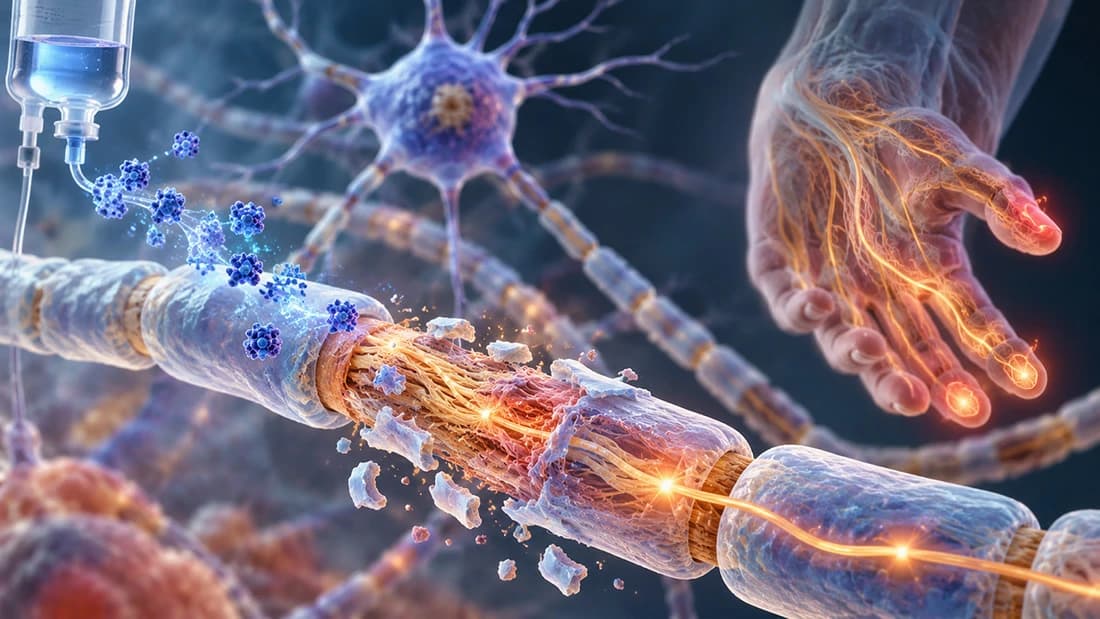
Once inside these vulnerable cell bodies, different chemotherapy classes cause damage in different ways. Platinum-based drugs bind directly to DNA inside dorsal root ganglion neurons, creating damage that these highly active cells struggle to fully repair. Taxanes and vinca alkaloids take a different route: they interfere with microtubules, the tube-like internal scaffolding that acts like a freight line, carrying proteins and nutrients from the cell body all the way out along the axon, the long fiber extending toward the fingertip or toe. When that scaffolding is destabilized, the transport line breaks down, and the farthest end of the nerve, the part serving the feet, tends to suffer first because it depends on the longest supply route.
Running underneath many of these drug-specific injuries is a shared downstream problem. Chemotherapy exposure impairs mitochondria, the structures inside cells that generate usable energy, and damaged mitochondria produce an excess of reactive byproducts that injure surrounding tissue, a state known as oxidative stress. This shared mechanism means that even though platinum drugs, taxanes, and vinca alkaloids start their damage differently, they can converge on a similar pattern of energy failure and cellular injury inside the same vulnerable sensory neurons.
Why the Pain Itself Can Feel Electric
Nerve damage alone doesn't explain why CIPN often produces burning or shock-like sensations rather than simple numbness. Part of the answer lies in the proteins that control a neuron's electrical signaling, called ion channels. When sensory neurons are injured, the balance of these channels shifts, making the nerve more easily triggered than it should be. The result is neuropathic pain, pain generated by a malfunctioning nervous system rather than by an actual injury at the fingertip or toe itself.
That hyperexcitability doesn't happen in isolation. Immune cells activate near the injured nerves and within the spinal cord itself, and this neuroinflammation appears to help both trigger and sustain the painful symptoms over time. In other words, the initial molecular damage may start the problem, but the nervous system's own inflammatory response can keep it going.
Why Some Damage Heals and Some Doesn't
Whether CIPN fades or lingers seems to hinge on a basic distinction: is the injury limited to the axon, the long fiber extension, or does it reach the neuron's cell body itself? Axonal degeneration, damage confined to the fiber, has real potential to recover, since the cell body can often regrow a new fiber over time, much like a plant regrowing a damaged branch from an intact root. But when chemotherapy exposure is severe or prolonged enough, it can kill the sensory neuron's cell body outright. That loss is not something the body can simply regenerate, which is the likely explanation for why some patients are left with permanent sensory changes long after their last infusion.
Who Is More Likely to Be Affected Severely
Not every patient faces the same risk. Cumulative chemotherapy dose matters: more total drug exposure over a treatment course raises the odds of lasting damage. Patients who already have some degree of peripheral neuropathy, including those with diabetes, tend to be more vulnerable to additional nerve injury from chemotherapy on top of their existing condition. Genetic factors appear to play a role too; a genome-wide association study identified specific gene variants linked to a higher risk of paclitaxel-induced sensory neuropathy, suggesting that some of the variability between patients is written into their biology rather than simply reflecting dose or drug choice. None of these factors guarantee severe or permanent neuropathy, but together they help explain why two patients on an identical regimen can have very different experiences.
What Helps, and What Doesn't Yet Have Evidence
CIPN is not just uncomfortable. It meaningfully reduces quality of life, and in many cases it's severe enough that oncology teams reduce the chemotherapy dose or stop treatment earlier than planned, which can affect how the underlying cancer treatment itself proceeds. That trade-off, between nerve symptoms and cancer treatment intensity, is one reason prevention and management matter clinically, not just for comfort.
On the treatment side, the evidence base is narrower than patients might hope. Duloxetine is currently the only drug backed by both a randomized controlled trial and clinical practice guideline support for treating established, painful CIPN. It's worth being clear about what that evidence does and doesn't show: duloxetine can help manage pain and improve function, but it does not reverse the underlying nerve damage or regenerate lost sensory neurons. Many other approaches circulate in patient communities, but they don't currently carry the same level of supported evidence for CIPN specifically.
Where the Science Still Has Gaps
The broad mechanisms behind CIPN, dorsal root ganglion vulnerability, drug-class-specific injury, mitochondrial stress, are reasonably well established. What's less settled is prediction: why one patient's axons regrow cleanly while another's sensory neurons are lost outright, and whether genetic testing could ever reliably flag who is at highest risk before treatment even starts. Until those questions are better answered, CIPN remains a side effect best discussed openly with an oncology care team, since symptoms, timing, and risk vary enough from person to person that no single description fits everyone.
Common Questions
References
- Marta Seretny, Gillian L. Currie, Emily S. Sena, Sabrina Ramnarine, Robin Grant, Malcolm R. MacLeod, Leslie A. Colvin, Marie Fallon (2014). Incidence, prevalence, and predictors of chemotherapy-induced peripheral neuropathy: A systematic review and meta-analysis
- Hana Starobova, Irina Vetter (2017). Pathophysiology of Chemotherapy-Induced Peripheral Neuropathy
- Nathan P. Staff, Anna Grisold, Wolfgang Grisold, Anthony J. Windebank (2017). Chemotherapy‐induced peripheral neuropathy: A current review
- Aparna Areti, Veera Ganesh Yerra, VGM Naidu, Ashutosh Kumar (2014). Oxidative stress and nerve damage: Role in chemotherapy induced peripheral neuropathy
- Renata Zajączkowska, Magdalena Kocot-Kępska, Wojciech Leppert, Anna Wrzosek, Joanna Mika, Jerzy Wordliczek (2019). Mechanisms of Chemotherapy-Induced Peripheral Neuropathy
- Andreas A. Argyriou, Martin Koltzenburg, Panagiotis Polychronopoulos, Spiridon Papapetropoulos, Haralabos P. Kalofonos (2008). Peripheral nerve damage associated with administration of taxanes in patients with cancer
- Guido Cavaletti, Paola Marmiroli (2010). Chemotherapy-induced peripheral neurotoxicity
- R. Michael Baldwin, Kouros Owzar, Hitoshi Zembutsu, Aparna Chhibber, Michiaki Kubo, Chen Jiang, Dorothy Watson, Rachel J. Eclov, Joel Mefford, Howard L. McLeod, Paula N. Friedman, Clifford A. Hudis, Eric P. Winer, Eric M. Jorgenson, John S. Witte, Lawrence N. Shulman, Yusuke Nakamura, Mark J. Ratain, Deanna L. Kroetz (2012). A Genome-Wide Association Study Identifies Novel Loci for Paclitaxel-Induced Sensory Peripheral Neuropathy in CALGB 40101
- Ellen M. Lavoie Smith, Herbert Pang, Constance Cirrincione, Stewart Fleishman, Electra D. Paskett, Tim Ahles, Linda R. Bressler, Camilo E. Fadul, Chetaye Knox, Nguyet Le-Lindqwister, Paul B. Gilman, Charles L. Shapiro, for the Alliance for Clinical Trials in Oncology (2013). Effect of Duloxetine on Pain, Function, and Quality of Life Among Patients With Chemotherapy-Induced Painful Peripheral Neuropathy
- Dawn L. Hershman, Christina Lacchetti, Robert H. Dworkin, Ellen M. Lavoie Smith, Jonathan Bleeker, Guido Cavaletti, Cynthia Chauhan, Patrick Gavin, Antoinette Lavino, Maryam B. Lustberg, Judith Paice, Bryan Schneider, Mary Lou Smith, Tom Smith, Shelby Terstriep, Nina Wagner-Johnston, Kate Bak, Charles L. Loprinzi (2014). Prevention and Management of Chemotherapy-Induced Peripheral Neuropathy in Survivors of Adult Cancers: American Society of Clinical Oncology Clinical Practice Guideline
- Floortje Mols, Tonneke Beijers, Gerard Vreugdenhil, Lonneke van de Poll-Franse (2014). Chemotherapy-induced peripheral neuropathy and its association with quality of life: a systematic review
Team Review: This article has been reviewed by Canceria Research Team