What Colon Polyps Reveal About How Colorectal Cancer Develops
Three distinct molecular pathways explain why some polyps turn dangerous while most never do
Key Takeaways
- •Most colon polyps never become cancer, and finding one during a colonoscopy is not a cancer diagnosis.
- •The classic adenoma-carcinoma sequence describes a stepwise buildup of mutations in genes including APC, KRAS, and TP53.
- •Hyperplastic polyps generally carry very low cancer risk, while adenomas and some serrated polyps carry meaningfully higher risk.
- •A separate serrated pathway, driven by BRAF mutation and widespread DNA methylation changes called CIMP, follows a distinct route to cancer.
- •A third pathway arises when DNA mismatch repair fails, producing microsatellite instability and a molecularly distinct tumor type.
- •Lynch syndrome, an inherited mismatch repair defect, raises cancer risk and can speed up progression from polyp to cancer.
- •Removing adenomatous polyps during colonoscopy is linked to lower long-term colorectal cancer incidence and mortality at a population level.
- •Genetic mutations and epigenetic changes appear to work together throughout colorectal tumor development, rather than as separate processes.
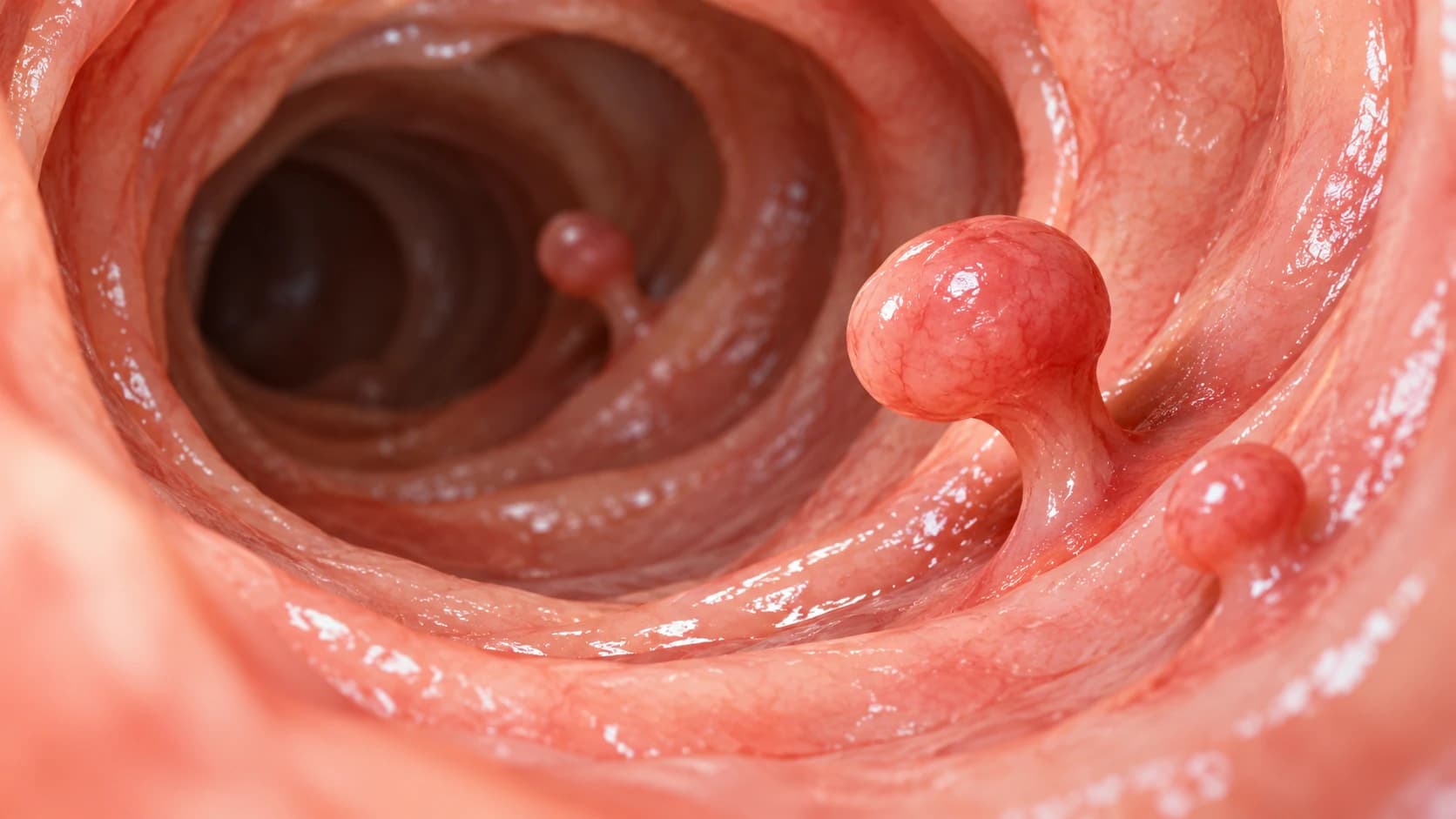
A colon polyp is a small clump of extra tissue growing on the inner lining of the colon or rectum. Many people who get a colonoscopy will have at least one found. Finding a polyp is not the same as being told you have cancer. The vast majority stay harmless for life, and some types almost never turn dangerous at all.
Still, decades of research show that most colorectal cancers don't appear out of nowhere. They grow out of certain kinds of polyps, often over many years, through identifiable biological changes. Understanding that process explains why some polyps worry doctors more than others, and why removing them during a colonoscopy can prevent cancer before it starts.
The Classic Route: From Normal Lining to Invasive Tumor
The best-studied path is called the adenoma-carcinoma sequence. It describes how normal colon lining cells slowly accumulate genetic damage, passing through an intermediate adenoma stage before becoming an invasive cancer. This model, worked out in detail by Eric Fearon and Bert Vogelstein, remains the foundation for how scientists think about colorectal cancer today.
The sequence usually begins with a mutation in a gene called APC. APC normally works like a brake pedal, holding back a growth signal that tells colon cells when to divide. When APC is damaged, that brake fails, and cells multiply more than they should, forming the earliest visible adenoma.
As an adenoma grows, it typically picks up more mutations. A gene called KRAS often mutates next, pushing cells to grow even when they shouldn't. Later, a gene called TP53, sometimes nicknamed the guardian of the genome because it normally stops damaged cells from dividing further, frequently fails too. Losing TP53 function is linked to the final step toward invasive cancer, when abnormal cells gain the ability to break through tissue boundaries. At each stage, pathologists can see increasing dysplasia, meaning abnormal patterns of cell growth, under the microscope.
This stepwise picture is well established, but it describes a tendency, not a guarantee. Most adenomas never complete the full sequence. Only a minority progress all the way to cancer, and when it happens, that progression usually unfolds over many years.
Not Every Polyp Carries the Same Risk
Polyps are not all built the same way, and their cancer risk varies accordingly. Hyperplastic polyps, the most common type found during colonoscopy, generally carry very low risk of ever becoming cancerous. Adenomatous polyps carry meaningfully higher risk, which tends to rise with their size and growth pattern. Some serrated polyps, distinguished by a saw-toothed pattern under the microscope, also carry real malignant potential, despite once being grouped with low-risk hyperplastic polyps.
This distinction matters in practice. It is one reason doctors examine a removed polyp's tissue closely rather than treating every polyp as interchangeable.
A Second Route: The Serrated Pathway
Not every colorectal cancer follows the classic APC-KRAS-TP53 sequence. Research has identified a separate route, called the serrated pathway, that begins differently and follows its own molecular logic.
This pathway often starts with a mutation in a gene called BRAF rather than APC. It also involves widespread chemical changes to DNA known as the CpG island methylator phenotype, or CIMP, in which many genes get silenced through methylation rather than through mutation. The practical effect can resemble losing a tumor suppressor gene, even though the DNA sequence itself hasn't changed. Cancers arising this way tend to look and behave somewhat differently from classic adenoma-driven tumors, which is part of why serrated polyps are now treated as their own category.
A Third Route: When DNA Repair Itself Fails
A third path to colorectal cancer doesn't start with a specific growth-promoting mutation at all. Instead, it begins when a cell loses its ability to correct everyday copying errors in its own DNA. Healthy cells rely on a built-in proofreading system, called mismatch repair, that fixes small mistakes made whenever DNA is copied. When that system breaks down, errors pile up quickly, especially in short repetitive DNA sequences called microsatellites. This telltale pattern, known as microsatellite instability, marks tumors that arose through a fundamentally different mechanism than the chromosomal instability of the classic sequence.
This repair failure can arise within a single tumor by chance, but it can also be inherited. People born with a faulty copy of a mismatch repair gene have a condition called Lynch syndrome, described in detail by Henry Lynch. Because every cell in their body already carries one damaged repair gene, polyps in people with Lynch syndrome need far fewer additional hits to progress. That helps explain why their cancers can develop unusually quickly, and at a younger age, than typical sporadic cases.
Why the Biology Supports Screening
These three pathways are different, but they share a common feature: cancer doesn't simply appear instantly. It develops through intermediate stages that can persist for years before invasion occurs. That window is exactly what colonoscopy is designed to use.
Large studies following patients over decades have found that removing adenomatous polyps during colonoscopy, a procedure called polypectomy, is associated with meaningfully lower rates of colorectal cancer, and death from the disease, later in life. This doesn't mean colonoscopy guarantees protection for every individual. It means that, across populations, interrupting the polyp-to-cancer process by removing the polyp works. The logic is straightforward: if a cell lineage needs several sequential changes spread over years to become cancerous, removing it at an early, still-benign stage stops the rest of that sequence from ever running its course.
Genes Are Only Part of the Story
None of these three pathways, classic, serrated, or mismatch-repair-driven, operates through DNA sequence changes alone. Alongside mutations, colorectal tumors accumulate epigenetic alterations, chemical modifications that change how genes are read without altering the underlying genetic code. These two kinds of change appear to work together throughout the process, rather than representing two competing explanations.
What remains genuinely open is why a given polyp, in a given person, takes one path rather than another, and why so many polyps seem to stall indefinitely without ever completing the sequence at all. Decades of molecular detail have clarified the steps involved. What tips an individual adenoma toward progression, or protects it from ever progressing, is still not fully understood.
Common Questions
References
- Eric R. Fearon, Bert Vogelstein (1990). A genetic model for colorectal tumorigenesis
- Bert Vogelstein, Eric R. Fearon, Stanley R. Hamilton, Scott E. Kern, Ann C. Preisinger, Mark Leppert, Alida M.M. Smits, Johannes L. Bos (1988). Genetic Alterations during Colorectal-Tumor Development
- Kenneth W. Kinzler, Mef C. Nilbert, Li-Kuo Su, Bert Vogelstein, Tracy M. Bryan, Daniel B. Levy, Kelly J. Smith, Antonette C. Preisinger, Philip Hedge, Douglas McKechnie, Rachel Finniear, Alex Markham, John Groffen, Mark S. Boguski, Stephen F. Altschul, Akira Horii, Hiroshi Ando, Yasuo Miyoshi, Yoshio Miki, Isamu Nishisho, Yusuke Nakamura (1991). Identification of FAP Locus Genes from Chromosome 5q21
- Sanford D. Markowitz, Monica M. Bertagnolli (2009). Molecular Basis of Colorectal Cancer
- (2007). Classification of colorectal cancer based on correlation of clinical, morphological and molecular features.
- Barbara Leggett, Vicki Whitehall (2010). Role of the Serrated Pathway in Colorectal Cancer Pathogenesis
- Yurij Ionov, Miguel A. Peinado, Sergei Malkhosyan, Darryl Shibata, Manuel Perucho (1993). Ubiquitous somatic mutations in simple repeated sequences reveal a new mechanism for colonic carcinogenesis
- Henry T. Lynch, Albert de la Chapelle (2003). Hereditary Colorectal Cancer
- Sidney J. Winawer, Ann G. Zauber, May Nah Ho, Michael J. O'Brien, Leonard S. Gottlieb, Stephen S. Sternberg, Jerome D. Waye, Melvin Schapiro, John H. Bond, Joel F. Panish, Frederick Ackroyd, Moshe Shike, Robert C. Kurtz, Lynn Hornsby-Lewis, Hans Gerdes, Edward T. Stewart (1993). Prevention of Colorectal Cancer by Colonoscopic Polypectomy
- (2012). [Colonoscopic polypectomy and long-term prevention of colorectal cancer deaths].
- Reiko Nishihara, Kana Wu, Paul Lochhead, Teppei Morikawa, Xiaoyun Liao, Zhi Rong Qian, Kentaro Inamura, Sun A. Kim, Aya Kuchiba, Mai Yamauchi, Yu Imamura, Walter C. Willett, Bernard A. Rosner, Charles S. Fuchs, Edward Giovannucci, Shuji Ogino, Andrew T. Chan (2013). Long-Term Colorectal-Cancer Incidence and Mortality after Lower Endoscopy
- William M. Grady, John M. Carethers (2008). Genomic and Epigenetic Instability in Colorectal Cancer Pathogenesis
Team Review: This article has been reviewed by Canceria Research Team