How CAR T-Cell Therapy Turns a Patient's Own Immune Cells Into Cancer Fighters
Inside the engineering behind CAR T cells, the blood cancers they can put into remission, and the serious risks and limits the therapy still faces
Key Takeaways
- •CAR T-cell therapy engineers a patient's own T cells to carry a synthetic receptor that recognizes cancer markers directly, bypassing the normal antigen-presentation pathway.
- •CD19-targeted CAR T cells produce durable remissions in a substantial share of patients with relapsed B-cell leukemia and lymphoma, supporting regulatory approval of these therapies.
- •A newer CAR built against BCMA has shown clinical benefit in relapsed or refractory multiple myeloma, extending the approach beyond CD19-positive blood cancers.
- •Cytokine release syndrome, a surge of inflammatory signaling triggered by CAR T-cell activation, is a common and potentially severe side effect requiring standardized grading and prompt management.
- •Neurotoxicity, formally called ICANS, is a separate serious risk of CAR T-cell therapy that can cause confusion or more severe neurological symptoms.
- •Cancers can relapse after CAR T-cell therapy either by losing the targeted marker, known as antigen escape, or because the CAR T cells themselves become exhausted and stop persisting.
- •CAR T-cell therapy remains far less effective against solid tumors than blood cancers, due to poor T-cell infiltration, a suppressive tumor environment, and inconsistent target expression.
- •The first human proof that CD19-targeted CAR T cells could induce remission came from an early case series in chronic lymphocytic leukemia, paving the way for later approved therapies.
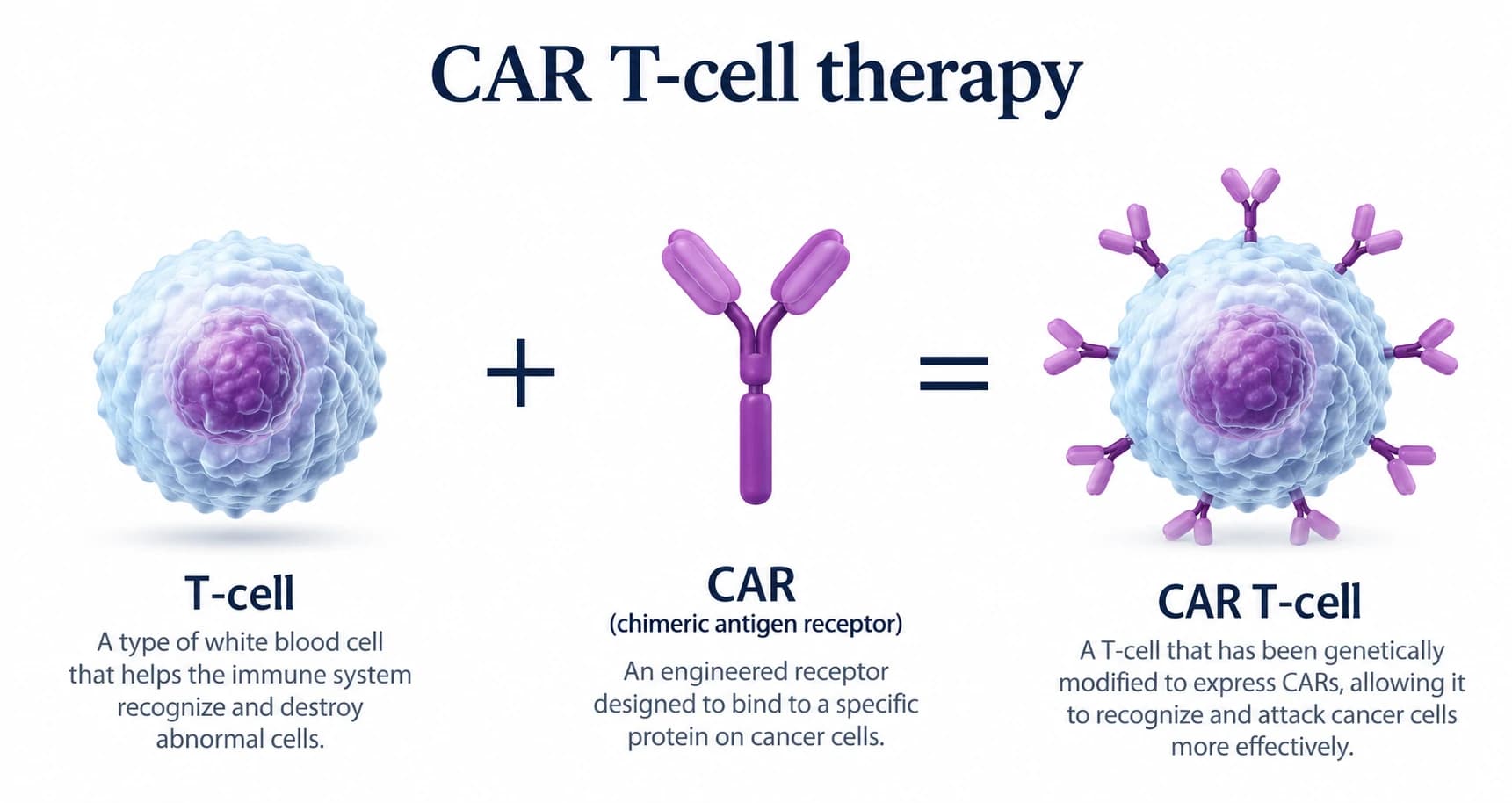
A T cell is one of the immune system's main attack cells, built to kill infected or abnormal cells on contact. Cancer cells are often very good at hiding from them. CAR T-cell therapy is a way of rebuilding a patient's own T cells so that hiding stops working, at least against certain cancers. It works by removing T cells from the blood, engineering them in a lab, and returning them to the same patient, a process called autologous cell therapy because the cells go back into the person they came from. In some patients, the result has been remission where other treatments had already failed.
Rebuilding a T Cell's Targeting System
Normally, a T cell recognizes trouble through its own receptor, which only reads tiny fragments of protein when another cell hands them over through a specific display system on the cell surface. Cancer cells can dodge this by altering that display, so the T cell never gets shown anything to react to. Engineers got around this problem by swapping the T cell's receptor for something more direct: a chimeric antigen receptor, or CAR. A CAR works less like a lock that needs a key delivered through a particular door, and more like a grappling hook. It latches straight onto a marker on the cancer cell's surface, no hand-off required.
Physically, a CAR is built from pieces stitched together: an outer section borrowed from an antibody that recognizes the target marker, an anchor through the cell membrane, and an inner tail that fires the "attack" signal once the outer part grabs hold. This design was first proposed in the early 1990s, when a research team led by Zelig Eshhar showed that fusing an antibody's targeting piece onto a T cell's internal signaling machinery could redirect the cell to kill based on direct recognition rather than the ordinary receptor pathway. That idea sat mostly in the laboratory for nearly two decades before it became something a person could actually receive.
From One Patient's Remission to Approved Treatments
The first sign this idea could work in a living person came in 2011, when a team including Carl June reported that T cells engineered against a marker called CD19 produced a dramatic remission in a patient with chronic lymphocytic leukemia. CD19 sits on the surface of most B cells, the immune cells that give rise to several leukemias and lymphomas, which made it a reasonable first target: killing B cells broadly is tolerable in a way that killing cells in a vital organ would not be.
That early case opened the door to larger trials. In B-cell acute lymphoblastic leukemia that had relapsed or stopped responding to standard treatment, CD19-directed CAR T cells produced durable remissions in a substantial share of children and young adults in the pivotal trial behind its approval. A related CD19-targeted therapy produced meaningful response rates in adults with refractory large B-cell lymphoma, a cancer that previously had few options once standard chemotherapy had failed. More recently, a different CAR built against BCMA, a marker found on antibody-producing plasma cells, showed clinical benefit in multiple myeloma, extending the approach into an entirely different blood cancer.
The Price of Switching On a Powerful Immune Response
CAR T cells multiply rapidly inside the body once they find their target, and that expansion is part of what makes the therapy powerful, and part of what makes it risky. As large numbers of CAR T cells activate at once, they flood the bloodstream with inflammatory signaling molecules. This reaction, called cytokine release syndrome, can range from mild fever to a severe, life-threatening drop in blood pressure and organ strain. Clinical teams now use a standardized grading system to decide how aggressively to step in.
A second, distinct risk affects the nervous system rather than the rest of the body. Some patients develop confusion, difficulty finding words, or in severe cases seizures or brain swelling, a syndrome now formally named immune effector cell-associated neurotoxicity syndrome, or ICANS. It does not always appear alongside cytokine release syndrome, and it needs its own monitoring and its own treatment approach, which is part of why specialized centers follow strict observation protocols after infusion.
Why Remissions Don't Always Last
Even when CAR T-cell therapy works, it does not always work permanently. Two separate problems can let a cancer come back. The first is that cancer cells quietly lose or hide the exact marker the CAR was built to recognize, a process called antigen escape. Without that marker to grab onto, the CAR T cells have nothing left to attack.
The second problem is that the CAR T cells themselves wear out. Repeated activation can push them into a worn-down state called T-cell exhaustion, in which they are still present but have lost much of their killing power. Many patients' CAR T cells simply stop persisting in the body over time, which limits how long the protection lasts even when the initial response was strong.
Why Solid Tumors Have Been a Harder Problem
The successes described above all involve cancers that live in the blood or bone marrow, where CAR T cells can circulate and meet their target easily. Solid tumors, such as those in the lung, pancreas, or breast, sit in a much tougher environment, and CAR T-cell therapy has so far shown far more limited efficacy against them.
Several barriers compound each other here. T cells often struggle to physically get inside a solid tumor's dense tissue in meaningful numbers. The conditions immediately surrounding the tumor frequently work against immune attack rather than allowing it. And different cells within the same solid tumor can carry different amounts of the target marker, or none at all, so even a successful attack on part of the tumor can leave the rest untouched. CAR T-cell therapy for solid tumors remains an active area of research, not an established treatment, and current results fall well short of what has been achieved in blood cancers.
What a Decade of Trials Has Taught
Looking across the blood cancer trials together, rather than any single one, a few consistent lessons emerge about durability, toxicity, and patient selection. Response rates vary by disease and by how heavily a patient has already been treated. Toxicity can usually be managed when caught early, which is why grading systems and close monitoring now exist as standard practice. And selecting patients whose cancer still expresses the target marker, and who can tolerate the acute inflammatory risks, matters as much as the engineering of the cells themselves.
CAR T-cell therapy is not a universal cure, and it is not available or appropriate for every cancer or every patient. For a defined set of blood cancers, it has become something close to a genuine late-line option where none existed before: a way of turning an unmodified part of a patient's own body into a tool built to find and kill what the rest of their treatment could not reach.
Common Questions
References
- Michel Sadelain, Renier Brentjens, Isabelle Rivière (2013). The Basic Principles of Chimeric Antigen Receptor Design
- Carl H. June, Michel Sadelain (2018). Chimeric Antigen Receptor Therapy
- Z Eshhar, T Waks, G Gross, D G Schindler (1993). Specific activation and targeting of cytotoxic lymphocytes through chimeric single chains consisting of antibody-binding domains and the gamma or zeta subunits of the immunoglobulin and T-cell receptors.
- Shannon L. Maude, Theodore W. Laetsch, Jochen Buechner, Susana Rives, Michael Boyer, Henrique Bittencourt, Peter Bader, Michael R. Verneris, Heather E. Stefanski, Gary D. Myers, Muna Qayed, Barbara De Moerloose, Hidefumi Hiramatsu, Krysta Schlis, Kara L. Davis, Paul L. Martin, Eneida R. Nemecek, Gregory A. Yanik, Christina Peters, Andre Baruchel, Nicolas Boissel, Francoise Mechinaud, Adriana Balduzzi, Joerg Krueger, Carl H. June, Bruce L. Levine, Patricia Wood, Tetiana Taran, Mimi Leung, Karen T. Mueller, Yiyun Zhang, Kapildeb Sen, David Lebwohl, Michael A. Pulsipher, Stephan A. Grupp (2018). Tisagenlecleucel in Children and Young Adults with B-Cell Lymphoblastic Leukemia
- Sattva S. Neelapu, Frederick L. Locke, Nancy L. Bartlett, Lazaros J. Lekakis, David B. Miklos, Caron A. Jacobson, Ira Braunschweig, Olalekan O. Oluwole, Tanya Siddiqi, Yi Lin, John M. Timmerman, Patrick J. Stiff, Jonathan W. Friedberg, Ian W. Flinn, Andre Goy, Brian T. Hill, Mitchell R. Smith, Abhinav Deol, Umar Farooq, Peter McSweeney, Javier Munoz, Irit Avivi, Januario E. Castro, Jason R. Westin, Julio C. Chavez, Armin Ghobadi, Krishna V. Komanduri, Ronald Levy, Eric D. Jacobsen, Thomas E. Witzig, Patrick Reagan, Adrian Bot, John Rossi, Lynn Navale, Yizhou Jiang, Jeff Aycock, Meg Elias, David Chang, Jeff Wiezorek, William Y. Go (2017). Axicabtagene Ciloleucel CAR T-Cell Therapy in Refractory Large B-Cell Lymphoma
- Noopur Raje, Jesus Berdeja, Yi Lin, David Siegel, Sundar Jagannath, Deepu Madduri, Michaela Liedtke, Jacalyn Rosenblatt, Marcela V. Maus, Ashley Turka, Lyh-Ping Lam, Richard A. Morgan, Kevin Friedman, Monica Massaro, Julie Wang, Greg Russotti, Zhihong Yang, Timothy Campbell, Kristen Hege, Fabio Petrocca, M. Travis Quigley, Nikhil Munshi, James N. Kochenderfer (2019). Anti-BCMA CAR T-Cell Therapy bb2121 in Relapsed or Refractory Multiple Myeloma
- Daniel W. Lee, Bianca D. Santomasso, Frederick L. Locke, Armin Ghobadi, Cameron J. Turtle, Jennifer N. Brudno, Marcela V. Maus, Jae H. Park, Elena Mead, Steven Pavletic, William Y. Go, Lamis Eldjerou, Rebecca A. Gardner, Noelle Frey, Kevin J. Curran, Karl Peggs, Marcelo Pasquini, John F. DiPersio, Marcel R.M. van den Brink, Krishna V. Komanduri, Stephan A. Grupp, Sattva S. Neelapu (2019). ASTCT Consensus Grading for Cytokine Release Syndrome and Neurologic Toxicity Associated with Immune Effector Cells
- (2019). Comments Regarding "ASBMT Consensus Grading for Cytokine Release Syndrome and Neurologic Toxicity Associated with Immune Effector Cells".
- Nirali N. Shah, Terry J. Fry (2019). Mechanisms of resistance to CAR T cell therapy
- Marina Martinez, Edmund Kyung Moon (2019). CAR T Cells for Solid Tumors: New Strategies for Finding, Infiltrating, and Surviving in the Tumor Microenvironment
- David L. Porter, Bruce L. Levine, Michael Kalos, Adam Bagg, Carl H. June (2011). Chimeric Antigen Receptor–Modified T Cells in Chronic Lymphoid Leukemia
- Robbie G. Majzner, Crystal L. Mackall (2019). Clinical lessons learned from the first leg of the CAR T cell journey
Team Review: This article has been reviewed by Canceria Research Team