How Hormonal Therapy Works Against Breast and Prostate Cancer
A look at how tamoxifen, aromatase inhibitors, and androgen-blocking therapies interrupt the hormonal signals that drive these cancers, and why resistance eventually develops.
Key Takeaways
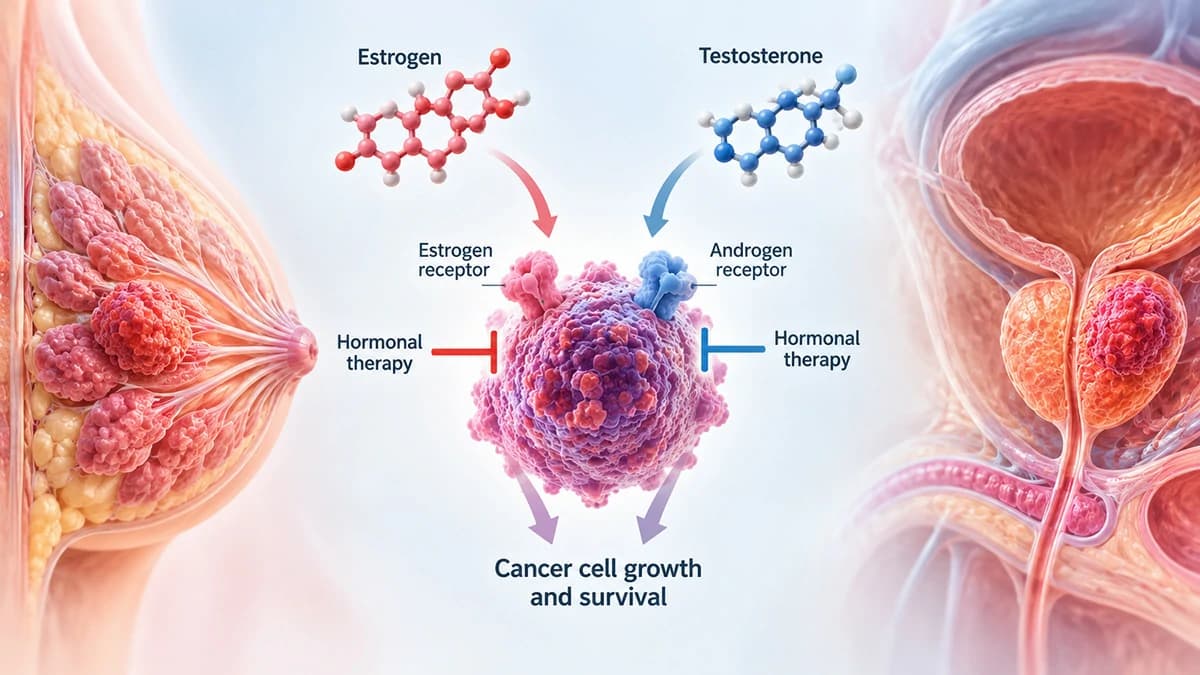
- •Many breast cancers depend on estrogen binding to the estrogen receptor, while most prostate cancers depend on androgens binding to the androgen receptor, to keep growing.
- •Tamoxifen works as a selective estrogen receptor modulator, physically blocking estrogen from binding the estrogen receptor in breast tissue while sometimes acting differently in other tissues like the uterus.
- •Large randomized trial data show that adjuvant tamoxifen reduces recurrence and mortality specifically in estrogen receptor-positive early breast cancer.
- •Aromatase inhibitors and androgen deprivation therapy work by lowering the body's hormone supply rather than blocking the receptor directly.
- •Prostate cancer frequently becomes resistant to androgen deprivation therapy by finding ways to keep the androgen receptor active despite very low testosterone, a state called castration-resistant prostate cancer.
- •Newer anti-androgen drugs such as abiraterone have been shown in randomized trials to extend survival in men with metastatic castration-resistant prostate cancer by more thoroughly blocking androgen production.
- •In some estrogen receptor-positive breast cancers, mutations in the ESR1 gene allow the estrogen receptor to stay active even without estrogen present, contributing to treatment resistance.
- •Hormonal therapy controls hormone-driven cancers over the long term but is not a cure, and it carries real side effects that should be weighed individually with an oncologist.
Some tumors grow because of a mistake in their DNA that revs up cell division on its own. Others behave more like a plant chasing sunlight: they keep growing only as long as a particular signal keeps arriving. Many breast cancers and most prostate cancers fall into this second category. They depend on hormones, the body's own chemical messengers, to keep dividing. Hormonal therapy works by cutting off that signal, rather than attacking the cancer cell directly the way chemotherapy does.
Two Hormones, Two Different Cancers
Breast cancer cells that depend on hormones usually carry a protein called the estrogen receptor. When estrogen attaches to this receptor, it acts like a key turning a lock, switching on genes that tell the cell to grow. Prostate cancer cells rely on a related but distinct protein, the androgen receptor, which responds to testosterone and other androgens in much the same way. The lock-and-key idea is similar in both cancers, but the hormones involved are different, and so are the drugs built to interrupt them.
Doctors test tumors for these receptors because their presence is what makes hormonal therapy a reasonable option in the first place. Cancers that lack the estrogen receptor or androgen receptor generally do not respond to hormone-blocking drugs, since they are not actually plugged into that signal.
Blocking the Receptor Itself: Tamoxifen
One of the earliest drugs built specifically to interrupt a hormone receptor was tamoxifen. It works as a selective estrogen receptor modulator, a class of drug often shortened to SERM. Rather than lowering estrogen levels in the body, tamoxifen goes straight to the estrogen receptor and physically occupies it, competing with estrogen for the same spot the way an understudy might take the lead role, leaving the intended performer with nowhere to stand.
In breast tissue, tamoxifen locks onto the receptor and holds it in a shape that does not switch on the growth genes. The twist is that tamoxifen behaves differently depending on the tissue. In other tissues, such as the uterus, it can activate the receptor instead of blocking it. This tissue-selective behavior is part of what makes tamoxifen both useful and complicated, and it is a major reason the drug's development is often described as a pioneering moment in cancer medicine, work closely associated with researcher V. Craig Jordan.
What the Trials Actually Showed
Describing tamoxifen as useful is one thing; proving it saves lives required decades of large trials. A patient-level analysis pooling data from thousands of women across many randomized trials found that several years of adjuvant tamoxifen, meaning tamoxifen given after initial treatment to prevent the cancer from returning, meaningfully reduced both the chance of recurrence and the chance of dying from estrogen receptor-positive breast cancer. The benefit was specific to tumors that actually carried the estrogen receptor, which fits the underlying biology: tamoxifen has little reason to help a tumor that never relied on estrogen signaling to begin with.
Cutting Off the Hormone Supply
Breast and prostate cancer also respond to a second strategy. Instead of blocking the receptor, lower the amount of hormone circulating in the body in the first place. In breast cancer, aromatase inhibitors block an enzyme the body needs to manufacture estrogen, starving estrogen receptor-positive tumors of their fuel. In prostate cancer, androgen deprivation therapy achieves something similar by interfering with the hormonal signals that normally tell the testicles to produce testosterone. Both approaches share the same basic logic as removing a plant's water supply rather than cutting its leaves: the receptor is still there, but the signal it depends on stops arriving.
When Prostate Cancer Stops Responding
Androgen deprivation therapy often controls prostate cancer for years, but it is rarely permanent. Many tumors eventually find ways to keep the androgen receptor switched on even when testosterone levels in the blood are very low, a transition that marks the shift to castration-resistant prostate cancer. A large genomic study of advanced, treatment-resistant tumors found that these cancers frequently alter the androgen receptor gene itself, sometimes amplifying it, sometimes mutating it, in ways that let the receptor keep signaling with little or no hormone present. In effect, the lock changes shape just enough to turn without the original key.
Newer Drugs That Close the Loophole
This discovery helped justify a newer generation of hormonal drugs designed to block androgen receptor activity more thoroughly, or to cut off androgen production from sources beyond the testicles. Abiraterone works this way, blocking an enzyme needed to produce androgens throughout the body, not only in the testicles. In a large randomized trial of men with metastatic castration-resistant prostate cancer, abiraterone improved overall survival compared with standard care. Enzalutamide, a related drug that binds the androgen receptor more tightly than older anti-androgens, follows a similar principle of shutting down receptor signaling more completely, though it is best understood as part of the same broader strategy rather than interchangeable in every clinical situation.
Breast Cancer's Own Route Around Treatment
Estrogen receptor-positive breast cancer can develop resistance through a different route. In some tumors that stop responding to hormonal therapy after months or years, the gene that encodes the estrogen receptor, called ESR1, acquires mutations in the region of the protein that normally binds estrogen. These mutations can lock the receptor into an active shape even without estrogen attached, so the growth signal stays on regardless of how little estrogen is available. This finding helps explain why some tumors keep growing even after aromatase inhibitors have driven estrogen levels very low, since the tumor no longer needs estrogen to keep the receptor switched on.
Benefits, Limits, and the Decisions They Involve
None of this makes hormonal therapy a cure. It is better understood as a long-term control strategy for cancers that depend on a specific hormonal signal, one that can keep disease in check for years without eliminating every cell capable of adapting. Hormonal therapies also carry real side effects, ranging from menopause-like symptoms and bone density loss to effects on mood and cardiovascular risk, and these trade-offs differ by drug, dose, and duration. Decisions about which hormonal therapy to use, for how long, and in what combination are specific to each patient's tumor biology and overall health, and they belong with an oncologist who can weigh the evidence against an individual's circumstances.
Understanding why these drugs work, and why resistance eventually develops, does not change those individual decisions. But it does explain why a treatment that interrupts a hormone signal, rather than attacking cancer cells directly, can control disease for years, and why researchers keep watching for the molecular workarounds tumors eventually find.
Common Questions
References
- V. Craig Jordan (2003). Tamoxifen: a most unlikely pioneering medicine
- Early Breast Cancer Trialists' Collaborative Group (EBCTCG) (2011). Relevance of breast cancer hormone receptors and other factors to the efficacy of adjuvant tamoxifen: patient-level meta-analysis of randomised trials
- Dan Robinson, Eliezer M. Van Allen, Yi-Mi Wu, Nikolaus Schultz, Robert J. Lonigro, Juan-Miguel Mosquera, Bruce Montgomery, Mary-Ellen Taplin, Colin C. Pritchard, Gerhardt Attard, Himisha Beltran, Wassim Abida, Robert K. Bradley, Jake Vinson, Xuhong Cao, Pankaj Vats, Lakshmi P. Kunju, Maha Hussain, Felix Y. Feng, Scott A. Tomlins, Kathleen A. Cooney, David C. Smith, Christine Brennan, Javed Siddiqui, Rohit Mehra, Yu Chen, Dana E. Rathkopf, Michael J. Morris, Stephen B. Solomon, Jeremy C. Durack, Victor E. Reuter, Anuradha Gopalan, Jianjiong Gao, Massimo Loda, Rosina T. Lis, Michaela Bowden, Stephen P. Balk, Glenn Gaviola, Carrie Sougnez, Manaswi Gupta, Evan Y. Yu, Elahe A. Mostaghel, Heather H. Cheng, Hyojeong Mulcahy, Lawrence D. True, Stephen R. Plymate, Heidi Dvinge, Roberta Ferraldeschi, Penny Flohr, Susana Miranda, Zafeiris Zafeiriou, Nina Tunariu, Joaquin Mateo, Raquel Perez-Lopez, Francesca Demichelis, Brian D. Robinson, Marc Schiffman, David M. Nanus, Scott T. Tagawa, Alexandros Sigaras, Kenneth W. Eng, Olivier Elemento, Andrea Sboner, Elisabeth I. Heath, Howard I. Scher, Kenneth J. Pienta, Philip Kantoff, Johann S. de Bono, Mark A. Rubin, Peter S. Nelson, Levi A. Garraway, Charles L. Sawyers, Arul M. Chinnaiyan (2015). Integrative Clinical Genomics of Advanced Prostate Cancer
- Johann S. de Bono, Christopher J. Logothetis, Arturo Molina, Karim Fizazi, Scott North, Luis Chu, Kim N. Chi, Robert J. Jones, Oscar B. Goodman, Fred Saad, John N. Staffurth, Paul Mainwaring, Stephen Harland, Thomas W. Flaig, Thomas E. Hutson, Tina Cheng, Helen Patterson, John D. Hainsworth, Charles J. Ryan, Cora N. Sternberg, Susan L. Ellard, Aude Fléchon, Mansoor Saleh, Mark Scholz, Eleni Efstathiou, Andrea Zivi, Diletta Bianchini, Yohann Loriot, Nicole Chieffo, Thian Kheoh, Christopher M. Haqq, Howard I. Scher (2011). Abiraterone and Increased Survival in Metastatic Prostate Cancer
- Weiyi Toy, Yang Shen, Helen Won, Bradley Green, Rita A Sakr, Marie Will, Zhiqiang Li, Kinisha Gala, Sean Fanning, Tari A King, Clifford Hudis, David Chen, Tetiana Taran, Gabriel Hortobagyi, Geoffrey Greene, Michael Berger, José Baselga, Sarat Chandarlapaty (2013). ESR1 ligand-binding domain mutations in hormone-resistant breast cancer
Team Review: This article has been reviewed by Canceria Research Team