How Tumors Build Their Own Blood Supply to Keep Growing
The biological switch that lets cancer cells summon new blood vessels, and how blocking it became a treatment strategy
Key Takeaways
- •Solid tumors cannot grow beyond a few millimeters without recruiting a new blood supply, since they need oxygen, nutrients, and waste removal just like any other tissue.
- •Many tumors sit dormant for a time before undergoing an 'angiogenic switch,' a shift into actively building new blood vessels that enables faster growth.
- •Low oxygen inside a growing tumor activates a protein called HIF-1α, which increases production of VEGF, a signal that instructs nearby endothelial cells to form new vessels.
- •Angiogenesis is considered one of the core enabling traits of cancer, not a rare feature of a few aggressive tumor types.
- •Tumor blood vessels are structurally abnormal compared with normal vessels: leaky, disorganized, and inconsistent in how well they deliver blood flow.
- •Drugs that block VEGF signaling, such as bevacizumab, have improved outcomes in some cancers, including a landmark trial in metastatic colorectal cancer.
- •Tumors can become resistant to anti-angiogenic drugs through several different biological routes, which limits how long these treatments stay effective.
- •Anti-angiogenic therapy works by limiting a tumor's blood supply rather than killing cancer cells directly, and is typically used alongside other treatments.
A solid tumor made of only a few thousand cells can survive quite happily on its own. But once it grows past a few millimeters across, something changes. Cells buried deep inside no longer get enough oxygen or nutrients, and they have no way to clear away their own waste. Without a fresh blood supply, growth simply stalls there, a limit first described by the surgeon-researcher Judah Folkman, who argued that tumors could not expand further without recruiting their own vessels.
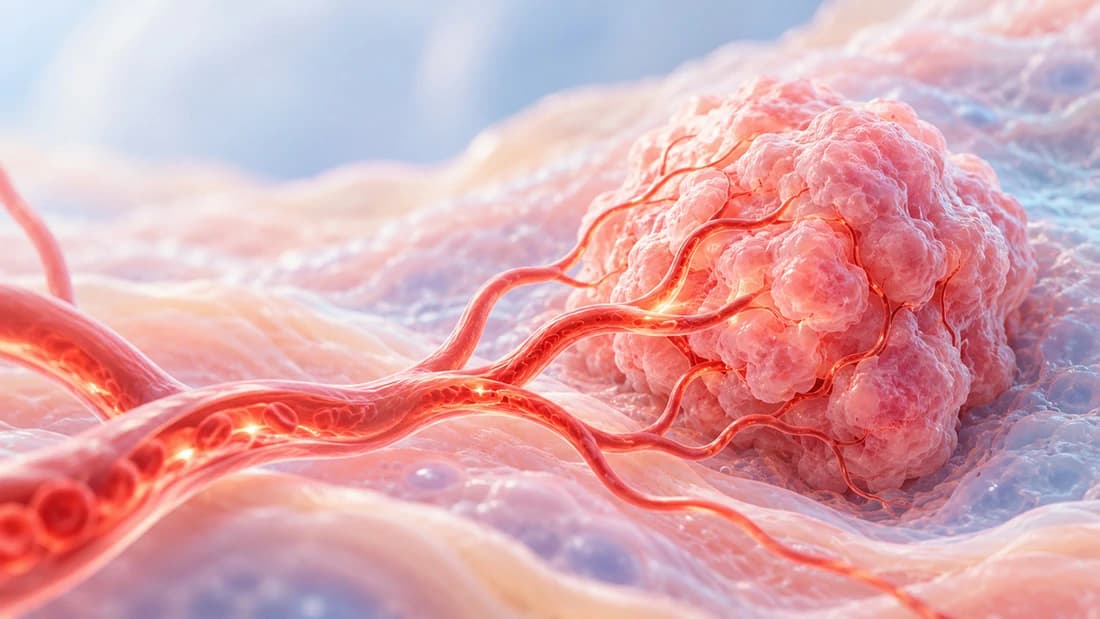
That early observation became the foundation for one of cancer biology's more consequential ideas: tumors don't just grow, they actively build the infrastructure that lets them keep growing. The process is called angiogenesis, the formation of new blood vessels from vessels that already exist. For a tumor, it isn't a side effect of growth. It's closer to a requirement.
The Switch That Turns a Dormant Tumor Into an Active One
Many early tumors sit quietly for a while in what researchers describe as a dormant, poorly vascularized state. Cells divide, but growth is slow and self-limiting, roughly balanced by cells dying off from the stress of too little oxygen. At some point, many tumors flip into a different mode entirely, one where new blood vessels flood in and growth accelerates sharply.
This transition is known as the angiogenic switch. It marks the moment a tumor stops being held back by its own blood supply and starts actively building more of it. The switch doesn't happen on a fixed schedule. It depends on a shifting balance between signals that encourage vessel growth and signals that suppress it, a balance that can tip at different points in different tumors.
How a Starved Tumor Calls for New Blood Vessels
The trigger for that tip is often simple: lack of oxygen. As a tumor outgrows its existing blood supply, the tissue at its core becomes hypoxic, meaning oxygen-starved. Cells sense this and respond by switching on a protein called HIF-1α, which acts like an alarm system for low oxygen. Once activated, HIF-1α turns on a set of genes that help the tumor cope, including the gene for a signaling protein called VEGF, short for vascular endothelial growth factor.
VEGF works by reaching out to endothelial cells, the thin layer of cells that line the inside of every blood vessel, and instructing them to divide, migrate, and assemble into new vessel branches. Picture a neighborhood that keeps expanding until its original road network can't keep up: VEGF is essentially the tumor's request for more roads. This hypoxia-to-HIF-1α-to-VEGF chain is one of the best-characterized drivers of tumor angiogenesis, though it works alongside other signals that can also push the switch.
Why Angiogenesis Counts as a Hallmark of Cancer
Because nearly all solid tumors eventually need this capability, angiogenesis is considered one of the defining enabling traits of cancer, grouped alongside things like uncontrolled division and the ability to invade nearby tissue. That framing matters because it shifts how the process is understood. Angiogenesis isn't a quirk of a few aggressive cancers. It's a capability that most solid tumors must acquire at some point if they are to grow beyond a very limited size, which is why it has been treated as a target for therapy rather than just a biological curiosity.
Blood Vessels Built in a Hurry
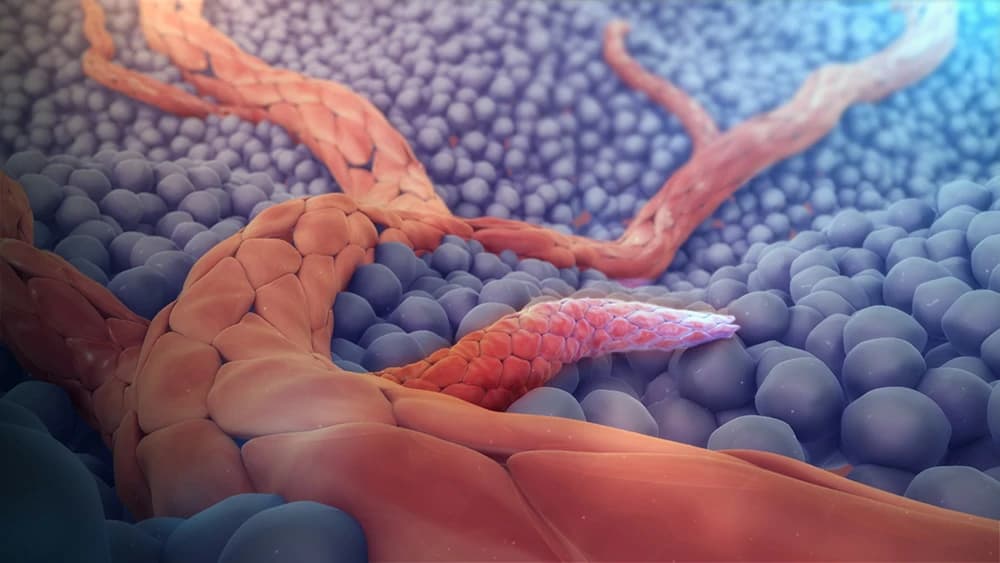
The vessels a tumor builds this way don't look or behave like normal blood vessels. Normal vasculature is orderly, following a hierarchy of larger and smaller vessels with tight, even walls. Tumor vessels, by contrast, tend to be leaky, twisted, and poorly organized, branching erratically and often ending in dead ends. The research that mapped this out, associated in part with work by Rakesh Jain, showed that this disorganization isn't a minor detail. It means blood flow through a tumor is uneven, oxygen delivery stays patchy even after new vessels form, and drugs carried in the bloodstream can struggle to reach all parts of the tumor evenly.
This has led to an idea called vascular normalization, where certain treatments, in some cases and for limited windows, can push tumor vessels toward a more normal structure rather than simply destroying them. The practical implications of that idea are still being worked out, but it reframes abnormal blood flow as something that might be corrected rather than only blocked.
Turning a Biological Insight Into a Treatment
The discovery that VEGF drives tumor blood vessel growth led directly to drugs designed to block it. Bevacizumab, an antibody that neutralizes VEGF before it can reach endothelial cells, was tested in a landmark trial for metastatic colorectal cancer, where adding it to standard chemotherapy improved patient outcomes compared with chemotherapy alone. That result helped establish anti-angiogenic therapy as a real treatment strategy rather than a laboratory concept, and VEGF-blocking drugs are now used across several cancer types.
It's worth being precise about what this means. These drugs work by starving a tumor of the new vessels it needs, not by attacking cancer cells directly. They are not effective for every cancer, and they are typically used alongside other treatments rather than in place of them.
Why the Effect Often Fades
Anti-angiogenic drugs don't always keep working indefinitely. Tumors can become resistant through several distinct routes: some switch to producing other blood-vessel-stimulating signals that don't rely on VEGF, some become better at surviving on the oxygen they already have, and some recruit blood vessels through alternative mechanisms altogether. Because there are multiple paths to resistance, blocking one signal rarely shuts the process down for good.
That multiplicity is part of why anti-angiogenic therapy, despite its conceptual elegance, has not become a cure on its own. It remains one tool among several, most useful when its limits are understood rather than oversold. Whether future strategies can close off enough of these escape routes at once to make the effect more durable is still an open question in the field.
Common Questions
References
- Louis M. Sherwood, Edith E. Parris, Judah Folkman (1971). Tumor Angiogenesis: Therapeutic Implications
- Douglas Hanahan, Judah Folkman (1996). Patterns and Emerging Mechanisms of the Angiogenic Switch during Tumorigenesis
- Napoleone Ferrara, Hans-Peter Gerber, Jennifer LeCouter (2003). The biology of VEGF and its receptors
- Gregg L. Semenza (2012). Hypoxia-Inducible Factors in Physiology and Medicine
- Douglas Hanahan, Robert A. Weinberg (2011). Hallmarks of Cancer: The Next Generation
- Rakesh K. Jain (2005). Normalization of Tumor Vasculature: An Emerging Concept in Antiangiogenic Therapy
- Peter Carmeliet, Rakesh K. Jain (2000). Angiogenesis in cancer and other diseases
- Herbert Hurwitz, Louis Fehrenbacher, William Novotny, Thomas Cartwright, John Hainsworth, William Heim, Jordan Berlin, Ari Baron, Susan Griffing, Eric Holmgren, Napoleone Ferrara, Gwen Fyfe, Beth Rogers, Robert Ross, Fairooz Kabbinavar (2004). Bevacizumab plus Irinotecan, Fluorouracil, and Leucovorin for Metastatic Colorectal Cancer
- Gabriele Bergers, Douglas Hanahan (2008). Modes of resistance to anti-angiogenic therapy
Team Review: This article has been reviewed by Canceria Research Team