Hyperbaric Oxygen Therapy and Cancer: What It Can Treat, and What Remains Uncertain
A look at where pressurized oxygen chambers have real evidence in cancer care, and where the science is still unsettled.
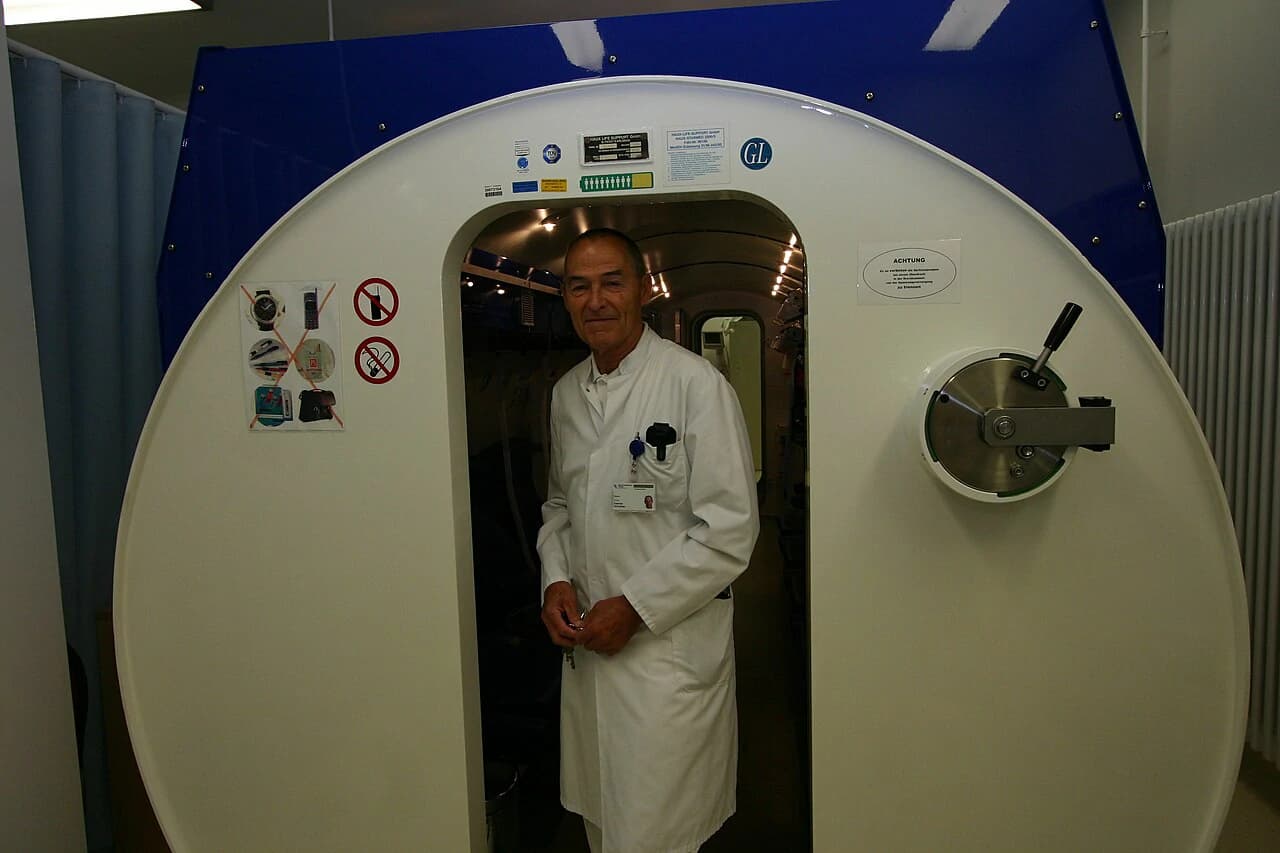
Key Takeaways
- •Hyperbaric oxygen therapy raises the oxygen dissolved in blood plasma by having patients breathe pure oxygen under pressure, delivering more oxygen to tissue than normal breathing can.
- •The strongest evidence for HBOT in cancer care supports treating late radiation tissue injuries, such as osteoradionecrosis, not treating tumors themselves.
- •HBOT has also shown benefit for radiation-induced bladder and rectal injury, including hemorrhagic cystitis and proctitis, in prospective clinical studies.
- •Tumor hypoxia, meaning low oxygen within solid tumors, is common and is linked to resistance to radiotherapy and chemotherapy as well as worse outcomes.
- •Researchers have tested combining HBOT with radiotherapy to overcome tumor hypoxia since the 1970s, but trial results have been mixed and this never became standard practice.
- •Low oxygen activates a protein called HIF-1α that can promote new blood vessel growth, raising a theoretical concern that added oxygen might help tumors build blood supply.
- •Despite this theoretical concern, clinical evidence has not shown that HBOT increases cancer recurrence in treated patients.
- •Animal studies on HBOT and tumor growth have produced inconsistent results depending on tumor type and exposure protocol, so they should not be read as directly predictive for people.
Hyperbaric oxygen therapy sounds like it might be built to fight cancer directly: a sealed chamber, pressurized air, a patient breathing pure oxygen under medical supervision. The reality is narrower, and more specific. HBOT has a genuine, well-documented place in cancer care, but that place is almost entirely about repairing damage from past treatment, not attacking active tumors. Understanding why means looking at what pressurized oxygen actually does in the body, and why oxygen matters so much to how tumors behave in the first place.
How Breathing Pressurized Oxygen Changes the Body
Normally, oxygen travels through blood mostly attached to red blood cells, with only a small amount dissolved directly in the plasma. Inside a hyperbaric chamber, a person breathes 100% oxygen at pressure well above normal atmospheric levels. That pressure forces much more oxygen to dissolve directly into the blood plasma itself. It's a bit like dissolving extra sugar into water under pressure: oxygen gets pushed into solution instead of relying only on its usual carrier. This sharply raises how much oxygen reaches tissue, including areas where blood flow is poor.
In injured but non-cancerous tissue, that oxygen surge supports repair. It helps stimulate new blood vessel growth, supports collagen production, the structural protein that rebuilds damaged tissue, and helps mobilize stem and progenitor cells that assist healing. This is the physiological basis for HBOT's approved medical uses, most of which involve wounds starved of oxygen.
Where the Evidence Is Strong: Repairing Radiation Damage
Cancer treatment can damage healthy tissue in ways that only show up years later. Radiation therapy, in particular, can leave blood vessels in treated areas damaged long after the cancer itself is gone. That leaves nearby tissue chronically short of oxygen. In bone, especially the jaw, this can progress to osteoradionecrosis, where bone tissue breaks down and fails to heal. Similar radiation injury can affect soft tissue elsewhere in the body.
This is where HBOT's evidence is strongest. A systematic review of the research found real benefit from HBOT for certain late radiation tissue injuries, supporting its established role in treating radiation damage, not the tumor radiation was originally used against. HBOT has also been studied for radiation-induced hemorrhagic cystitis and proctitis, conditions where radiation damages the bladder or rectal lining and leaves it prone to bleeding and poor healing. A prospective study of patients treated with HBOT for these conditions reported better patient-perceived recovery. In both cases, the oxygen isn't treating cancer. It's repairing normal tissue that cancer treatment left starved of oxygen.
Why Tumors Often Run Short on Oxygen
To understand why anyone considered pairing HBOT with cancer treatment itself, rather than just wound repair, it helps to understand tumor hypoxia. Solid tumors often outgrow their own blood supply, and the vessels they do build tend to be disorganized and leaky. The result is that many solid tumors contain regions with considerably lower oxygen than surrounding healthy tissue.
That matters clinically, not only biologically. Low-oxygen tumor regions tend to resist both radiotherapy and chemotherapy, and tumors with substantial hypoxic regions are generally linked to worse outcomes. Radiation therapy depends heavily on oxygen for its cell-damaging effect, since oxygen helps lock in the DNA damage radiation causes. Cells sitting in low-oxygen regions are simply harder to kill with the same radiation dose. That is why hypoxia has long been recognized as a practical obstacle to curing some cancers.
Testing Oxygen as a Partner to Radiotherapy
Hypoxia's role in blunting radiation sensitivity led researchers decades ago to ask an obvious question. If low oxygen protects tumor cells from radiation, could adding oxygen make radiation work better? HBOT was tested as exactly that kind of radiosensitizer, a treatment meant to make cancer cells more vulnerable to radiation, starting in the 1970s. A 1977 British trial testing HBOT alongside radiotherapy in head and neck cancer, led by Henk and colleagues, was among the notable early efforts.
The results across this body of work were mixed, varying by cancer type, trial design, and timing of oxygen delivery relative to radiation. Decades later, Jens Overgaard reviewed this history and described hypoxic radiosensitization as a strategy that had been, in his words, 'adored and ignored' by turns. His review acknowledged a real biological rationale that never translated into a reliable clinical benefit across settings. That history is useful context for today: using oxygen to help radiotherapy isn't a new idea, it's a decades-old research question with a complicated, unresolved answer.
The Open Question: Could More Oxygen Also Help a Tumor Grow?
The same hypoxia that weakens radiotherapy's effect also does something else. It activates a cellular low-oxygen alarm system centered on a protein called HIF-1α. When oxygen runs low, HIF-1α switches on, triggering changes that help cells survive the shortage, including signals that promote angiogenesis, the growth of new blood vessels. In a tumor, that can mean building the very blood supply a hypoxic tumor needs to keep growing.
That raises a reasonable, biologically grounded question. If raising tissue oxygen helps angiogenesis and repair in wounds, could the same effect help a tumor build its blood supply too? Reviews addressing this concern treat it as plausible rather than dismissible, since the signaling pathways genuinely do connect oxygen levels to new vessel growth. But plausible is not the same as proven. Clinical evidence has not established that HBOT increases cancer recurrence in treated patients, despite this theoretical concern. Animal studies looking directly at HBOT's effect on tumor growth have produced inconsistent results, varying by tumor type, animal model, and how oxygen exposure was delivered. That inconsistency is itself a reason for caution, against reading any single preclinical result as settling the question in either direction.
What This Means in Practice
None of this adds up to HBOT being a cancer treatment. None of it proves HBOT is dangerous for people with a cancer history, either. The evidence that exists supports a fairly narrow role: repairing radiation-damaged tissue once cancer treatment is otherwise complete. Evidence testing HBOT as a radiotherapy enhancer is older, mixed, and never became standard practice. The theoretical concern about feeding tumor growth remains exactly that, a concern worth taking seriously, not one current clinical data confirms.
For someone with active, residual, or recently treated cancer considering HBOT for a wound or radiation injury, questions like cancer type, stage, and treatment history matter. They're best worked through with the treating oncology team, not assumed from general principles. The science here is genuinely unresolved in places. That uncertainty deserves to be stated plainly, rather than resolved by wishful thinking in either direction.
Photo: Pumpkin Diamond / Wikimedia Commons / CC BY-SA 4.0
Common Questions
References
- Stephen R. Thom (2011). Hyperbaric Oxygen: Its Mechanisms and Efficacy
- Michael H Bennett, John Feldmeier, Neil B Hampson, Robert Smee, Christopher Milross (2016). Hyperbaric oxygen therapy for late radiation tissue injury
- Peter Vaupel, Arnulf Mayer (2007). Hypoxia in cancer: significance and impact on clinical outcome
- (2001). Tumor hypoxia: definitions and current clinical, biologic, and molecular aspects.
- J.M. Henk, P.B. Kunkler, C.W. Smith (1977). RADIOTHERAPY AND HYPERBARIC OXYGEN IN HEAD AND NECK CANCER
- Jens Overgaard (2007). Hypoxic Radiosensitization: Adored and Ignored
- Ingrid Moen, Linda E. B. Stuhr (2012). Hyperbaric oxygen therapy and cancer—a review
- (2013). Hyperbaric oxygen treatment in radiation-induced cystitis and proctitis: a prospective cohort study on patient-perceived quality of recovery.
Team Review: This article has been reviewed by Canceria Research Team