How Chronic Inflammation Shapes Breast Cancer Risk and Growth
From inflamed fat tissue to immune cells living inside tumors, researchers are mapping how long-term inflammation connects to breast cancer risk, progression, and a rare aggressive subtype.
Key Takeaways
- •Chronic, low-grade inflammation is increasingly recognized as an enabling feature of cancer development, including in breast cancer.
- •Obesity-related inflammation in breast fat tissue, marked by crown-like structures, has been linked to breast cancer risk, particularly after menopause.
- •Inflamed breast tissue can increase local aromatase activity, raising estrogen production in ways that may support hormone receptor-positive tumor growth.
- •Immune cells inside breast tumors, including tumor-associated macrophages, can influence tumor growth, survival, and response to chemotherapy.
- •Elevated blood markers of inflammation, such as CRP and interleukin-6, have been associated with worse breast cancer outcomes, though they are not reliable individual risk predictors.
- •Inflammatory breast cancer is a distinct, aggressive subtype defined by lymphatic blockage in the skin, not by general chronic inflammation.
- •Aspirin and other anti-inflammatory drugs show some association with reduced cancer mortality in trial data, but evidence is mixed and these drugs carry real risks.
- •Targeting obesity-related adipose tissue inflammation is an active area of research for breast cancer prevention, but it is not yet an established clinical strategy.
Inflammation is usually something people notice: a sprained ankle, a sore throat, redness that fades in a few days. But a slower, quieter version can persist in the body for years without any visible sign. Research increasingly ties this long-running form of inflammation to cancer, including breast cancer. It does not announce itself. Instead, immune signals stay switched on at a low level, gradually reshaping the tissue around them.
Inflammation as an Enabling Condition for Cancer
Cancer biologists now treat chronic inflammation as one of the conditions that makes cancer development possible, not simply a side effect of a tumor that already exists. Influential work describing the core biological traits shared across cancers, including an analysis by Douglas Hanahan and Robert Weinberg, lists inflammation among the features that help tumors get started and keep growing. Related research describes inflammation as something that can promote genetic damage, encourage new blood vessel growth, and help abnormal cells escape signals that would normally trigger their elimination. This does not mean inflammation causes cancer by itself. It means that when inflammation becomes chronic, it changes the environment tissue sits in, making that environment more hospitable to cells that would otherwise be cleared away.
Obesity, Breast Fat, and Crown-Like Structures
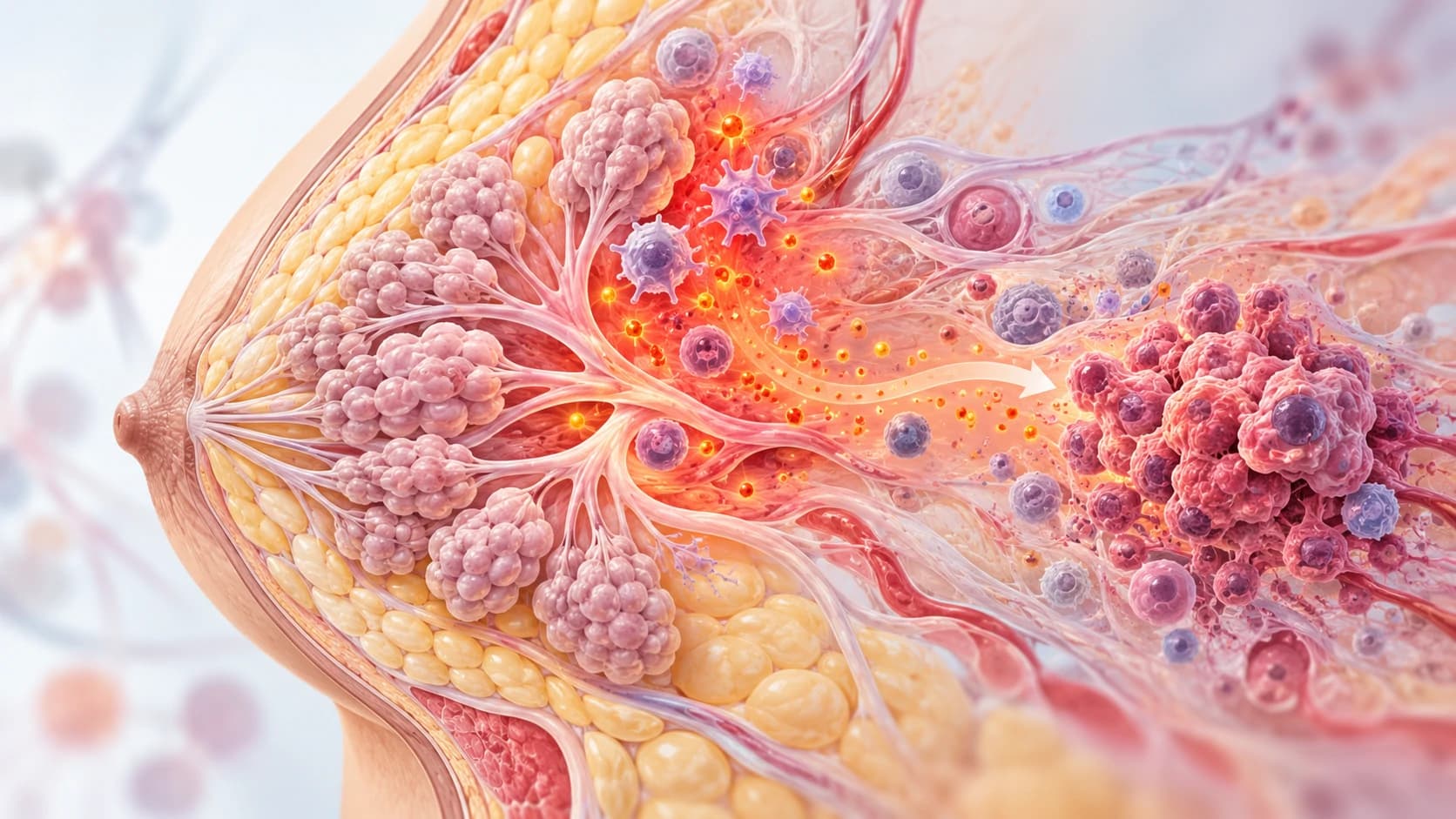
One of the clearest examples of this plays out in breast fat tissue, especially after menopause. Fat tissue is not just storage. It is active, hormone-producing tissue, and in obesity, fat cells can die faster than the body clears them away. When that happens, immune cells gather around the dying fat cells in a ring-shaped pattern researchers call a crown-like structure. These clusters are a visible marker of localized inflammation inside the breast itself. Research led by Andrew Dannenberg's group found these structures more often in breast tissue from obese women with breast cancer, alongside a more broadly inflamed tissue environment. This matters particularly after menopause, when fat tissue becomes the body's main source of estrogen, a hormone that can fuel the growth of certain breast cancers.
From Inflamed Fat to Local Estrogen Production
That hormone connection runs through an enzyme called aromatase, which converts other hormones into estrogen inside breast tissue. Inflamed fat containing crown-like structures produces higher levels of signaling molecules that push aromatase activity upward. The result is more estrogen made locally, right where breast tissue sits, rather than relying only on estrogen circulating from elsewhere in the body. For breast cancers that depend on estrogen to grow, known as hormone receptor-positive cancers, this local boost could plausibly support tumor growth. The evidence for this pathway comes mainly from tissue studies in obese women, so it describes a mechanism that appears biologically active rather than a fully proven driver of disease in every patient.
Immune Cells Living Inside the Tumor
Inflammation's influence does not stop at the fat surrounding a tumor. Breast tumors are embedded in what researchers call a tumor microenvironment, the mix of blood vessels, signaling molecules, and immune cells surrounding cancer cells that shapes how those cells behave. Among the immune cells found there, tumor-associated macrophages stand out. Macrophages normally help clear damaged cells and debris, but inside a tumor they can be reprogrammed to support growth instead of fighting it. Research examining the mix of immune cells across breast tumors, associated with David DeNardo and colleagues, found that this immune composition predicted patient survival and affected how tumors responded to chemotherapy. The immune environment around a tumor, in other words, is not a passive bystander. It actively participates in how the disease progresses and how well treatment works.
What Blood Tests Can and Cannot Tell Us
Because inflammation can be measured in blood, researchers have asked whether simple blood markers predict breast cancer risk or outcomes. C-reactive protein, a substance the liver releases during inflammation, and interleukin-6, a signaling molecule immune cells use to communicate, have both been studied this way. Elevated levels of these markers have been associated with reduced survival among breast cancer patients, and C-reactive protein has been examined across many cancer types as a marker tied to diagnosis and prognosis. These associations are useful for understanding biology, but they are not established tools for predicting an individual person's breast cancer risk. Inflammation markers rise for many reasons unrelated to cancer, which limits how specific they can be on their own.
Inflammatory Breast Cancer Is a Separate, More Urgent Diagnosis
It is worth separating all of this from inflammatory breast cancer itself, a distinct and rare diagnosis that should not be confused with the general inflammatory processes described above. It does not usually present as a lump. Instead, cancer cells block lymphatic vessels in the skin of the breast, causing it to become red, swollen, and warm, sometimes within weeks. It is biologically aggressive and tends to spread faster than more common breast cancer subtypes. Its name reflects the breast's visibly inflamed appearance, not the underlying chronic inflammation discussed elsewhere in this article. The two ideas share a word, but they should not be collapsed into one.
Could Anti-Inflammatory Drugs Lower Risk?
If chronic inflammation contributes to cancer development, an obvious question follows: could drugs that reduce inflammation also reduce cancer risk? Aspirin and other anti-inflammatory drugs, sometimes called NSAIDs, work partly by blocking enzymes involved in inflammatory signaling. An analysis combining data from multiple randomized trials found that daily aspirin use was associated with a reduced long-term risk of dying from cancer, with some relevance to breast cancer, though results varied across cancer types and were not uniformly strong. Separately, researchers have begun exploring whether directly treating obesity-related fat tissue inflammation, rather than relying on general anti-inflammatory drugs, could become a strategy for lowering breast cancer risk. That work remains investigational. Aspirin and similar drugs also carry real risks, including bleeding, so decisions about using them for cancer-related reasons should involve a physician rather than independent use.
Where the Evidence Leaves Us
Taken together, the research paints chronic inflammation as a genuine contributor to breast cancer biology, acting through several connected channels: fat tissue inflammation and local estrogen production, immune cells living inside tumors, and circulating markers that track with outcomes. None of these channels works alone, and none of them turns inflammation into a single, deterministic cause of breast cancer. Obesity remains just one risk factor among many, and inflammatory markers are clues rather than diagnostic tools. What the field still needs is clearer evidence on whether directly targeting inflammation changes outcomes, rather than simply correlating with them. For now, the relationship between inflammation and breast cancer is best understood as an active, evolving area of research rather than a settled story with a simple fix.
Common Questions
References
- Douglas Hanahan, Robert A. Weinberg (2011). Hallmarks of Cancer: The Next Generation
- Alberto Mantovani, Paola Allavena, Antonio Sica, Frances Balkwill (2008). Cancer-related inflammation
- Patrick G. Morris, Clifford A. Hudis, Dilip Giri, Monica Morrow, Domenick J. Falcone, Xi Kathy Zhou, Baoheng Du, Edi Brogi, Carolyn B. Crawford, Levy Kopelovich, Kotha Subbaramaiah, Andrew J. Dannenberg (2011). Inflammation and Increased Aromatase Expression Occur in the Breast Tissue of Obese Women with Breast Cancer
- (2012). Increased levels of COX-2 and prostaglandin E2 contribute to elevated aromatase expression in inflamed breast tissue of obese women.
- Neil M. Iyengar, Ayca Gucalp, Andrew J. Dannenberg, Clifford A. Hudis (2016). Obesity and Cancer Mechanisms: Tumor Microenvironment and Inflammation
- Kristine H. Allin, Børge G. Nordestgaard (2011). Elevated C-reactive protein in the diagnosis, prognosis, and cause of cancer
- David G. DeNardo, Donal J. Brennan, Elton Rexhepaj, Brian Ruffell, Stephen L. Shiao, Stephen F. Madden, William M. Gallagher, Nikhil Wadhwani, Scott D. Keil, Sharfaa A. Junaid, Hope S. Rugo, E. Shelley Hwang, Karin Jirström, Brian L. West, Lisa M. Coussens (2011). Leukocyte Complexity Predicts Breast Cancer Survival and Functionally Regulates Response to Chemotherapy
- (2007). Inflammation and breast cancer. Balancing immune response: crosstalk between adaptive and innate immune cells during breast cancer progression.
- Fredika M. Robertson, Melissa Bondy, Wei Yang, Hideko Yamauchi, Shannon Wiggins, Samira Kamrudin, Savitri Krishnamurthy, Huong Le-Petross, Luc Bidaut, Audrey N. Player, Sanford H. Barsky, Wendy A. Woodward, Thomas Buchholz, Anthony Lucci, Naoto Ueno, Massimo Cristofanilli (2010). Inflammatory Breast Cancer: The Disease, the Biology, the Treatment
- Peter M Rothwell, F Gerald R Fowkes, Jill FF Belch, Hisao Ogawa, Charles P Warlow, Tom W Meade (2011). Effect of daily aspirin on long-term risk of death due to cancer: analysis of individual patient data from randomised trials
- Ayca Gucalp, Neil M. Iyengar, Clifford A. Hudis, Andrew J. Dannenberg (2016). Targeting obesity-related adipose tissue dysfunction to prevent cancer development and progression
Team Review: This article has been reviewed by Canceria Research Team