Liver Cancer: Why Chronic Liver Disease Sets the Stage for Tumors
How hepatitis, fatty liver disease, and genetic changes drive hepatocellular carcinoma, and how detection and treatment have evolved.
Key Takeaways
- •Liver cancer is not one disease: hepatocellular carcinoma and cholangiocarcinoma arise from different cells and require different treatment approaches.
- •Most hepatocellular carcinoma develops in a liver already scarred by years of chronic injury, making cirrhosis the single biggest known risk factor.
- •Chronic hepatitis B and C infection remain leading worldwide causes of liver cancer, while fatty liver disease linked to obesity and diabetes is a fast-rising cause, sometimes even without cirrhosis.
- •Hepatitis B vaccination programs have been linked to substantial reductions in childhood liver cancer rates, showing that preventing infection can prevent cancer decades later.
- •Recurring genetic changes, including mutations in the TERT gene's promoter region, are common in liver cancer and help explain how tumor cells escape normal growth limits.
- •Blood tests like AFP are useful but imperfect for early detection, which is why regular ultrasound surveillance in high-risk patients is recommended.
- •Treatment is matched to tumor stage and liver function, ranging from transplantation under the Milan criteria to localized procedures like TACE and systemic drugs like sorafenib.
- •Survival in advanced liver cancer has improved since systemic therapy became available, and newer immune-based treatments are now part of an evolving treatment landscape.
Liver cancer is really two different diseases that happen to share an organ. Most cases are hepatocellular carcinoma, or HCC, which begins in the liver's main working cells, the ones responsible for filtering blood and producing proteins. A smaller share are cholangiocarcinoma, which starts instead in the thin ducts that carry bile out of the liver. The two cancers have different causes, grow in different ways, and are treated differently, so treating them as interchangeable is a mistake. This article focuses mainly on HCC, since it makes up the large majority of primary liver cancer and is the form best supported by the evidence discussed here.
How often liver cancer occurs, and how often it kills, differs enormously by region of the world. Rates track closely with local patterns of viral hepatitis, alcohol use, and metabolic disease. That's why liver cancer looks like a very different problem in different parts of the world. Understanding that geography means understanding what actually damages the liver over time. In the large majority of HCC cases, the cancer does not appear in a healthy organ. It grows out of a liver that has already been injured for years, often decades, before any tumor forms.
A Scarred Liver Is Where Most Tumors Take Root
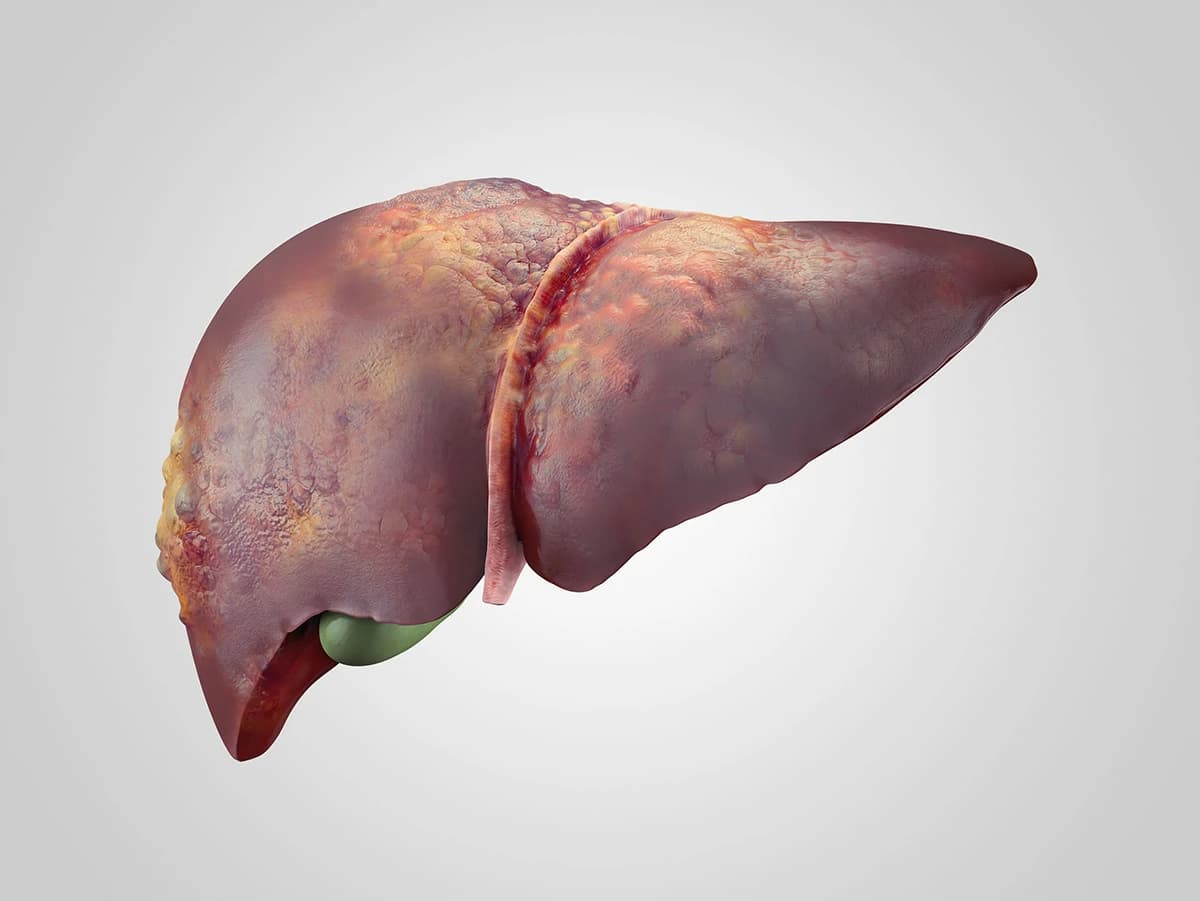
Cirrhosis is severe, long-term scarring of the liver. It develops after years of repeated injury, whether from infection, alcohol, or fat accumulation, and it is present in the great majority of people who go on to develop HCC. Think of it like skin that gets cut over and over in the same spot: eventually the repeated healing leaves tough, disorganized scar tissue instead of smooth skin. The liver responds to chronic injury the same way, replacing damaged cells again and again.
That constant cycle of damage and repair is dangerous because every round of cell division is a chance for a copying mistake. Most of these mistakes are harmless or get caught by the cell's own repair systems. But over enough years, in enough dividing cells, a mistake eventually lands in the wrong gene, one that controls growth or division, and a cancerous cell line begins. This is why cirrhosis itself, regardless of what originally caused it, functions as the single biggest known risk factor for HCC.
The Underlying Causes: Infection, Alcohol, and a Newer Culprit
Chronic infection with hepatitis B virus or hepatitis C virus is a leading cause of HCC worldwide, responsible for a large share of cases in regions where these infections are common. Both viruses can quietly inflame the liver for decades, often without obvious symptoms, pushing it slowly toward cirrhosis and creating fertile ground for cancer to develop. Heavy, prolonged alcohol use is another long-recognized route to the same destination, causing liver scarring through a different mechanism but arriving at similar risk.
A newer and fast-growing contributor is non-alcoholic fatty liver disease, or NAFLD, and its more severe form, non-alcoholic steatohepatitis, known as NASH. Both involve fat building up in liver tissue, often alongside obesity and type 2 diabetes, and both are becoming more common as those conditions rise worldwide. What makes NAFLD and NASH particularly notable is that they can lead to HCC even in people who have not developed full cirrhosis, unlike most other causes. That detail matters for screening decisions, since liver cancer risk cannot always be ruled out just because cirrhosis has not been diagnosed.
Hepatitis B carries one advantage the other causes do not: it is preventable with a vaccine. A landmark study following vaccinated children in Taiwan, where the virus was once extremely common, found that a national hepatitis B vaccination program was followed by a significant drop in childhood liver cancer rates. It was one of the first times a vaccine against an infection had been shown to reduce cancer rates in the real world. It remains a touchstone for how prevention further upstream, at the level of infection, can eventually show up as fewer cancer diagnoses.
What Goes Wrong Inside the Cell
Underneath these outside causes, HCC has a fairly characteristic set of internal genetic changes. The most frequent involves a gene called TERT, found in a region known as its promoter, the genetic "on switch" that controls how active the gene is. Mutations there make TERT unusually active, which keeps cells capable of dividing indefinitely instead of aging out and stopping, a trait cancer cells generally need to keep growing. Alongside TERT changes, other recurrent mutations affect genes that normally restrain cell growth or manage how cells respond to internal signals. Losing that restraint helps a tumor take hold and expand. These genetic changes do not appear overnight. They accumulate gradually, which fits with how HCC typically develops over years of chronic liver injury rather than suddenly.
Why Catching It Early Is Still Difficult
Early-stage liver tumors rarely cause symptoms, so detection depends on actively looking for them in people already known to be at risk, mainly those with cirrhosis. The blood test most often used is alpha-fetoprotein, or AFP, a protein that is sometimes elevated when liver cancer is present. AFP is inexpensive and widely available, but it misses a meaningful proportion of early tumors and can also rise for reasons unrelated to cancer, which limits how much it can be relied on alone.
Because of those limitations, AFP is usually paired with regular liver ultrasound scans in people with cirrhosis. Evidence pooling results across multiple surveillance studies has found that regular ultrasound monitoring, with or without AFP, is associated with detecting tumors at an earlier stage and may improve survival compared with no monitoring at all. The benefit is not guaranteed for every patient, and surveillance works best as an ongoing habit rather than a one-time test. Still, for people already living with cirrhosis, it represents one of the more actionable tools available before symptoms appear.
Treating Liver Cancer: Matching the Approach to the Stage
Because HCC usually arises in an already damaged liver, treatment decisions must weigh two things: the tumor itself, and how much healthy liver function remains. That makes liver cancer care unusually dependent on a person's overall liver health, not just the cancer alone. For patients with early-stage disease and significant cirrhosis, removing the diseased liver entirely through transplantation can address both problems at once.
A landmark study found that patients selected using specific tumor size and number limits, now known as the Milan criteria, had favorable long-term survival after transplantation. Their outcomes were comparable to transplant recipients who did not have cancer at all. That finding, established by Mazzaferro and colleagues, reshaped how transplant candidacy is decided and remains the basis for selecting patients today.
For tumors that cannot be surgically removed, but have not spread beyond the liver, there is a procedure called transarterial chemoembolization, or TACE. It delivers chemotherapy directly into the blood vessels feeding the tumor, while cutting off its blood supply. A randomized trial comparing this approach with symptom-focused care alone found a clear survival advantage for selected patients, establishing TACE as a standard option for intermediate-stage disease.
When the cancer has spread beyond the liver, or surgery and localized treatments are no longer options, systemic drug therapy becomes the mainstay. Sorafenib blocks several growth-related signaling proteins at once. It was the first systemic therapy shown to extend survival in advanced HCC, a result that opened the door to drug treatment for a cancer once thought to have few options beyond local procedures. More recently, drugs that work through the immune system, broadly known as immune checkpoint inhibitors, have become part of the treatment landscape for advanced disease. They reflect a broader shift toward helping the immune system recognize tumors, rather than attacking the tumor directly with chemotherapy. Treatment choice ultimately depends on tumor stage, liver function, and overall health, decisions made individually by a specialist care team rather than by any fixed formula.
Where the Evidence Leaves Us
The throughline across HCC's causes, genetics, and treatment is the liver's own history of injury. Viral infection, alcohol, and metabolic disease all lead to the same destination of chronic damage, repeated repair, and eventually genetic errors that let a tumor take hold. That shared pathway is also why prevention has such outsized potential. Hepatitis vaccination, treating existing viral infection, and managing metabolic disease all intervene upstream, though none of them can undo cancer that has already formed.
Detection remains genuinely hard, since the tools available today, while useful, still miss cases or raise false alarms. Treatment has moved from essentially no options for advanced disease a generation ago to a tiered set of approaches matched to stage and liver function. What remains unresolved is how best to detect and treat the rising number of cases linked to fatty liver disease in people without cirrhosis. That pattern is one the field is still working to fully understand.
Common Questions
References
- Hashem B. El-Serag (2012). Epidemiology of Viral Hepatitis and Hepatocellular Carcinoma
- Mei-Hwei Chang, Chien-Jen Chen, Mei-Shu Lai, Hsu-Mei Hsu, Tzee-Chung Wu, Man-Shan Kong, Der-Cherng Liang, Wen-Yi Shau, Ding-Shinn Chen (1997). Universal Hepatitis B Vaccination in Taiwan and the Incidence of Hepatocellular Carcinoma in Children
- Zobair M. Younossi, Aaron B. Koenig, Dinan Abdelatif, Yousef Fazel, Linda Henry, Mark Wymer (2016). Global epidemiology of nonalcoholic fatty liver disease—Meta‐analytic assessment of prevalence, incidence, and outcomes
- Jessica Zucman-Rossi, Augusto Villanueva, Jean-Charles Nault, Josep M. Llovet (2015). Genetic Landscape and Biomarkers of Hepatocellular Carcinoma
- (2013). High frequency of telomerase reverse-transcriptase promoter somatic mutations in hepatocellular carcinoma and preneoplastic lesions.
- Jorge A. Marrero, Ziding Feng, Yinghui Wang, Mindie H. Nguyen, Alex S. Befeler, Lewis R. Roberts, K. Rajender Reddy, Denise Harnois, Josep M. Llovet, Daniel Normolle, Jackie Dalhgren, David Chia, Anna S. Lok, Paul D. Wagner, Sudhir Srivastava, Myron Schwartz (2009). α-Fetoprotein, Des-γ Carboxyprothrombin, and Lectin-Bound α-Fetoprotein in Early Hepatocellular Carcinoma
- Vincenzo Mazzaferro, Enrico Regalia, Roberto Doci, Salvatore Andreola, Andrea Pulvirenti, Federico Bozzetti, Fabrizio Montalto, Mario Ammatuna, Alberto Morabito, Leandro Gennari (1996). Liver Transplantation for the Treatment of Small Hepatocellular Carcinomas in Patients with Cirrhosis
- Josep M Llovet, Maria Isabel Real, Xavier Montaña, Ramon Planas, Susana Coll, John Aponte, Carmen Ayuso, Margarita Sala, Jordi Muchart, Ricard Solà, Joan Rodés, Jordi Bruix (2002). Arterial embolisation or chemoembolisation versus symptomatic treatment in patients with unresectable hepatocellular carcinoma: a randomised controlled trial
- Josep M. Llovet, Sergio Ricci, Vincenzo Mazzaferro, Philip Hilgard, Edward Gane, Jean-Frédéric Blanc, Andre Cosme de Oliveira, Armando Santoro, Jean-Luc Raoul, Alejandro Forner, Myron Schwartz, Camillo Porta, Stefan Zeuzem, Luigi Bolondi, Tim F. Greten, Peter R. Galle, Jean-François Seitz, Ivan Borbath, Dieter Häussinger, Tom Giannaris, Minghua Shan, Marius Moscovici, Dimitris Voliotis, Jordi Bruix (2008). Sorafenib in Advanced Hepatocellular Carcinoma
- A. SINGAL, M. L. VOLK, A. WALJEE, R. SALGIA, P. HIGGINS, M. A. M. ROGERS, J. A. MARRERO (2009). Meta‐analysis: surveillance with ultrasound for early‐stage hepatocellular carcinoma in patients with cirrhosis
- Hyuna Sung, Jacques Ferlay, Rebecca L. Siegel, Mathieu Laversanne, Isabelle Soerjomataram, Ahmedin Jemal, Freddie Bray (2021). Global Cancer Statistics 2020: GLOBOCAN Estimates of Incidence and Mortality Worldwide for 36 Cancers in 185 Countries
Team Review: This article has been reviewed by Canceria Research Team