Why Radiation Therapy Still Matters After Breast Cancer Surgery
How radiation lowers the risk of recurrence after lumpectomy and mastectomy, what shorter treatment schedules mean for patients, and what long-term risks are now well understood
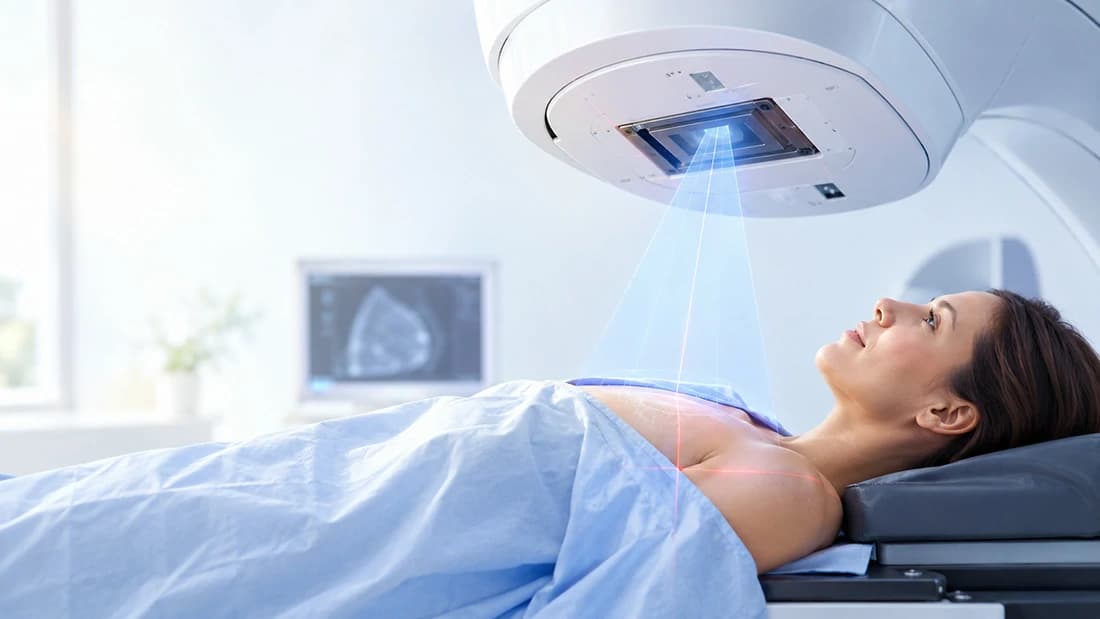
Key Takeaways
- •Radiation therapy works by using high-energy, ionizing radiation to damage DNA inside cells; cancer cells are generally less able than healthy cells to repair this damage.
- •After breast-conserving surgery, radiation significantly lowers the risk of local recurrence and modestly reduces breast cancer death, based on pooled data from thousands of women in randomized trials.
- •After mastectomy, radiation improves outcomes mainly in patients with positive lymph nodes, with the benefit growing alongside the extent of nodal involvement.
- •Hypofractionated radiation schedules, which use fewer and larger doses over a shorter period, have matched the effectiveness and safety of traditional longer schedules in large trials followed for up to a decade.
- •Radiation reaching the heart raises long-term risk of ischemic heart disease in proportion to the dose received, a risk that is more relevant for left-sided tumors and persists for years after treatment.
- •Partial breast irradiation, which treats only the tumor bed, can match whole-breast radiation outcomes, but only in carefully selected, lower-risk patients.
- •In ductal carcinoma in situ (DCIS), radiation after lumpectomy meaningfully reduces local recurrence, though its effect on overall survival is less clear given the generally favorable prognosis of DCIS.
- •The abscopal effect, where radiation of one tumor seems to trigger immune responses affecting tumors elsewhere, remains rare and experimental rather than a reliable treatment strategy.
Radiation therapy uses high-energy beams, usually X-rays, strong enough to break the DNA strands inside cells. This kind of radiation is called ionizing radiation, because it carries enough energy to strip electrons from atoms, damaging the genetic material cells need to divide. Healthy cells can usually repair this kind of damage. Cancer cells, which divide more often and repair themselves less reliably, are more likely to die or lose the ability to multiply. Doctors deliver the total dose in smaller pieces over days or weeks, an approach called fractionation, so healthy tissue has time to recover between sessions while damage to tumor cells keeps accumulating.
Closing the Gap Left by Surgery
When a tumor is removed with breast-conserving surgery, often called a lumpectomy, the surgeon takes out the visible tumor along with a margin of surrounding tissue. Microscopic cancer cells can still remain behind, too small to see and impossible to remove with a scalpel alone. A large pooled analysis of randomized trials involving thousands of women found that adding radiation after this kind of surgery substantially lowers the chance of the cancer returning in the breast. It also produced a modest but real reduction in the risk of dying from breast cancer over the following fifteen years. This is why radiation has become a standard part of breast-conserving treatment rather than an optional add-on.
When Radiation Follows Mastectomy
Mastectomy removes the entire breast, but that does not guarantee every cancer cell is gone, especially if the disease had already reached nearby lymph nodes. Pooled data from more than twenty randomized trials show that radiation after mastectomy reduces recurrence and improves long-term survival, particularly in women with positive lymph nodes. The benefit tends to grow with the number of nodes involved, which is one reason treatment teams look closely at nodal status when deciding whether radiation is needed after mastectomy. For women with no nodal involvement, the calculation is different, and the decision depends on other features of the tumor.
Shorter Schedules, Similar Results
Breast radiation was once delivered daily for five to six weeks. Hypofractionation changes that arithmetic: fewer sessions, each with a slightly higher dose, compressing the total schedule. Long-running randomized trials followed women for a decade and found that hypofractionated schedules controlled the cancer, and caused side effects, about as reliably as the older, longer regimen. More recent trials have pushed this further, showing that a schedule lasting just one week can match outcomes measured five years later. The shift matters in practical terms. It is a bit like paying off a loan with fewer, larger installments rather than many small ones: the total effect is similar, but it asks less of a person's time, travel, and daily disruption.
Weighing the Long-Term Risks
Radiation's effects do not end when treatment does. Research led by Sarah Darby and colleagues, drawing on data from women treated for breast cancer, found that radiation reaching the heart raises the long-term risk of ischemic heart disease, a narrowing of the arteries that supply the heart muscle. The risk rose in proportion to the dose of radiation the heart actually received, and the increase persisted for years after treatment ended. This risk matters more for left-sided breast tumors, where the heart sits closer to the treatment field, which is part of why modern planning techniques focus heavily on minimizing the dose that reaches cardiac tissue. The absolute risk for most patients remains low, but it is real enough to factor into long-term survivorship care.
Treating Less Tissue: Partial Breast Irradiation
Instead of irradiating the whole breast, some approaches target only the tissue immediately around where the tumor was removed, known as partial breast irradiation. One method delivers a single, concentrated dose during surgery itself, while the tumor bed is still exposed. In randomized trials comparing these targeted approaches with standard whole-breast radiation, outcomes were comparable in carefully selected patients considered to be at lower risk of recurrence. This equivalence does not extend to everyone. It depends heavily on tumor size, biology, and other features used to identify who is a reasonable candidate for a smaller treatment field.
Radiation and Non-Invasive Disease
Ductal carcinoma in situ, or DCIS, is an early, non-invasive form of breast cancer confined to the milk ducts. A landmark trial testing lumpectomy with and without radiation in DCIS patients found that radiation meaningfully reduced local recurrence. Its effect on overall survival was far less clear, largely because DCIS itself carries a low risk of death regardless of treatment. That distinction shapes how radiation is discussed for DCIS: it lowers the chance the disease comes back, but whether that translates into a survival advantage depends on the individual case.
A Rare and Unproven Immune Connection
Radiation's effects are usually confined to the tissue it actually reaches. Occasionally, though, treating one tumor appears to trigger immune activity that also affects tumors elsewhere in the body, a phenomenon researchers Silvia Formenti and Sandra Demaria described as a systemic effect of local treatment. This is known as the abscopal effect. It remains rare, poorly predictable, and far from a standard part of breast cancer care. It is best understood as an open scientific question rather than a treatment strategy a patient could currently rely on.
Taken together, these findings describe a treatment whose benefits and risks both scale with dose, extent, and patient selection rather than applying uniformly to everyone. Shorter schedules, smaller treatment fields, and more precise targeting have each made radiation more tolerable without giving up its core effect on recurrence. What remains genuinely open is how far that precision can go: which patients can safely receive less treatment, and which still need the fuller course, are questions oncology teams continue to answer case by case.
Common Questions
References
- (2005). Effects of radiotherapy and of differences in the extent of surgery for early breast cancer on local recurrence and 15-year survival: an overview of the randomised trials.
- EBCTCG (Early Breast Cancer Trialists' Collaborative Group) (2014). Effect of radiotherapy after mastectomy and axillary surgery on 10-year recurrence and 20-year breast cancer mortality: meta-analysis of individual patient data for 8135 women in 22 randomised trials
- Joanne S Haviland, J Roger Owen, John A Dewar, Rajiv K Agrawal, Jane Barrett, Peter J Barrett-Lee, H Jane Dobbs, Penelope Hopwood, Pat A Lawton, Brian J Magee, Judith Mills, Sandra Simmons, Mark A Sydenham, Karen Venables, Judith M Bliss, John R Yarnold (2013). The UK Standardisation of Breast Radiotherapy (START) trials of radiotherapy hypofractionation for treatment of early breast cancer: 10-year follow-up results of two randomised controlled trials
- Timothy J. Whelan, Jean-Philippe Pignol, Mark N. Levine, Jim A. Julian, Robert MacKenzie, Sameer Parpia, Wendy Shelley, Laval Grimard, Julie Bowen, Himu Lukka, Francisco Perera, Anthony Fyles, Ken Schneider, Sunil Gulavita, Carolyn Freeman (2010). Long-Term Results of Hypofractionated Radiation Therapy for Breast Cancer
- Adrian Murray Brunt, Joanne S Haviland, Duncan A Wheatley, Mark A Sydenham, Abdulla Alhasso, David J Bloomfield, Charlie Chan, Mark Churn, Susan Cleator, Charlotte E Coles, Andrew Goodman, Adrian Harnett, Penelope Hopwood, Anna M Kirby, Cliona C Kirwan, Carolyn Morris, Zohal Nabi, Elinor Sawyer, Navita Somaiah, Liba Stones, Isabel Syndikus, Judith M Bliss, John R Yarnold, Abdulla Alhasso, Anne Armstrong, Judith Bliss, David Bloomfield, Jo Bowen, Murray Brunt, Charlie Chan, Hannah Chantler, Mark Churn, Susan Cleator, Charlotte Coles, Ellen Donovan, Andy Goodman, Susan Griffin, Jo Haviland, Penny Hopwood, Anna Kirby, Julie Kirk, Cliona Kirwan, Marjory MacLennan, Carolyn Morris, Zohal Nabi, Elinor Sawyer, Mark Sculphur, Judith Sinclair, Navita Somaiah, Liba Stones, Mark Sydenham, Isabel Syndikus, Jean Tremlett, Karen Venables, Duncan Wheatley, John Yarnold (2020). Hypofractionated breast radiotherapy for 1 week versus 3 weeks (FAST-Forward): 5-year efficacy and late normal tissue effects results from a multicentre, non-inferiority, randomised, phase 3 trial
- Sarah C. Darby, Marianne Ewertz, Paul McGale, Anna M. Bennet, Ulla Blom-Goldman, Dorthe Brønnum, Candace Correa, David Cutter, Giovanna Gagliardi, Bruna Gigante, Maj-Britt Jensen, Andrew Nisbet, Richard Peto, Kazem Rahimi, Carolyn Taylor, Per Hall (2013). Risk of Ischemic Heart Disease in Women after Radiotherapy for Breast Cancer
- Umberto Veronesi, Roberto Orecchia, Patrick Maisonneuve, Giuseppe Viale, Nicole Rotmensz, Claudia Sangalli, Alberto Luini, Paolo Veronesi, Viviana Galimberti, Stefano Zurrida, Maria Cristina Leonardi, Roberta Lazzari, Federica Cattani, Oreste Gentilini, Mattia Intra, Pietro Caldarella, Bettina Ballardini (2013). Intraoperative radiotherapy versus external radiotherapy for early breast cancer (ELIOT): a randomised controlled equivalence trial
- Jayant S Vaidya, Frederik Wenz, Max Bulsara, Jeffrey S Tobias, David J Joseph, Mohammed Keshtgar, Henrik L Flyger, Samuele Massarut, Michael Alvarado, Christobel Saunders, Wolfgang Eiermann, Marinos Metaxas, Elena Sperk, Marc Sütterlin, Douglas Brown, Laura Esserman, Mario Roncadin, Alastair Thompson, John A Dewar, Helle M R Holtveg, Steffi Pigorsch, Mary Falzon, Eleanor Harris, April Matthews, Chris Brew-Graves, Ingrid Potyka, Tammy Corica, Norman R Williams, Michael Baum (2014). Risk-adapted targeted intraoperative radiotherapy versus whole-breast radiotherapy for breast cancer: 5-year results for local control and overall survival from the TARGIT-A randomised trial
- B Fisher, J Dignam, N Wolmark, E Mamounas, J Costantino, W Poller, E R Fisher, D L Wickerham, M Deutsch, R Margolese, N Dimitrov, M Kavanah (1998). Lumpectomy and radiation therapy for the treatment of intraductal breast cancer: findings from National Surgical Adjuvant Breast and Bowel Project B-17.
- Silvia C Formenti, Sandra Demaria (2009). Systemic effects of local radiotherapy
Team Review: This article has been reviewed by Canceria Research Team