Why Glioblastoma Is So Difficult to Treat Successfully
Diffuse tumor growth, a protective brain barrier, genetic diversity, and an immune-suppressing environment all stand in the way of lasting control.
Key Takeaways
- •Glioblastoma cells infiltrate diffusely into normal brain tissue, making complete surgical removal essentially impossible.
- •The blood-brain barrier blocks many drugs from reaching residual tumor cells after surgery, limiting chemotherapy options.
- •Standard treatment, radiation plus temozolomide (the Stupp protocol), modestly extends survival but is not curative for most patients.
- •MGMT gene silencing predicts a better response to temozolomide, but even MGMT-methylated tumors frequently recur.
- •Glioblastomas vary molecularly between patients, with distinct subtypes, and within a single tumor, undermining treatments aimed at one pathway.
- •A subpopulation of glioma stem-like cells resists radiation and chemotherapy and can repopulate tumors after treatment.
- •The glioblastoma microenvironment is highly immunosuppressive, and checkpoint inhibitor trials have so far failed to improve survival in unselected patients.
- •Recurrent glioblastomas often carry new genetic changes reflecting evolution under treatment pressure, contributing to resistance.
Glioblastoma is the most common and aggressive primary brain tumor in adults, treated with a combination of surgery, radiation, and chemotherapy. Yet decades of research have not solved it. Median survival under current standard therapy remains limited, often measured in months rather than years, a sobering fact that highlights the gap between having a treatment and actually controlling the disease. Understanding why requires looking at several separate obstacles, each one capable of undermining treatment on its own.
A Tumor That Spreads Before It Can Be Found
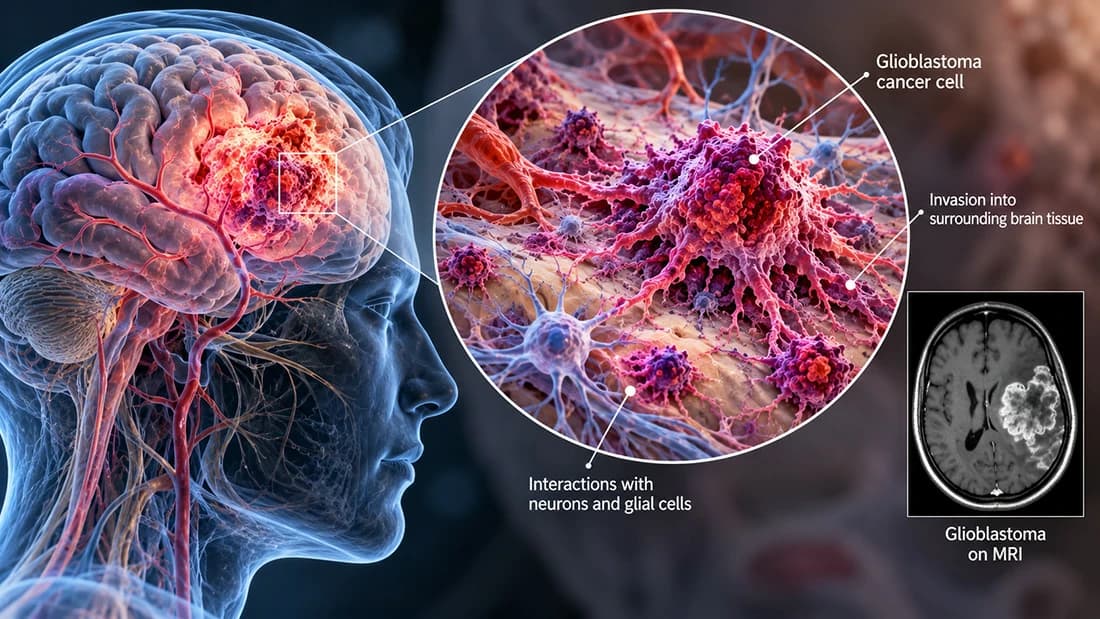
Most solid tumors grow as a relatively contained mass that a surgeon can cut out with a margin of healthy tissue around it. Glioblastoma doesn't behave that way. Its cells send thin, finger-like extensions deep into surrounding normal brain, often well beyond anything visible on a scan. That diffuse spread means a surgeon can remove the obvious tumor bulk but almost never every cancer cell. It has been compared to blotting up ink that has already soaked into paper: you can lift away the stain you can see, but threads of it have spread further than the eye can follow. This single feature, described by neuropathologists studying how gliomas invade brain tissue, is enough on its own to explain why surgery alone has never been curative.
A Barrier Designed to Keep Things Out
Whatever tumor cells remain after surgery have to be addressed with radiation or drugs, and that is where the brain's own architecture works against treatment. Blood vessels in the brain are wrapped in a tightly sealed layer of cells known as the blood-brain barrier, which normally protects brain tissue from toxins and infections circulating in the blood. The barrier doesn't distinguish between a harmful toxin and a potentially useful cancer drug; it simply blocks most molecules trying to cross. That is one reason many drugs that work well against tumors elsewhere in the body never reach meaningful concentrations inside brain tissue.
Why Even the Standard Treatment Falls Short
The treatment most glioblastoma patients receive today pairs radiation with an oral chemotherapy drug, temozolomide, a combination established in a landmark clinical trial and often called the Stupp protocol. Long-term follow-up confirmed that adding temozolomide to radiation modestly improves survival compared with radiation alone. Modestly is the key word: the regimen extends life for many patients but cures almost none.
Part of why some patients respond better than others comes down to a DNA-repair gene called MGMT. When a chemical tag silences this gene, a process known as promoter methylation, tumor cells lose some of their ability to repair the damage temozolomide causes, making them more vulnerable to the drug. Patients whose tumors carry this silencing tend to benefit more from chemotherapy. But the benefit has limits: even MGMT-methylated tumors frequently recur, which shows that drug sensitivity alone isn't enough to achieve lasting control.
One Tumor Name, Many Different Tumors
Part of the difficulty is that "glioblastoma" is not one uniform disease. Large-scale genomic studies have found that tumors from different patients cluster into distinct molecular subtypes, sometimes labeled classical, mesenchymal, or proneural, each associated with different patterns of genetic abnormality and different biological behavior. A drug designed around one subtype's biology may do little for another.
The variation doesn't stop between patients. Studies that sequence individual cells from a single tumor have found that even one person's glioblastoma contains cells in several different states, carrying different genetic changes within the same mass. It behaves less like one type of weed in a garden and more like several weed species tangled together; a treatment that kills one kind can leave the others untouched to take over.
A Reserve Population Built to Outlast Treatment
Within that mixed population, a subset of cells resembles stem cells in their ability to self-renew and regenerate tumor growth. Laboratory research has found that these glioma stem-like cells are preferentially resistant to radiation, in part because they activate their internal DNA-damage repair machinery more efficiently than other tumor cells. Separate work tracking tumors after chemotherapy found that a similarly restricted cell population survives treatment and goes on to repopulate the tumor. Together, these findings suggest a sobering pattern: the cells most responsible for driving recurrence may be the ones best equipped to survive the very treatments meant to eliminate them.
An Immune System Kept on a Short Leash
Immunotherapy has transformed treatment for some cancers, but it has largely disappointed in glioblastoma. Part of the explanation lies in the environment surrounding the tumor. The tissue around a glioblastoma is dense with immune cells, including scavenger cells called macrophages, but these cells are often reprogrammed by the tumor into a state that suppresses rather than supports an immune attack. The central nervous system also has immune characteristics that differ from most of the body, sometimes described as a form of relative immune privilege, which further shapes how immune cells behave around a brain tumor.
Against that backdrop, a major randomized trial testing a checkpoint inhibitor, a drug that releases a brake immune cells normally keep on themselves, found no survival benefit over an existing drug in patients with recurrent glioblastoma. That result stood in contrast to the gains checkpoint inhibitors had already shown in several other cancers, underlining how different the glioblastoma immune environment appears to be.
Recurrence With a Tumor That Has Changed
Almost all glioblastomas eventually come back, and when they do, the tumor is often not the same one that was first treated. Clinical observation shows that recurrent tumors frequently carry new genetic and molecular changes, consistent with the surviving cell population evolving under the pressure of radiation and chemotherapy. In effect, treatment doesn't just fail to eliminate the cancer; it can select for whichever cells were best able to withstand it, leaving a tougher opponent behind.
A Problem With No Single Fix
No single mechanism fully accounts for why glioblastoma remains so hard to control. Infiltrative growth limits surgery. A protective brain barrier limits drug delivery. Genetic variation within and between tumors limits the reach of any single targeted strategy. A resistant stem-like cell population and a suppressive immune environment both work against treatments meant to finish the job, and tumors that return have often changed in ways that make them harder to treat a second time. Each obstacle compounds the others, which is why progress in glioblastoma has come slowly, through incremental gains rather than a single breakthrough, and why current research continues to probe each of these mechanisms rather than searching for one answer to explain them all.
Common Questions
References
- An Claes, Albert J. Idema, Pieter Wesseling (2007). Diffuse glioma growth: a guerilla war
- Roger Stupp, Warren P. Mason, Martin J. van den Bent (2005). “Radiotherapy plus Concomitant and Adjuvant Temozolomide for Glioblastoma”
- Roger Stupp, Monika E Hegi, Warren P Mason, Martin J van den Bent, Martin JB Taphoorn, Robert C Janzer, Samuel K Ludwin, Anouk Allgeier, Barbara Fisher, Karl Belanger, Peter Hau, Alba A Brandes, Johanna Gijtenbeek, Christine Marosi, Charles J Vecht, Karima Mokhtari, Pieter Wesseling, Salvador Villa, Elizabeth Eisenhauer, Thierry Gorlia, Michael Weller, Denis Lacombe, J Gregory Cairncross, René-Olivier Mirimanoff (2009). Effects of radiotherapy with concomitant and adjuvant temozolomide versus radiotherapy alone on survival in glioblastoma in a randomised phase III study: 5-year analysis of the EORTC-NCIC trial
- Monika E. Hegi, Annie-Claire Diserens, Thierry Gorlia, Marie-France Hamou, Nicolas de Tribolet, Michael Weller, Johan M. Kros, Johannes A. Hainfellner, Warren Mason, Luigi Mariani, Jacoline E.C. Bromberg, Peter Hau, René O. Mirimanoff, J. Gregory Cairncross, Robert C. Janzer, Roger Stupp (2005). MGMT Gene Silencing and Benefit from Temozolomide in Glioblastoma
- Roel G.W. Verhaak, Katherine A. Hoadley, Elizabeth Purdom, Victoria Wang, Yuan Qi, Matthew D. Wilkerson, C. Ryan Miller, Li Ding, Todd Golub, Jill P. Mesirov, Gabriele Alexe, Michael Lawrence, Michael O'Kelly, Pablo Tamayo, Barbara A. Weir, Stacey Gabriel, Wendy Winckler, Supriya Gupta, Lakshmi Jakkula, Heidi S. Feiler, J. Graeme Hodgson, C. David James, Jann N. Sarkaria, Cameron Brennan, Ari Kahn, Paul T. Spellman, Richard K. Wilson, Terence P. Speed, Joe W. Gray, Matthew Meyerson, Gad Getz, Charles M. Perou, D. Neil Hayes (2010). Integrated Genomic Analysis Identifies Clinically Relevant Subtypes of Glioblastoma Characterized by Abnormalities in PDGFRA, IDH1, EGFR, and NF1
- (2008). Comprehensive genomic characterization defines human glioblastoma genes and core pathways.
- Anoop P. Patel, Itay Tirosh, John J. Trombetta, Alex K. Shalek, Shawn M. Gillespie, Hiroaki Wakimoto, Daniel P. Cahill, Brian V. Nahed, William T. Curry, Robert L. Martuza, David N. Louis, Orit Rozenblatt-Rosen, Mario L. Suvà, Aviv Regev, Bradley E. Bernstein (2014). Single-cell RNA-seq highlights intratumoral heterogeneity in primary glioblastoma
- Cyril Neftel, Julie Laffy, Mariella G. Filbin, Toshiro Hara, Marni E. Shore, Gilbert J. Rahme, Alyssa R. Richman, Dana Silverbush, McKenzie L. Shaw, Christine M. Hebert, John Dewitt, Simon Gritsch, Elizabeth M. Perez, L. Nicolas Gonzalez Castro, Xiaoyang Lan, Nicholas Druck, Christopher Rodman, Danielle Dionne, Alexander Kaplan, Mia S. Bertalan, Julia Small, Kristine Pelton, Sarah Becker, Dennis Bonal, Quang-De Nguyen, Rachel L. Servis, Jeremy M. Fung, Ravindra Mylvaganam, Lisa Mayr, Johannes Gojo, Christine Haberler, Rene Geyeregger, Thomas Czech, Irene Slavc, Brian V. Nahed, William T. Curry, Bob S. Carter, Hiroaki Wakimoto, Priscilla K. Brastianos, Tracy T. Batchelor, Anat Stemmer-Rachamimov, Maria Martinez-Lage, Matthew P. Frosch, Ivan Stamenkovic, Nicolo Riggi, Esther Rheinbay, Michelle Monje, Orit Rozenblatt-Rosen, Daniel P. Cahill, Anoop P. Patel, Tony Hunter, Inder M. Verma, Keith L. Ligon, David N. Louis, Aviv Regev, Bradley E. Bernstein, Itay Tirosh, Mario L. Suvà (2019). An Integrative Model of Cellular States, Plasticity, and Genetics for Glioblastoma
- Shideng Bao, Qiulian Wu, Roger E. McLendon, Yueling Hao, Qing Shi, Anita B. Hjelmeland, Mark W. Dewhirst, Darell D. Bigner, Jeremy N. Rich (2006). Glioma stem cells promote radioresistance by preferential activation of the DNA damage response
- (2012). A restricted cell population propagates glioblastoma growth after chemotherapy.
- Daniela F. Quail, Johanna A. Joyce (2017). The Microenvironmental Landscape of Brain Tumors
- David A. Reardon, Alba A. Brandes, Antonio Omuro, Paul Mulholland, Michael Lim, Antje Wick, Joachim Baehring, Manmeet S. Ahluwalia, Patrick Roth, Oliver Bähr, Surasak Phuphanich, Juan Manuel Sepulveda, Paul De Souza, Solmaz Sahebjam, Michael Carleton, Kay Tatsuoka, Corina Taitt, Ricardo Zwirtes, John Sampson, Michael Weller (2020). Effect of Nivolumab vs Bevacizumab in Patients With Recurrent Glioblastoma
- Antonio Omuro (2013). Glioblastoma and Other Malignant Gliomas
- Patrick Y. Wen, Santosh Kesari (2008). Malignant Gliomas in Adults
Team Review: This article has been reviewed by Canceria Research Team