Why Pancreatic Cancer Is So Hard to Catch Early and Treat Effectively
The hidden biology, from stealth genetics to a drug-blocking tumor shield, behind one of the most difficult cancers to diagnose in time
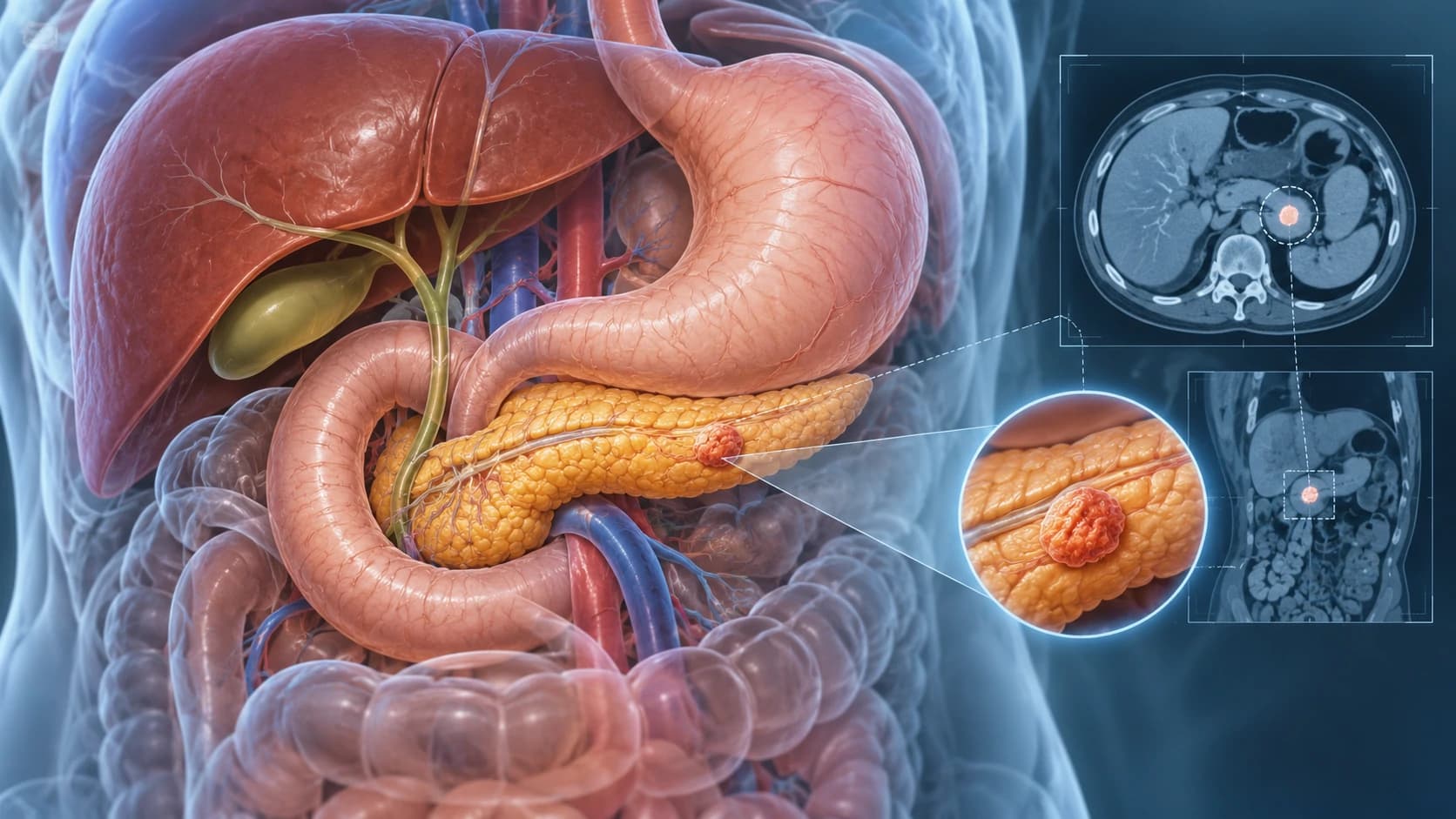
Key Takeaways
- •Pancreatic cancer incidence and mortality are projected to keep rising, placing it among the leading causes of cancer-related death in coming years.
- •Genomic studies suggest the ability to spread to distant organs often arises relatively late in a pancreatic tumor's genetic evolution, but by the time the cancer is detected, substantial genetic diversification has usually already occurred.
- •Nearly all pancreatic tumors carry a KRAS mutation along with disruptions to TP53 and other genes that normally restrain cell growth, removing multiple safeguards at once.
- •Many pancreatic tumors build a dense, scar-like tissue layer called desmoplasia that can compress blood vessels and limit how well chemotherapy reaches cancer cells.
- •The tissue environment surrounding pancreatic tumors is often immunosuppressive, limiting T cell infiltration and reducing the effectiveness of immunotherapy.
- •A small subpopulation of cells within pancreatic tumors, sometimes called cancer stem cells, may survive chemotherapy and contribute to tumor regrowth.
- •There is currently no reliable blood test or imaging method for early, population-wide detection of pancreatic cancer; CA 19-9 is useful for monitoring but not for screening.
- •Blood-based biomarkers derived from tumor-released exosomes are being investigated as a possible future early-detection tool, though this remains experimental.
Pancreatic cancer is rarely caught early. Most cases are diagnosed after the disease has already spread beyond the pancreas, when treatment options are far more limited. Researchers who track cancer statistics project that its burden will keep rising, placing it among the leading causes of cancer death in the years ahead. That trajectory isn't driven by one single problem. It reflects a tumor that is unusually good at hiding from diagnostic tools, resisting therapy once found, and evolving genetically long before most people notice anything is wrong.
Why Blood Tests and Scans Struggle to Catch It Early
There isn't yet a reliable blood test or scan that can flag pancreatic cancer at an early stage in people without symptoms. A protein called CA 19-9 sometimes rises in the blood of people who already have the disease, and doctors use it to help track how treatment is working. But it also rises in other, unrelated conditions, and some tumors don't produce it at all. That makes it too unreliable to use for screening healthy people.
This gap matters because of how the disease evolves inside the body. Genomic sequencing comparing a patient's original tumor with the separate growths that later appeared elsewhere in the body found that the specific cells capable of spreading to distant organs typically emerge years after the first cancer-causing mutations occur. A study led by pancreatic cancer researcher Christine Iacobuzio-Donahue and colleagues estimated that this ability to spread arises relatively late in the tumor's genetic lifespan. In theory, that leaves a window when the cancer exists but hasn't yet spread.
In practice, no detection method reliably reaches patients during that window. By the time symptoms appear and imaging finds something, the tumor has usually already built up substantial genetic diversity, and often already seeded distant sites. The gap between when the cancer would theoretically be catchable and when it is actually found is one of the central reasons outcomes remain poor.
Early Research Into New Warning Signs
Some investigational research is trying to close that gap. One approach has looked at exosomes, tiny particles that cells release into the bloodstream carrying fragments of protein and genetic material. A team led by cancer researcher Raghu Kalluri identified a specific protein on the surface of exosomes shed by pancreatic cancer cells, and found it could help distinguish samples from early-stage patients from those of healthy individuals. This work is still investigational and has not become a standard diagnostic tool, but it points toward a possible future where a blood sample could flag the disease before symptoms do.
The Genetic Blueprint Behind Its Aggressiveness
Nearly every pancreatic tumor carries a mutation in a gene called KRAS, which locks a cell's growth signal in the "on" position so it divides without normal restraint. Large-scale sequencing of pancreatic tumors found that alongside KRAS, a gene called TP53, which normally helps cells detect DNA damage and either repair it or self-destruct, is frequently disrupted as well. Two other genes that usually act as brakes on cell growth and division are also commonly knocked out. Together, these alterations form a core genetic signature found across the large majority of pancreatic cancers, rather than a single mutation explaining the disease on its own.
That combination matters because it disables several layers of cellular control at once. Losing one brake might slow a cell down elsewhere in the body. Losing several brakes at the same time, together with a stuck-on growth signal, removes multiple checks simultaneously. The resulting tumor isn't simply mutated in one place; it's systematically stripped of the safeguards that would normally catch and stop abnormal growth.
A Fortress Built From Scar Tissue
Beyond its genetics, pancreatic cancer builds a physical defense. Many pancreatic tumors surround themselves with an unusually thick layer of dense, scar-like tissue, a process known as desmoplasia. This tissue can make up a large share of a tumor's total mass, sometimes outweighing the cancer cells themselves.
That scar tissue does more than take up space. In mouse models of pancreatic cancer, this dense material compressed blood vessels within the tumor, restricting blood flow and limiting how much chemotherapy could actually reach the cancer cells. It behaves less like a wall surrounding a city and more like concrete poured into the city's own streets, squeezing shut the very vessels that would deliver the drug. When researchers experimentally disrupted a signaling pathway involved in building this tissue, drug delivery improved in those models, suggesting the stroma itself is a real obstacle rather than a passive bystander. Later reviews of stromal biology in pancreatic cancer have cautioned that the picture is more complicated than "more stroma is always worse," since this supportive tissue can have mixed effects depending on context.
How the Tumor Keeps the Immune System at Bay
The tissue surrounding a pancreatic tumor, known as the tumor microenvironment, does more than block drugs. It also works against the immune system. In many pancreatic cancers, this environment limits how many immune cells, particularly the T cells that would normally recognize and kill cancer cells, are able to get into the tumor and stay active once there.
This immunosuppressive quality helps explain why immunotherapy drugs, which have transformed treatment for several other cancers by releasing the brakes on T cells, have so far shown far more limited success against pancreatic cancer. The problem isn't that T cells can't be trained to recognize the tumor. It's that the terrain around the tumor makes it difficult for them to arrive and function. Researchers studying this barrier describe it as one of the central challenges for making immunotherapy work in this disease, alongside efforts to pair it with approaches that might open the tumor up.
Resistant Cells That Outlast Treatment
Even when chemotherapy does reach the tumor, it doesn't always eliminate it completely. Research has identified a small subpopulation of cells within pancreatic tumors, often called cancer stem cells, that appear to behave differently from the bulk of the tumor. These cells have been described as capable of surviving treatment and regenerating a tumor, somewhat like a weed that regrows from a root fragment left behind even after the visible plant has been cleared away.
This subpopulation offers one explanation for why chemotherapy can shrink a tumor yet still allow it to return later. It isn't yet established exactly how these cells differ at a molecular level across patients, or how central they are compared with other causes of recurrence. Still, their identification added a cellular dimension, not just a genetic one, to why treatment resistance is so persistent in this disease.
A Disease Defined by Layered Defenses
Late genetic evolution, a scarred physical barrier, an immune-dampening environment, and a resistant cellular reserve each explain part of why pancreatic cancer is so hard to catch and treat. None of them is the whole story alone. Together, they describe a tumor that is difficult to detect in time and difficult to fully eliminate once it is found.
Much of the research described here, from blood-based biomarkers to stroma-targeting strategies, remains investigational rather than part of routine care. But each line of inquiry targets a specific piece of this layered defense, and that is likely where any real improvement in outcomes will eventually have to come from.
Common Questions
References
- Kenneth P. Olive, Michael A. Jacobetz, Christian J. Davidson, Aarthi Gopinathan, Dominick McIntyre, Davina Honess, Basetti Madhu, Mae A. Goldgraben, Meredith E. Caldwell, David Allard, Kristopher K. Frese, Gina DeNicola, Christine Feig, Chelsea Combs, Stephen P. Winter, Heather Ireland-Zecchini, Stefanie Reichelt, William J. Howat, Alex Chang, Mousumi Dhara, Lifu Wang, Felix Rückert, Robert Grützmann, Christian Pilarsky, Kamel Izeradjene, Sunil R. Hingorani, Pearl Huang, Susan E. Davies, William Plunkett, Merrill Egorin, Ralph H. Hruban, Nigel Whitebread, Karen McGovern, Julian Adams, Christine Iacobuzio-Donahue, John Griffiths, David A. Tuveson (2009). Inhibition of Hedgehog Signaling Enhances Delivery of Chemotherapy in a Mouse Model of Pancreatic Cancer
- (2019). Stromal biology and therapy in pancreatic cancer: ready for clinical translation?
- Adham S. Bear, Robert H. Vonderheide, Mark H. O'Hara (2020). Challenges and Opportunities for Pancreatic Cancer Immunotherapy
- Shinichi Yachida, Siân Jones, Ivana Bozic, Tibor Antal, Rebecca Leary, Baojin Fu, Mihoko Kamiyama, Ralph H. Hruban, James R. Eshleman, Martin A. Nowak, Victor E. Velculescu, Kenneth W. Kinzler, Bert Vogelstein, Christine A. Iacobuzio-Donahue (2010). Distant metastasis occurs late during the genetic evolution of pancreatic cancer
- Siân Jones, Xiaosong Zhang, D. Williams Parsons, Jimmy Cheng-Ho Lin, Rebecca J. Leary, Philipp Angenendt, Parminder Mankoo, Hannah Carter, Hirohiko Kamiyama, Antonio Jimeno, Seung-Mo Hong, Baojin Fu, Ming-Tseh Lin, Eric S. Calhoun, Mihoko Kamiyama, Kimberly Walter, Tatiana Nikolskaya, Yuri Nikolsky, James Hartigan, Douglas R. Smith, Manuel Hidalgo, Steven D. Leach, Alison P. Klein, Elizabeth M. Jaffee, Michael Goggins, Anirban Maitra, Christine Iacobuzio-Donahue, James R. Eshleman, Scott E. Kern, Ralph H. Hruban, Rachel Karchin, Nickolas Papadopoulos, Giovanni Parmigiani, Bert Vogelstein, Victor E. Velculescu, Kenneth W. Kinzler (2008). Core Signaling Pathways in Human Pancreatic Cancers Revealed by Global Genomic Analyses
- Nicola Waddell, Marina Pajic, Ann-Marie Patch, David K. Chang, Karin S. Kassahn, Peter Bailey, Amber L. Johns, David Miller, Katia Nones, Kelly Quek, Michael C. J. Quinn, Alan J. Robertson, Muhammad Z. H. Fadlullah, Tim J. C. Bruxner, Angelika N. Christ, Ivon Harliwong, Senel Idrisoglu, Suzanne Manning, Craig Nourse, Ehsan Nourbakhsh, Shivangi Wani, Peter J. Wilson, Emma Markham, Nicole Cloonan, Matthew J. Anderson, J. Lynn Fink, Oliver Holmes, Stephen H. Kazakoff, Conrad Leonard, Felicity Newell, Barsha Poudel, Sarah Song, Darrin Taylor, Nick Waddell, Scott Wood, Qinying Xu, Jianmin Wu, Mark Pinese, Mark J. Cowley, Hong C. Lee, Marc D. Jones, Adnan M. Nagrial, Jeremy Humphris, Lorraine A. Chantrill, Venessa Chin, Angela M. Steinmann, Amanda Mawson, Emily S. Humphrey, Emily K. Colvin, Angela Chou, Christopher J. Scarlett, Andreia V. Pinho, Marc Giry-Laterriere, Ilse Rooman, Jaswinder S. Samra, James G. Kench, Jessica A. Pettitt, Neil D. Merrett, Christopher Toon, Krishna Epari, Nam Q. Nguyen, Andrew Barbour, Nikolajs Zeps, Nigel B. Jamieson, Janet S. Graham, Simone P. Niclou, Rolf Bjerkvig, Robert Grützmann, Daniela Aust, Ralph H. Hruban, Anirban Maitra, Christine A. Iacobuzio-Donahue, Christopher L. Wolfgang, Richard A. Morgan, Rita T. Lawlor, Vincenzo Corbo, Claudio Bassi, Massimo Falconi, Giuseppe Zamboni, Giampaolo Tortora, Margaret A. Tempero, Anthony J. Gill, James R. Eshleman, Christian Pilarsky, Aldo Scarpa, Elizabeth A. Musgrove, John V. Pearson, Andrew V. Biankin, Sean M. Grimmond (2015). Whole genomes redefine the mutational landscape of pancreatic cancer
- Chenwei Li, David G. Heidt, Piero Dalerba, Charles F. Burant, Lanjing Zhang, Volkan Adsay, Max Wicha, Michael F. Clarke, Diane M. Simeone (2007). Identification of Pancreatic Cancer Stem Cells
- Lola Rahib, Benjamin D. Smith, Rhonda Aizenberg, Allison B. Rosenzweig, Julie M. Fleshman, Lynn M. Matrisian (2014). Projecting Cancer Incidence and Deaths to 2030: The Unexpected Burden of Thyroid, Liver, and Pancreas Cancers in the United States
- Sonia A. Melo, Linda B. Luecke, Christoph Kahlert, Agustin F. Fernandez, Seth T. Gammon, Judith Kaye, Valerie S. LeBleu, Elizabeth A. Mittendorf, Juergen Weitz, Nuh Rahbari, Christoph Reissfelder, Christian Pilarsky, Mario F. Fraga, David Piwnica-Worms, Raghu Kalluri (2015). Glypican-1 identifies cancer exosomes and detects early pancreatic cancer
Team Review: This article has been reviewed by Canceria Research Team