How Gut Bacteria Can Shape Cancer Risk and Treatment Success
Specific microbes in the digestive tract appear to influence colon tumor growth and how well immunotherapy and chemotherapy work.
Key Takeaways
- •Certain gut bacteria, including Fusobacterium nucleatum and a toxin-producing strain of Bacteroides fragilis, are linked to colorectal tumor development through specific inflammatory and growth-signaling mechanisms.
- •Bacterial biofilms containing tumor-promoting species have been found in the colons of patients with a hereditary colorectal cancer syndrome, suggesting bacterial clustering may matter alongside individual species.
- •Fusobacterium nucleatum has also been linked to resistance to chemotherapy in colorectal cancer, not just to how tumors start.
- •Short-chain fatty acids like butyrate, produced when gut bacteria ferment fiber, help generate regulatory T cells that keep immune responses balanced.
- •Multiple human studies have found that gut bacterial composition is associated with how well patients respond to anti-PD-1 immune checkpoint inhibitor therapy.
- •In animal studies, the antitumor effects of both CTLA-4 checkpoint blockade and the chemotherapy drug cyclophosphamide depended on the presence of specific gut bacteria.
- •Antibiotic use around the time of checkpoint inhibitor treatment has been associated with reduced treatment efficacy and worse survival in observational studies.
- •Early clinical trials have shown that fecal microbiota transplantation can restore immunotherapy response in some previously non-responsive melanoma patients, but this remains an investigational approach, not a standard treatment.
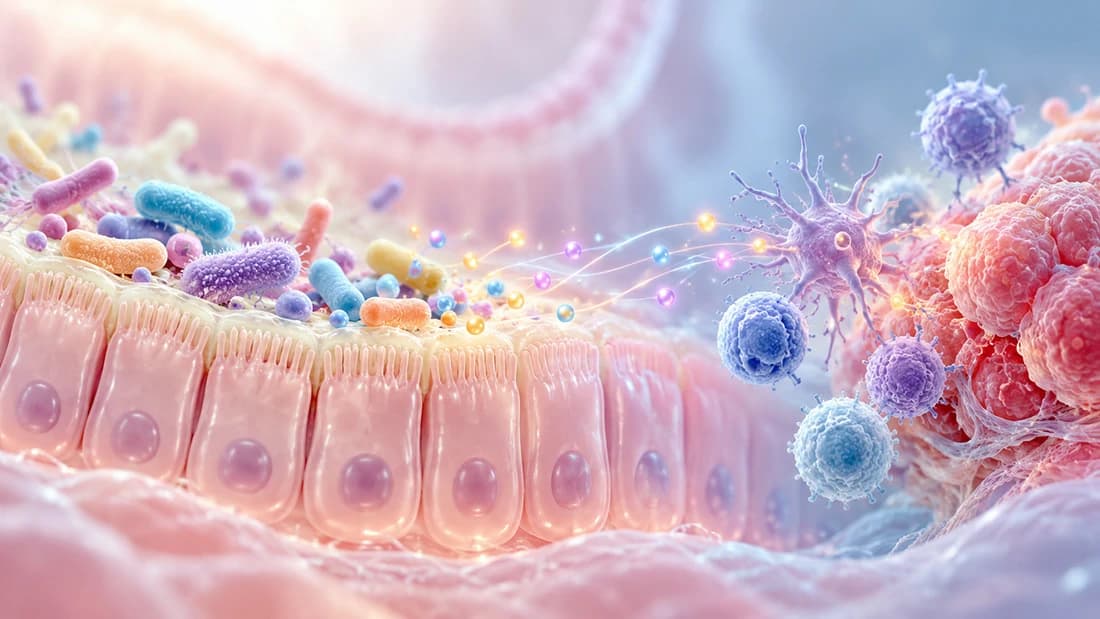
Trillions of bacteria live inside the human gut, quietly shaping digestion, metabolism, and immune function. Over the past decade and a half, researchers have found that this community, known as the gut microbiome, also has a surprising relationship with cancer. Some gut bacteria appear to help tumors get started. Others seem to help the immune system fight tumors once they exist, including during treatment with modern immunotherapy drugs. The picture is still incomplete, but a handful of specific findings have held up well enough to anchor how scientists think about the connection.
When Gut Bacteria Help Start a Tumor
One bacterium has drawn more attention than any other in this field: Fusobacterium nucleatum. It normally lives in the mouth, but it turns up at much higher levels inside colorectal tumor tissue than in healthy colon tissue. That alone would only be a correlation. What makes the finding mechanistic is a specific molecule the bacterium carries that latches onto a protein on the surface of colon cells, a protein that normally helps cells stick together and behave in an orderly way. When the bacterial molecule binds it, a growth-signaling pathway inside the cell switches on, pushing colon cells to divide more than they should.
Fusobacterium is not the only culprit. A specific strain of Bacteroides fragilis, a bacterium that is usually a harmless member of the gut community, can produce a toxin that provokes a particular kind of inflammatory immune response in the colon lining. In mouse studies, this toxin-producing strain accelerated colon tumor formation by activating immune cells that promote inflammation rather than calm it down.
Work from Cynthia Sears's laboratory, which first linked this toxin-producing strain to colon tumors, later found something related in people. Patients with a hereditary condition called familial adenomatous polyposis, who face very high lifetime risk of colorectal cancer, often carry colonies of bacteria clustered together on the gut lining in structures called biofilms. These biofilms can include the same tumor-promoting species found in mice. Their presence in a high-risk population suggests bacterial clustering, not just individual species, may matter for how tumors arise in the colon.
A Second Problem: Bacteria That Help Tumors Resist Treatment
Fusobacterium's role does not necessarily end once a tumor exists. Research in colorectal cancer tissue found that it can also help tumor cells survive chemotherapy. The bacterium appears to do this by influencing a built-in cellular process that lets stressed cells recycle damaged parts and survive rather than die. In colorectal cancer samples, a stronger Fusobacterium presence tracked with greater resistance to standard chemotherapy drugs. That pattern suggests the same organism implicated in starting some colon tumors may also make them harder to treat later.
How Gut Bacteria Train the Immune System
To understand why bacteria matter for treatments that rely on the immune system, it helps to look at a far more routine microbial job: digesting fiber. When gut bacteria ferment dietary fiber, they produce small molecules called short-chain fatty acids, including one called butyrate. Butyrate is not just a metabolic byproduct. It signals to immune cells in the colon lining and encourages a subset of them, regulatory T cells, to develop.
Regulatory T cells act something like a brake pedal for the immune system, keeping inflammation from spiraling out of control. This single mechanism illustrates a broader theme in the field. Gut bacteria do not just occupy space in the digestive tract; they actively shape how calm or reactive the immune system is, with consequences that reach far beyond the gut itself.
Gut Bacteria and the Success of Immunotherapy
That immune-shaping role becomes clinically important with immune checkpoint inhibitors, a class of cancer drugs that work by releasing natural brakes on the immune system so it can attack tumor cells. Several independent studies, published around the same time, found that cancer patients with certain gut bacterial profiles were more likely to respond to anti-PD-1 checkpoint inhibitor treatment, across different tumor types including melanoma and epithelial cancers. One of these studies, led by a research team including Jennifer Wargo, profiled patients' gut bacteria alongside detailed immune analysis of their tumors. A more diverse, favorable bacterial community lined up with stronger immune activity inside the tumor itself.
The relationship is not limited to anti-PD-1 drugs. In mice, the antitumor effect of CTLA-4 checkpoint blockade, a related immunotherapy, depended heavily on the presence of specific gut bacteria. Animals raised without a normal gut bacterial community responded far more poorly to the same treatment. Separately, researchers found that adding a particular type of beneficial bacterium, Bifidobacterium, to the gut community of mice improved tumor control during treatment with a related checkpoint drug, apparently by boosting the ability of certain immune cells to alert the rest of the immune system to the tumor's presence.
Taken together, these preclinical and clinical findings point toward the same idea from different directions. The gut microbiome appears to influence whether checkpoint immunotherapy succeeds, although exactly which bacteria matter, and why, still varies somewhat between studies.
Chemotherapy, Antibiotics, and the Microbiome
Checkpoint inhibitors are not the only treatments affected. In mice, the chemotherapy drug cyclophosphamide works partly by allowing certain gut bacteria to move out of the intestine and stimulate immune cells elsewhere in the body. When those bacteria were eliminated, the drug's antitumor immune effects weakened. This suggests that some chemotherapy benefits, not only immunotherapy benefits, may depend on an intact gut bacterial community.
That dependency raises a practical concern: antibiotics. Several studies in cancer patients have found that antibiotic use around the time of checkpoint inhibitor treatment is associated with worse responses and shorter survival, a pattern consistent enough across patient groups to be taken seriously. The likely explanation is that broad-spectrum antibiotics disrupt the same bacterial populations that otherwise support immune activity. This does not mean antibiotics should be avoided when they are medically necessary; infections in cancer patients still need to be treated, and any change to antibiotic use should be made only in consultation with the treating oncology team.
Testing Whether the Microbiome Can Be Changed
If gut bacteria shape immunotherapy response, an obvious next question is whether changing a patient's microbiome could help those who are not responding. Two separate clinical teams tested this directly, using fecal microbiota transplantation, a procedure that transfers processed stool, and the bacteria in it, from a donor into a patient's digestive tract. In both trials, patients with advanced melanoma who had stopped responding to anti-PD-1 therapy received a transplant from a patient who had previously responded well to the same treatment. In a subset of these previously resistant patients, tumors began responding again after the transplant.
These results are genuinely striking, but they come from early-phase clinical trials involving small numbers of patients. Fecal microbiota transplantation for this purpose remains an investigational approach under active study, not an approved cancer treatment. It would not be appropriate for patients to pursue outside a clinical trial setting.
What the Evidence Does and Doesn't Show
Taken as a whole, this research describes a field that is active, biologically plausible, and still maturing. The gut microbiome's links to cancer risk, chemotherapy response, and immunotherapy outcomes are supported by a mix of laboratory, animal, and human studies. Much of the human evidence remains observational, showing association rather than strict proof of cause and effect in every case.
No probiotic, supplement, or specific diet has been shown to reliably change cancer risk or treatment outcomes in the way these mechanistic studies might suggest, and attempting to do so without medical guidance carries no established benefit. For now, the clearest message is that gut bacteria are a genuine participant in how cancer develops and how certain treatments perform. That is exactly why researchers continue to study whether the microbiome can be measured, monitored, or safely adjusted to help patients in the future.
Common Questions
References
- Mara Roxana Rubinstein, Xiaowei Wang, Wendy Liu, Yujun Hao, Guifang Cai, Yiping W. Han (2013). Fusobacterium nucleatum Promotes Colorectal Carcinogenesis by Modulating E-Cadherin/β-Catenin Signaling via its FadA Adhesin
- Shaoguang Wu, Ki-Jong Rhee, Emilia Albesiano, Shervin Rabizadeh, Xinqun Wu, Hung-Rong Yen, David L Huso, Frederick L Brancati, Elizabeth Wick, Florencia McAllister, Franck Housseau, Drew M Pardoll, Cynthia L Sears (2009). A human colonic commensal promotes colon tumorigenesis via activation of T helper type 17 T cell responses
- (2018). Re: Gut Microbiome Influences Efficacy of PD-1-based Immunotherapy Against Epithelial Tumors.
- V. Gopalakrishnan, C. N. Spencer, L. Nezi, A. Reuben, M. C. Andrews, T. V. Karpinets, P. A. Prieto, D. Vicente, K. Hoffman, S. C. Wei, A. P. Cogdill, L. Zhao, C. W. Hudgens, D. S. Hutchinson, T. Manzo, M. Petaccia de Macedo, T. Cotechini, T. Kumar, W. S. Chen, S. M. Reddy, R. Szczepaniak Sloane, J. Galloway-Pena, H. Jiang, P. L. Chen, E. J. Shpall, K. Rezvani, A. M. Alousi, R. F. Chemaly, S. Shelburne, L. M. Vence, P. C. Okhuysen, V. B. Jensen, A. G. Swennes, F. McAllister, E. Marcelo Riquelme Sanchez, Y. Zhang, E. Le Chatelier, L. Zitvogel, N. Pons, J. L. Austin-Breneman, L. E. Haydu, E. M. Burton, J. M. Gardner, E. Sirmans, J. Hu, A. J. Lazar, T. Tsujikawa, A. Diab, H. Tawbi, I. C. Glitza, W. J. Hwu, S. P. Patel, S. E. Woodman, R. N. Amaria, M. A. Davies, J. E. Gershenwald, P. Hwu, J. E. Lee, J. Zhang, L. M. Coussens, Z. A. Cooper, P. A. Futreal, C. R. Daniel, N. J. Ajami, J. F. Petrosino, M. T. Tetzlaff, P. Sharma, J. P. Allison, R. R. Jenq, J. A. Wargo (2018). Gut microbiome modulates response to anti–PD-1 immunotherapy in melanoma patients
- Vyara Matson, Jessica Fessler, Riyue Bao, Tara Chongsuwat, Yuanyuan Zha, Maria-Luisa Alegre, Jason J. Luke, Thomas F. Gajewski (2018). The commensal microbiome is associated with anti–PD-1 efficacy in metastatic melanoma patients
- Marie Vétizou, Jonathan M. Pitt, Romain Daillère, Patricia Lepage, Nadine Waldschmitt, Caroline Flament, Sylvie Rusakiewicz, Bertrand Routy, Maria P. Roberti, Connie P. M. Duong, Vichnou Poirier-Colame, Antoine Roux, Sonia Becharef, Silvia Formenti, Encouse Golden, Sascha Cording, Gerard Eberl, Andreas Schlitzer, Florent Ginhoux, Sridhar Mani, Takahiro Yamazaki, Nicolas Jacquelot, David P. Enot, Marion Bérard, Jérôme Nigou, Paule Opolon, Alexander Eggermont, Paul-Louis Woerther, Elisabeth Chachaty, Nathalie Chaput, Caroline Robert, Christina Mateus, Guido Kroemer, Didier Raoult, Ivo Gomperts Boneca, Franck Carbonnel, Mathias Chamaillard, Laurence Zitvogel (2015). Anticancer immunotherapy by CTLA-4 blockade relies on the gut microbiota
- Sophie Viaud, Fabiana Saccheri, Grégoire Mignot, Takahiro Yamazaki, Romain Daillère, Dalil Hannani, David P. Enot, Christina Pfirschke, Camilla Engblom, Mikael J. Pittet, Andreas Schlitzer, Florent Ginhoux, Lionel Apetoh, Elisabeth Chachaty, Paul-Louis Woerther, Gérard Eberl, Marion Bérard, Chantal Ecobichon, Dominique Clermont, Chantal Bizet, Valérie Gaboriau-Routhiau, Nadine Cerf-Bensussan, Paule Opolon, Nadia Yessaad, Eric Vivier, Bernhard Ryffel, Charles O. Elson, Joël Doré, Guido Kroemer, Patricia Lepage, Ivo Gomperts Boneca, François Ghiringhelli, Laurence Zitvogel (2013). The Intestinal Microbiota Modulates the Anticancer Immune Effects of Cyclophosphamide
- Erez N. Baruch, Ilan Youngster, Guy Ben-Betzalel, Rona Ortenberg, Adi Lahat, Lior Katz, Katerina Adler, Daniela Dick-Necula, Stephen Raskin, Naamah Bloch, Daniil Rotin, Liat Anafi, Camila Avivi, Jenny Melnichenko, Yael Steinberg-Silman, Ronac Mamtani, Hagit Harati, Nethanel Asher, Ronnie Shapira-Frommer, Tal Brosh-Nissimov, Yael Eshet, Shira Ben-Simon, Oren Ziv, Md Abdul Wadud Khan, Moran Amit, Nadim J. Ajami, Iris Barshack, Jacob Schachter, Jennifer A. Wargo, Omry Koren, Gal Markel, Ben Boursi (2021). Fecal microbiota transplant promotes response in immunotherapy-refractory melanoma patients
- Diwakar Davar, Amiran K. Dzutsev, John A. McCulloch, Richard R. Rodrigues, Joe-Marc Chauvin, Robert M. Morrison, Richelle N. Deblasio, Carmine Menna, Quanquan Ding, Ornella Pagliano, Bochra Zidi, Shuowen Zhang, Jonathan H. Badger, Marie Vetizou, Alicia M. Cole, Miriam R. Fernandes, Stephanie Prescott, Raquel G. F. Costa, Ascharya K. Balaji, Andrey Morgun, Ivan Vujkovic-Cvijin, Hong Wang, Amir A. Borhani, Marc B. Schwartz, Howard M. Dubner, Scarlett J. Ernst, Amy Rose, Yana G. Najjar, Yasmine Belkaid, John M. Kirkwood, Giorgio Trinchieri, Hassane M. Zarour (2021). Fecal microbiota transplant overcomes resistance to anti–PD-1 therapy in melanoma patients
- Yukihiro Furusawa, Yuuki Obata, Shinji Fukuda, Takaho A. Endo, Gaku Nakato, Daisuke Takahashi, Yumiko Nakanishi, Chikako Uetake, Keiko Kato, Tamotsu Kato, Masumi Takahashi, Noriko N. Fukuda, Shinnosuke Murakami, Eiji Miyauchi, Shingo Hino, Koji Atarashi, Satoshi Onawa, Yumiko Fujimura, Trevor Lockett, Julie M. Clarke, David L. Topping, Masaru Tomita, Shohei Hori, Osamu Ohara, Tatsuya Morita, Haruhiko Koseki, Jun Kikuchi, Kenya Honda, Koji Hase, Hiroshi Ohno (2013). Commensal microbe-derived butyrate induces the differentiation of colonic regulatory T cells
- David J. Pinato, Sarah Howlett, Diego Ottaviani, Heather Urus, Aisha Patel, Takashi Mineo, Cathryn Brock, Danielle Power, Olivia Hatcher, Alison Falconer, Manasi Ingle, Anna Brown, Dorothy Gujral, Sarah Partridge, Naveed Sarwar, Michael Gonzalez, Maggie Bendle, Conrad Lewanski, Thomas Newsom-Davis, Elias Allara, Mark Bower (2019). Association of Prior Antibiotic Treatment With Survival and Response to Immune Checkpoint Inhibitor Therapy in Patients With Cancer
- Bertrand Routy, Emmanuelle Le Chatelier, Lisa Derosa, Connie P. M. Duong, Maryam Tidjani Alou, Romain Daillère, Aurélie Fluckiger, Meriem Messaoudene, Conrad Rauber, Maria P. Roberti, Marine Fidelle, Caroline Flament, Vichnou Poirier-Colame, Paule Opolon, Christophe Klein, Kristina Iribarren, Laura Mondragón, Nicolas Jacquelot, Bo Qu, Gladys Ferrere, Céline Clémenson, Laura Mezquita, Jordi Remon Masip, Charles Naltet, Solenn Brosseau, Coureche Kaderbhai, Corentin Richard, Hira Rizvi, Florence Levenez, Nathalie Galleron, Benoit Quinquis, Nicolas Pons, Bernhard Ryffel, Véronique Minard-Colin, Patrick Gonin, Jean-Charles Soria, Eric Deutsch, Yohann Loriot, François Ghiringhelli, Gérard Zalcman, François Goldwasser, Bernard Escudier, Matthew D. Hellmann, Alexander Eggermont, Didier Raoult, Laurence Albiges, Guido Kroemer, Laurence Zitvogel (2018). Gut microbiome influences efficacy of PD-1–based immunotherapy against epithelial tumors
- Ayelet Sivan, Leticia Corrales, Nathaniel Hubert, Jason B. Williams, Keston Aquino-Michaels, Zachary M. Earley, Franco W. Benyamin, Yuk Man Lei, Bana Jabri, Maria-Luisa Alegre, Eugene B. Chang, Thomas F. Gajewski (2015). Commensal Bifidobacterium promotes antitumor immunity and facilitates anti–PD-L1 efficacy
- Christine M. Dejea, Payam Fathi, John M. Craig, Annemarie Boleij, Rahwa Taddese, Abby L. Geis, Xinqun Wu, Christina E. DeStefano Shields, Elizabeth M. Hechenbleikner, David L. Huso, Robert A. Anders, Francis M. Giardiello, Elizabeth C. Wick, Hao Wang, Shaoguang Wu, Drew M. Pardoll, Franck Housseau, Cynthia L. Sears (2018). Patients with familial adenomatous polyposis harbor colonic biofilms containing tumorigenic bacteria
- (2017). Fusobacterium nucleatum Promotes Chemoresistance to Colorectal Cancer by Modulating Autophagy.
- Beth A. Helmink, M. A. Wadud Khan, Amanda Hermann, Vancheswaran Gopalakrishnan, Jennifer A. Wargo (2019). The microbiome, cancer, and cancer therapy
Team Review: This article has been reviewed by Canceria Research Team