When Cancer Depends on One Gene: The Science of Oncogene Addiction and Drug Resistance
How a single mutated gene can make tumors shrink dramatically, and why cancer cells often find a way around the drugs built to block it
Key Takeaways
- •Oncogene addiction describes cancer cells that depend so heavily on one dominant mutated gene that blocking it can trigger rapid cell death, despite the tumor carrying many other genetic abnormalities.
- •Animal studies turning off the MYC oncogene caused tumor regression, offering direct experimental evidence that a single gene can control a tumor's survival.
- •Imatinib's effect on BCR-ABL-driven chronic myeloid leukemia, and EGFR-, ALK-, BRAF-, and HER2-targeted drugs in other cancers, are real-world examples of oncogene addiction being successfully exploited.
- •A model called oncogenic shock proposes that targeted drugs cut off a cancer cell's survival signal faster than its growth machinery can adapt, which may explain unusually rapid treatment responses.
- •Resistance frequently arises through gatekeeper mutations, such as secondary changes in BCR-ABL or EGFR, that physically block the drug from binding its target.
- •Cancer cells can also bypass a blocked target entirely through mechanisms like MET gene amplification or MAPK pathway reactivation, rerouting growth signals around the drug.
- •Tumors are genetically diverse, and resistant cell populations may already exist before treatment begins, allowing them to expand once drug-sensitive cells are eliminated.
- •Resistance is a common pattern across multiple cancer types and targeted drugs, though its timing and mechanism vary by cancer type, mutation, and individual patient biology.
A tumor can carry hundreds of genetic mistakes. Yet in some cancers, one single mutated gene seems to matter far more than all the others combined. Knock that one gene out, and the cancer cell doesn't just slow down. It can die.
A Tumor's One Weak Spot
This dependency has a name: oncogene addiction. It describes a cancer cell that has become so reliant on one dominant growth signal that losing it is catastrophic, even though the cell still carries many other abnormalities. Think of a building with a dozen structural flaws that nonetheless stays standing, as long as one particular support beam holds. Remove that beam, and everything else stops mattering. The idea was first laid out clearly in the early 2000s, framing a single oncogene as cancer's own vulnerable spot rather than just another feature of a chaotic genome.
Proof From a Mouse and a Pill
The strongest early evidence came from animal experiments. Researchers engineered mice whose tumors depended on an overactive version of a gene called MYC, a master switch that normally tells cells when to grow and divide. When MYC was experimentally switched off, tumors didn't just stop growing. They regressed, and in some cases disappeared. That was a striking demonstration that a single gene, when it is the right one, can hold a tumor's fate.
The human proof came soon after, in a disease called chronic myeloid leukemia. Nearly every case of this leukemia is driven by a single abnormal fusion protein called BCR-ABL, created when two chromosomes swap pieces and fuse two genes together. A drug called imatinib was designed to block BCR-ABL specifically. In clinical trials, it produced remission rates that were, at the time, unheard of for a targeted pill. It remains one of the clearest real-world examples of oncogene addiction working exactly as the concept predicts.
When the Right Mutation Predicts the Right Drug
The same pattern later showed up across other cancers, each tied to its own driver mutation: a genetic change that actively fuels growth rather than just riding along. In non-small cell lung cancer, tumors carrying activating mutations in a gene called EGFR responded dramatically to EGFR-blocking drugs such as gefitinib, while tumors without the mutation largely did not. A related lung cancer subset, defined by a rearranged gene called ALK, responded strongly to ALK-targeted drugs like crizotinib. In melanoma, tumors carrying a specific mutation in the BRAF gene, known as V600E, responded to BRAF inhibitors such as vemurafenib with measurable survival benefit. And in breast cancer, tumors with extra copies of the HER2 gene responded to the HER2-targeted antibody trastuzumab. Four different cancers, four different genes, but the same underlying logic: find the one gene the tumor can't live without, then block it.
Why the Response Can Feel So Sudden
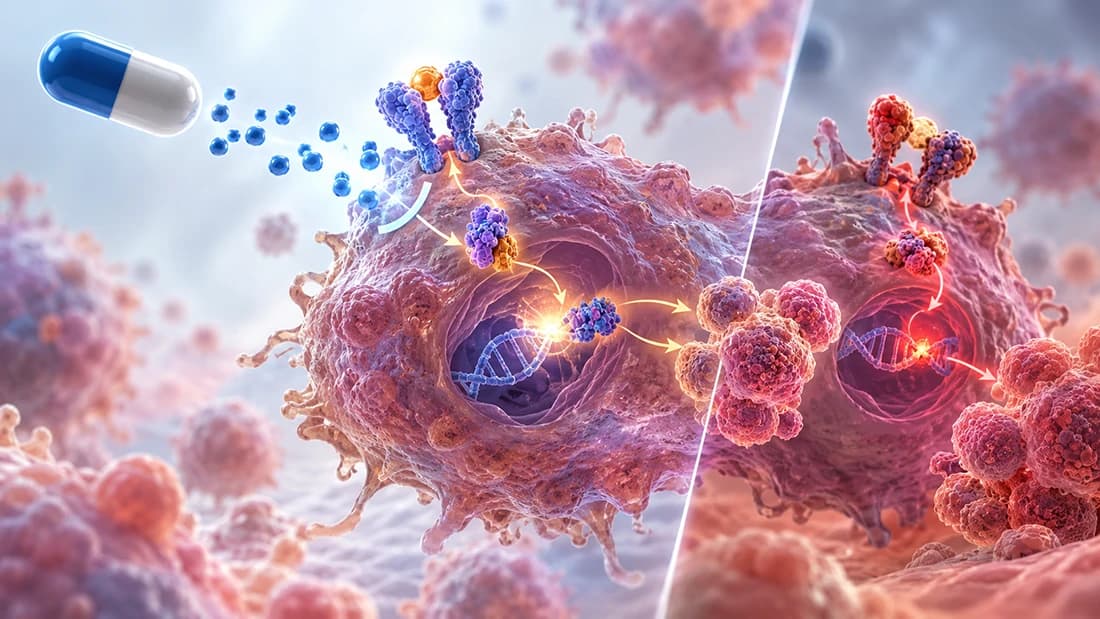
What makes these responses striking clinically is often their speed. Tumors can begin shrinking within days of starting a targeted drug, far faster than the slow attrition typical of older chemotherapies. One proposed explanation is called oncogenic shock. The idea is that cancer cells depend on their driver oncogene for two separate things at once: a steady survival signal, and a growth signal. When the drug hits, the survival signal collapses almost immediately, while the machinery that would otherwise keep the cell alive hasn't had time to adapt. The mismatch tips the cell into programmed self-destruction, a process called apoptosis. That timing gap, rather than a gradual starvation of the tumor, may explain why some responses look less like slow decline and more like a switch being flipped.
How Resistance Creeps Back In
The dramatic part of the story rarely ends the way patients and doctors hope. In chronic myeloid leukemia, resistance to imatinib commonly traces back to new point mutations inside the BCR-ABL protein itself, changes that subtly reshape the spot where the drug needs to bind. If the drug can no longer attach properly, it can no longer block the signal. A closely related pattern shows up in EGFR-mutant lung cancer, where resistance frequently involves a second mutation at what's called the gatekeeper position, a specific spot in the protein that normally controls access to its active site. A gatekeeper mutation effectively changes the shape of the doorway so the drug no longer fits, even though the original driver mutation, and the cancer's dependence on it, is often still there.
Rerouting Around the Blockade
Not all resistance works by changing the lock. Sometimes the cancer cell finds a detour instead. This is called bypass signaling: a different route to the same destination, even while the original target stays fully blocked. In some EGFR-mutant lung cancers, resistance develops when cells amplify a separate gene called MET, which switches on a parallel signaling pathway that achieves the same growth-promoting effect the EGFR drug was trying to shut down. Something analogous happens in BRAF-mutant melanoma, where resistant cells can reactivate the same downstream growth pathway through other mutations, or by boosting a different kinase that takes over the job the blocked protein used to do. In both cases, the drug is still doing exactly what it was designed to do. The cell has simply stopped needing that particular door to stay alive.
The Tumor Was Never Just One Thing
Underlying both of these resistance patterns is a deeper and older observation: tumors are not single, uniform populations of identical cells. This idea of clonal evolution, first proposed decades ago and refined substantially since, holds that a tumor is more like a mixed population constantly competing and changing, with better-adapted cells gradually taking over. Applied to resistance, this means a small number of cells carrying a resistance mutation, or a bypass pathway already switched on, may exist in a tumor before treatment even begins. The drug doesn't need to create these cells. It only needs to clear away their drug-sensitive neighbors, leaving the resistant minority free to expand. Genetically diverse tumors appear to have more raw material for this kind of selection to act on, which may help explain why resistance timelines vary so much between patients and cancer types.
None of this makes resistance a guaranteed outcome for any individual person, and the pace and pattern of resistance differ across cancer types, specific mutations, and treatment histories. What the research consistently shows is that oncogene addiction and resistance are two sides of the same biological coin. The very narrowness that makes a tumor so exploitable by a single drug is also what gives a handful of pre-existing or newly acquired changes the power to restore its survival. Understanding exactly how that happens, gene by gene and cancer by cancer, remains one of the more active areas connecting laboratory research to the choices made in oncology clinics today.
Common Questions
References
- I. Bernard Weinstein (2002). Addiction to Oncogenes--the Achilles Heal of Cancer
- Dean W. Felsher, J.Michael Bishop (1999). Reversible Tumorigenesis by MYC in Hematopoietic Lineages
- Brian J. Druker, Moshe Talpaz, Debra J. Resta, Bin Peng, Elisabeth Buchdunger, John M. Ford, Nicholas B. Lydon, Hagop Kantarjian, Renaud Capdeville, Sayuri Ohno-Jones, Charles L. Sawyers (2001). Efficacy and Safety of a Specific Inhibitor of the BCR-ABL Tyrosine Kinase in Chronic Myeloid Leukemia
- Thomas J. Lynch, Daphne W. Bell, Raffaella Sordella, Sarada Gurubhagavatula, Ross A. Okimoto, Brian W. Brannigan, Patricia L. Harris, Sara M. Haserlat, Jeffrey G. Supko, Frank G. Haluska, David N. Louis, David C. Christiani, Jeff Settleman, Daniel A. Haber (2004). Activating Mutations in the Epidermal Growth Factor Receptor Underlying Responsiveness of Non–Small-Cell Lung Cancer to Gefitinib
- Mercedes E. Gorre, Mansoor Mohammed, Katharine Ellwood, Nicholas Hsu, Ron Paquette, P. Nagesh Rao, Charles L. Sawyers (2001). Clinical Resistance to STI-571 Cancer Therapy Caused by BCR-ABL Gene Mutation or Amplification
- William Pao, Vincent A Miller, Katerina A Politi, Gregory J Riely, Romel Somwar, Maureen F Zakowski, Mark G Kris, Harold Varmus (2005). Acquired Resistance of Lung Adenocarcinomas to Gefitinib or Erlotinib Is Associated with a Second Mutation in the EGFR Kinase Domain
- Jeffrey A. Engelman, Kreshnik Zejnullahu, Tetsuya Mitsudomi, Youngchul Song, Courtney Hyland, Joon Oh Park, Neal Lindeman, Christopher-Michael Gale, Xiaojun Zhao, James Christensen, Takayuki Kosaka, Alison J. Holmes, Andrew M. Rogers, Federico Cappuzzo, Tony Mok, Charles Lee, Bruce E. Johnson, Lewis C. Cantley, Pasi A. Jänne (2007). MET Amplification Leads to Gefitinib Resistance in Lung Cancer by Activating ERBB3 Signaling
- Paul B. Chapman, Axel Hauschild, Caroline Robert, John B. Haanen, Paolo Ascierto, James Larkin, Reinhard Dummer, Claus Garbe, Alessandro Testori, Michele Maio, David Hogg, Paul Lorigan, Celeste Lebbe, Thomas Jouary, Dirk Schadendorf, Antoni Ribas, Steven J. O'Day, Jeffrey A. Sosman, John M. Kirkwood, Alexander M.M. Eggermont, Brigitte Dreno, Keith Nolop, Jiang Li, Betty Nelson, Jeannie Hou, Richard J. Lee, Keith T. Flaherty, Grant A. McArthur (2011). Improved Survival with Vemurafenib in Melanoma with BRAF V600E Mutation
- (2010). COT drives resistance to RAF inhibition through MAP kinase pathway reactivation.
- Peter C. Nowell (1976). The Clonal Evolution of Tumor Cell Populations
- Rebecca A Burrell, Charles Swanton (2014). The evolution of the unstable cancer genome
- Manabu Soda, Young Lim Choi, Munehiro Enomoto, Shuji Takada, Yoshihiro Yamashita, Shunpei Ishikawa, Shin-ichiro Fujiwara, Hideki Watanabe, Kentaro Kurashina, Hisashi Hatanaka, Masashi Bando, Shoji Ohno, Yuichi Ishikawa, Hiroyuki Aburatani, Toshiro Niki, Yasunori Sohara, Yukihiko Sugiyama, Hiroyuki Mano (2007). Identification of the transforming EML4–ALK fusion gene in non-small-cell lung cancer
- Eunice L. Kwak, Yung-Jue Bang, D. Ross Camidge, Alice T. Shaw, Benjamin Solomon, Robert G. Maki, Sai-Hong I. Ou, Bruce J. Dezube, Pasi A. Jänne, Daniel B. Costa, Marileila Varella-Garcia, Woo-Ho Kim, Thomas J. Lynch, Panos Fidias, Hannah Stubbs, Jeffrey A. Engelman, Lecia V. Sequist, WeiWei Tan, Leena Gandhi, Mari Mino-Kenudson, Greg C. Wei, S. Martin Shreeve, Mark J. Ratain, Jeffrey Settleman, James G. Christensen, Daniel A. Haber, Keith Wilner, Ravi Salgia, Geoffrey I. Shapiro, Jeffrey W. Clark, A. John Iafrate (2010). Anaplastic Lymphoma Kinase Inhibition in Non–Small-Cell Lung Cancer
- Dennis J. Slamon, Brian Leyland-Jones, Steven Shak, Hank Fuchs, Virginia Paton, Alex Bajamonde, Thomas Fleming, Wolfgang Eiermann, Janet Wolter, Mark Pegram, Jose Baselga, Larry Norton (2001). Use of Chemotherapy plus a Monoclonal Antibody against HER2 for Metastatic Breast Cancer That Overexpresses HER2
- Sreenath V. Sharma, Michael A. Fischbach, Daniel A. Haber, Jeffrey Settleman (2006). “Oncogenic Shock”: Explaining Oncogene Addiction through Differential Signal Attenuation
Team Review: This article has been reviewed by Canceria Research Team