Why Some Cancer Cells Run on Oxygen Instead of Sugar
New research complicates the classic Warburg effect, showing that stem-like, drug-resistant, and metastatic cancer cells often depend on oxidative phosphorylation rather than glycolysis alone.
Key Takeaways
- •Otto Warburg's original observation that cancer cells favor glycolysis even with oxygen present became known as the Warburg effect, shaping decades of cancer metabolism research.
- •Using glycolysis does not mean a cancer cell's mitochondria are broken; many tumor cells retain fully functional oxidative phosphorylation capacity.
- •Leukemia stem cells and glioma stem cells have been shown in laboratory studies to depend more on oxidative phosphorylation than on glycolysis.
- •Pancreatic cancer cells that survive oncogene-targeted treatment can shift toward mitochondrial dependence, driven partly by KRAS and MYC signaling.
- •Circulating tumor cells linked to metastasis showed increased mitochondrial activity and oxidative phosphorylation compared with primary tumor cells.
- •Tumors can contain metabolically mixed populations, where glycolytic cells export lactate that neighboring, more oxidative cells use as fuel.
- •Drugs like metformin that interfere with mitochondrial energy production are an active area of preclinical cancer research, not an approved treatment.
- •Modern research describes cancer metabolism as flexible, with cells shifting between glycolysis and oxidative phosphorylation depending on genetics and environment.
For much of the twentieth century, one observation dominated how scientists thought about cancer's energy use. In the 1920s, the biochemist Otto Warburg noticed something odd about tumor cells grown in his lab. Most cells, when oxygen is available, use it to burn fuel efficiently inside their mitochondria, the compartments that act like a cell's power plants. Tumor cells, though, kept using a faster but less efficient shortcut called glycolysis, breaking down sugar for energy even with plenty of oxygen around. Warburg described this pattern, now called aerobic glycolysis or the Warburg effect, and argued it reflected something fundamentally different about how cancer cells generate energy.
That single observation shaped cancer research for decades. It made sense of oddities doctors had already noticed, such as tumors absorbing unusually large amounts of glucose, a property still used today in imaging scans to locate cancer. But ask whether every cancer cell behaves this way, and the answer from recent decades turns out to be more complicated than the original picture suggested.
Functioning Mitochondria, Not Broken Machinery
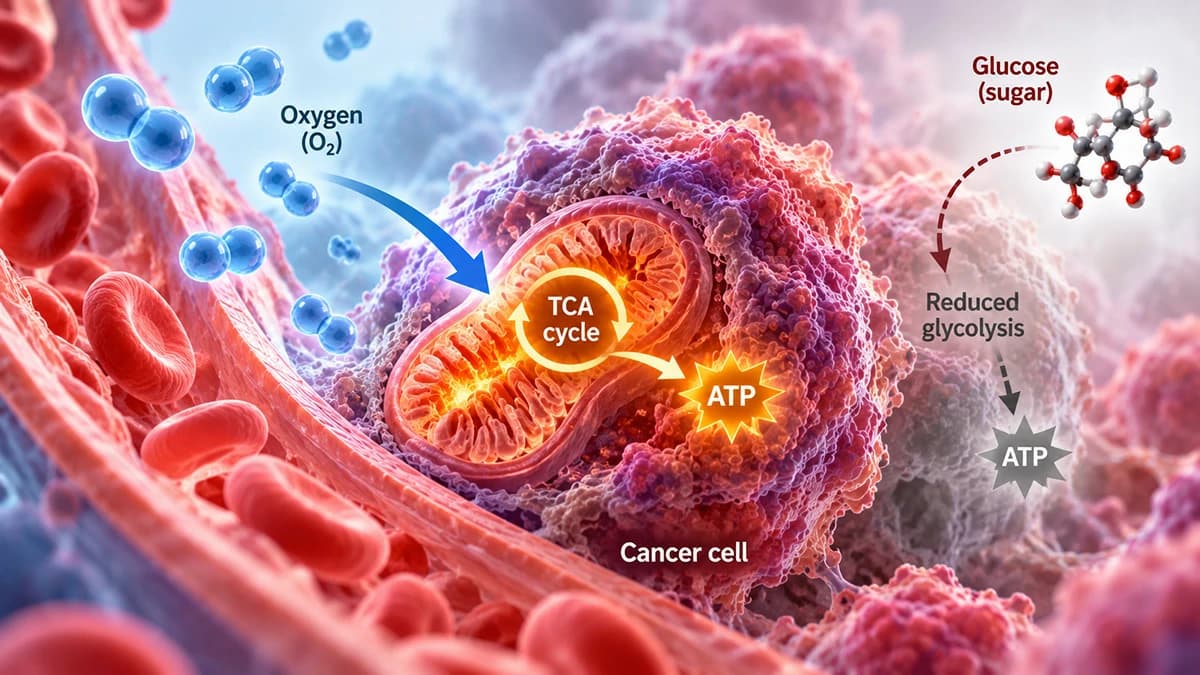
One common misunderstanding deserves correcting early. Favoring glycolysis does not mean a cancer cell's mitochondria are damaged or useless. Research reviewing cancer metabolism has found that many tumor cells retain mitochondria fully capable of oxidative phosphorylation, the oxygen-dependent process that produces far more energy per glucose molecule than glycolysis alone.
In other words, many cancer cells choose glycolysis, at least part of the time, rather than being forced into it by broken internal machinery. That distinction matters. If the mitochondria still work, a cell can switch back toward oxidative phosphorylation when circumstances change, and that is exactly what researchers have observed in several specific, well-studied situations.
Stem-Like Cancer Cells Often Run on Oxidative Phosphorylation
Perhaps the clearest exception to the sugar-burning stereotype comes from cancer stem cells, a small subset of cells within a tumor thought to be capable of regenerating it and often linked to resistance after treatment. In acute myeloid leukemia, a blood cancer, researchers identified a rare population of leukemia stem cells that sit quietly, not dividing, and depend heavily on oxidative phosphorylation rather than glycolysis. One research team showed that these quiet cells could be selectively killed by blocking a survival protein tied to that oxidative dependence, which also revealed how differently these cells behave compared with the bulk of the tumor.
A similar pattern turned up in glioma, a type of brain tumor. Stem-like glioma cells also showed a metabolic profile favoring oxidative phosphorylation over glycolysis compared with the tumor's non-stem cells. Together, these findings suggest that the cells most associated with a tumor's long-term persistence are not necessarily the ones behaving like Warburg's classic description.
Surviving Treatment: A Pancreatic Cancer Case Study
Drug resistance offers another window into this complexity. In laboratory models of pancreatic cancer, cells that survived the shutdown of a cancer-driving gene shifted their metabolism toward mitochondrial function instead of glycolysis. This shift depended partly on signaling from two well-known cancer genes, KRAS and MYC, both of which can rewire how a cell generates energy as well as how it grows. The surviving cells became dependent on working mitochondria to persist, a dependency that did not exist in the original, drug-sensitive tumor cells.
This matters for treatment because cells like these, the ones left behind after therapy, are often the seed of recurrence. If residual disease depends on oxidative phosphorylation rather than glycolysis, approaches designed only around the Warburg model could miss the very cells most likely to cause a relapse.
Metastasis Favors a Different Metabolic Strategy
Spreading to distant organs is metabolically demanding, and cells that manage it appear to call on mitochondria more than glycolysis. A study of circulating tumor cells, those shed from a tumor into the bloodstream, found that increased activity of a protein that drives mitochondria-building pushed cells toward relying more on oxidative phosphorylation. Cells with this profile were more likely to successfully metastasize, work associated with Valerie LeBleu's research group. The result points to oxidative metabolism as something cancer cells can recruit for a specific, demanding task, not merely a leftover from normal biology.
A Tumor Can Run on Two Fuels at Once
Even within a single tumor, cells do not all behave the same way. Some regions, often poorly supplied with oxygen, rely heavily on glycolysis and release lactate, a glycolysis byproduct, as waste. Other cells nearby, with better access to oxygen, can absorb that lactate and burn it through oxidative phosphorylation instead of using glucose directly. Researchers have described this arrangement, sometimes called a lactate shuttle, as a kind of division of labor between two populations within the same tumor.
Think of it less like a single engine and more like a small town where one factory's waste becomes another factory's raw material. This internal cooperation complicates any treatment strategy built around a single, uniform metabolic target, since cutting off glucose supply alone may not touch the cells running on recycled lactate.
Can Oxidative Phosphorylation Be Targeted Directly?
If some cancer cells depend on oxidative phosphorylation, blocking it becomes an obvious research question. Laboratory studies have shown that metformin, a drug long used for type 2 diabetes, blocks a key part of the mitochondria's energy-generating machinery, slowing tumor growth in preclinical models. That finding has fueled broader interest in developing drugs that interfere with mitochondrial energy production in cancer cells specifically.
None of this has translated into an approved cancer treatment built around blocking oxidative phosphorylation. The research remains largely preclinical, conducted in cell lines and animal models rather than validated in patients. It is a promising research direction, not a treatment available today.
A More Flexible Picture Than Warburg Imagined
Taken together, these findings describe cancer metabolism as adaptable rather than fixed. Cancer cells can lean on glycolysis, oxidative phosphorylation, or glutamine processed through mitochondrial pathways, depending on their genetics, their location within a tumor, and what stage of the disease process they are in. MYC, beyond its role in the pancreatic cancer example above, has also been shown to push cells toward burning glutamine through mitochondrial metabolism, a pathway distinct from classic glycolysis.
This flexibility, often called metabolic plasticity, is now considered a defining feature of cancer metabolism rather than a footnote to the Warburg effect. It also explains why the question of whether cancer runs on sugar has no single answer. Some cells do, especially in oxygen-poor regions of a tumor. Others, including the stem-like, drug-resistant, and metastatic populations described here, depend on the oxygen-based machinery that Warburg thought cancer cells had largely abandoned.
This has one clear implication for how patients should interpret popular claims about starving cancer through diet or fasting. Restricting sugar intake does not uniformly starve a tumor, because many of the cells most relevant to relapse and spread do not rely primarily on glucose-driven glycolysis to survive. Metabolic research in this area remains an active scientific field, not a basis for replacing standard, evidence-based cancer care.
Common Questions
References
- Otto Warburg (1956). On the Origin of Cancer Cells
- Ralph J. DeBerardinis, Julian J. Lum, Georgia Hatzivassiliou, Craig B. Thompson (2008). The Biology of Cancer: Metabolic Reprogramming Fuels Cell Growth and Proliferation
- Eleni D. Lagadinou, Alexander Sach, Kevin Callahan, Randall M. Rossi, Sarah J. Neering, Mohammad Minhajuddin, John M. Ashton, Shanshan Pei, Valerie Grose, Kristen M. O’Dwyer, Jane L. Liesveld, Paul S. Brookes, Michael W. Becker, Craig T. Jordan (2013). BCL-2 Inhibition Targets Oxidative Phosphorylation and Selectively Eradicates Quiescent Human Leukemia Stem Cells
- Erina Vlashi, Chann Lagadec, Laurent Vergnes, Tomoo Matsutani, Kenta Masui, Maria Poulou, Ruxandra Popescu, Lorenza Della Donna, Patrick Evers, Carmen Dekmezian, Karen Reue, Heather Christofk, Paul S. Mischel, Frank Pajonk (2011). Metabolic state of glioma stem cells and nontumorigenic cells
- Andrea Viale, Piergiorgio Pettazzoni, Costas A. Lyssiotis, Haoqiang Ying, Nora Sánchez, Matteo Marchesini, Alessandro Carugo, Tessa Green, Sahil Seth, Virginia Giuliani, Maria Kost-Alimova, Florian Muller, Simona Colla, Luigi Nezi, Giannicola Genovese, Angela K. Deem, Avnish Kapoor, Wantong Yao, Emanuela Brunetto, Ya’an Kang, Min Yuan, John M. Asara, Y. Alan Wang, Timothy P. Heffernan, Alec C. Kimmelman, Huamin Wang, Jason B. Fleming, Lewis C. Cantley, Ronald A. DePinho, Giulio F. Draetta (2014). Oncogene ablation-resistant pancreatic cancer cells depend on mitochondrial function
- Valerie S. LeBleu, Joyce T. O’Connell, Karina N. Gonzalez Herrera, Harriet Wikman, Klaus Pantel, Marcia C. Haigis, Fernanda Machado de Carvalho, Aline Damascena, Ludmilla Thome Domingos Chinen, Rafael M. Rocha, John M. Asara, Raghu Kalluri (2014). PGC-1α mediates mitochondrial biogenesis and oxidative phosphorylation in cancer cells to promote metastasis
- (2008). Targeting lactate-fueled respiration selectively kills hypoxic tumor cells in mice.
- (2014). Metformin inhibits mitochondrial complex I of cancer cells to reduce tumorigenesis.
- David R. Wise, Ralph J. DeBerardinis, Anthony Mancuso, Nabil Sayed, Xiao-Yong Zhang, Harla K. Pfeiffer, Ilana Nissim, Evgueni Daikhin, Marc Yudkoff, Steven B. McMahon, Craig B. Thompson (2008). Myc regulates a transcriptional program that stimulates mitochondrial glutaminolysis and leads to glutamine addiction
- Ralph J. DeBerardinis, Navdeep S. Chandel (2016). Fundamentals of cancer metabolism
Team Review: This article has been reviewed by Canceria Research Team