How Radiation Therapy Can Turn On the Immune System Against Cancer
Radiotherapy doesn't just destroy tumor cells directly, it can also alert and arm the immune system, though not always in predictable ways.
Key Takeaways
- •Radiation therapy doesn't just destroy cancer cells directly, it can also trigger immune activation through a process called immunogenic cell death.
- •Radiation-damaged DNA can activate the cGAS-STING pathway, producing interferons that help rally the immune system against a tumor.
- •Radiation can increase MHC class I display on tumor cells, making them more recognizable to patrolling T cells.
- •Radiation also raises PD-L1 on tumor cells, which can suppress the immune response unless paired with a checkpoint-blocking drug.
- •Combining radiotherapy with immune checkpoint inhibitors has shown synergistic effects in preclinical models by engaging separate immune mechanisms.
- •The abscopal effect, tumor shrinkage outside the treated area, is real but uncommon, and should not be expected as a routine outcome.
- •Radiation dose and scheduling can influence how immunogenic treatment is; very high single doses may reduce immune activation through the enzyme Trex1.
- •In a major randomized trial, adding the checkpoint inhibitor durvalumab after chemoradiotherapy improved survival in stage III non-small cell lung cancer.
Radiotherapy has long been described simply as a way to damage the DNA inside cancer cells until they die. That description is accurate, but it leaves out something researchers have spent the last two decades uncovering: radiation doesn't just kill cells quietly. It can also call in the immune system, turning a local treatment into something that occasionally reaches cancer growing far from the treated site. Understanding this interaction has become central to how oncologists think about pairing radiotherapy with newer immune-based drugs.
A Treatment That Does More Than Damage DNA
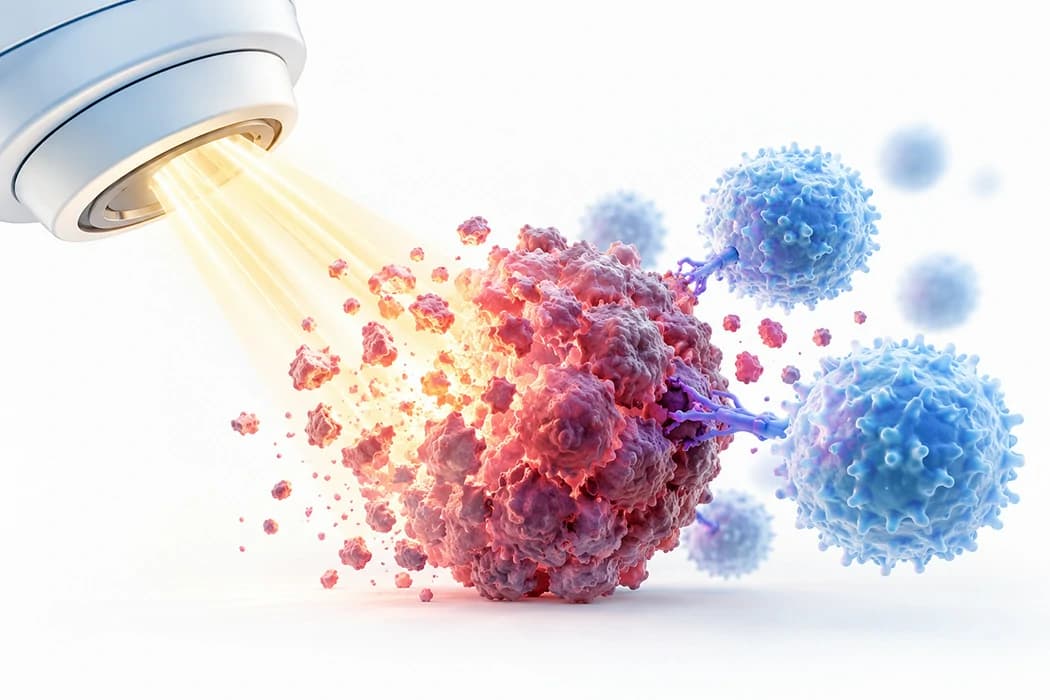
Standard radiotherapy delivers focused beams of energy to a tumor, breaking strands of DNA inside cancer cells until they can no longer divide or survive. For decades, this was considered the whole story: radiation as a local, mechanical kill switch. But dying cells don't always die quietly. Some forms of cell death release molecules that act like distress flares, drawing the attention of nearby immune cells. Researchers describe this radiation-triggered process as immunogenic cell death, a way of dying that releases tumor fragments and danger signals the immune system can recognize. Rather than simply disappearing, tumor cells killed this way can effectively advertise their presence to the immune system.
The Alarm Signal: A Built-In DNA Detector
Part of that advertisement starts with the damaged DNA itself. When radiation shatters DNA inside a tumor cell, fragments can spill out of the nucleus into the main body of the cell, where they don't belong. Cells have a built-in detector for exactly this situation, a molecular alarm system known as the cGAS-STING pathway. When it senses stray DNA floating loose, it triggers the release of signaling proteins called type I interferons. Interferons were first known for fighting viral infections, but they also help recruit and activate the immune cells needed to attack a tumor. Preclinical research in mice has shown this pathway is a major reason radiation can drive an antitumor immune response, rather than simply destroying cells outright.
Making Tumors Easier for the Immune System to See
Radiation changes more than a cell's internal alarm system, it also changes what shows on the outside. Cells constantly display small protein fragments on molecules called MHC class I, which sit on the cell surface like flags that let patrolling immune cells, known as T cells, inspect what's happening inside. Research has found that radiation can both increase the number of these flags and shift which protein fragments get displayed, making tumor cells more recognizable as abnormal. In effect, radiotherapy can turn up the signal telling the immune system that a cell doesn't belong.
The Other Side: When Radiation Dampens the Response
None of this means radiotherapy reliably helps the immune system, it can also work against it. One clear example involves a protein called PD-L1, which tumor cells use as a kind of off-switch for approaching T cells. Radiation can increase PD-L1 on tumor cells, and preclinical studies show this rise can blunt the very immune attack radiation just provoked, unless it's paired with a drug that blocks PD-L1. Radiation can also reduce the number of circulating immune cells and, in some settings, favor suppressive immune cells that keep the response in check. The effect of radiation on immunity is a balance, not a simple switch toward activation.
Pairing Radiation with Checkpoint Inhibitors
That balance is exactly why researchers began testing radiotherapy alongside drugs called immune checkpoint inhibitors, treatments that release the brakes a tumor places on the immune system. In preclinical models, combining local radiation with checkpoint blockade produced stronger antitumor effects than either approach alone. One study found that radiation combined with two different checkpoint-blocking antibodies activated separate, non-overlapping immune mechanisms, work associated with Twyman-Saint Victor and colleagues. The implication is that radiation and checkpoint blockade don't simply add up their individual effects, they can engage different arms of the immune system that reinforce one another.
The Abscopal Effect: Rare but Scientifically Revealing
The most striking possible outcome of this interaction has a name: the abscopal effect, shrinkage of tumors located outside the field that was actually irradiated. The idea is that a localized burst of radiation can trigger a systemic immune response capable of reaching cancer elsewhere in the body. A widely discussed case involved a patient with melanoma whose distant tumors regressed after radiation to a single site, alongside immune changes consistent with a genuine immune-mediated response. The abscopal effect has been documented and studied, but it remains uncommon in everyday practice. It should be understood as a notable exception rather than an outcome patients can expect from radiotherapy alone.
Does the Radiation Dose or Schedule Matter?
How radiation is delivered appears to shape how immunogenic it is. Giving radiation in smaller doses spread across multiple sessions, a practice called fractionation, differs biologically from a single very large dose. Research in mice found that very high single doses can trigger a cell's own DNA-degrading enzyme, Trex1, which chews up stray DNA fragments before the alarm system can detect them. In that setting, a bigger dose didn't translate into a bigger immune response, it blunted it. This suggests that calibrating dose and schedule, not simply maximizing dose, matters for how well radiation cooperates with the immune system.
From Laboratory Findings to a Clinical Trial
Most of this mechanistic picture comes from laboratory and animal studies, which show how radiation-immune interactions can work but don't by themselves prove benefit in patients. The clearest human evidence to date comes from a large randomized trial in people with stage III non-small cell lung cancer who had already completed chemotherapy combined with radiotherapy. Adding a checkpoint inhibitor, durvalumab, afterward improved survival outcomes compared with chemoradiotherapy alone. This doesn't confirm every mechanism described above was operating in that setting, but it is a concrete demonstration that sequencing radiotherapy with checkpoint blockade can produce measurable clinical benefit in a defined patient population. It is also a reminder that these results apply to that specific disease and regimen, not to radiotherapy-immunotherapy combinations generally.
What Remains Open
Radiotherapy's relationship with the immune system is neither purely friend nor foe. It can hand the immune system fresh evidence of a tumor's existence while simultaneously handing the tumor new tools to suppress the response it just provoked. Which effect dominates likely depends on tumor type, radiation dose and schedule, and what other therapy is layered on top. The abscopal effect shows what's biologically possible, not what's reliably achievable. Ongoing research is trying to work out how to tip that balance more consistently toward immune activation, across more cancer types than the lung cancer and melanoma settings where the clearest evidence currently exists.
Common Questions
References
- Encouse B. Golden, Lionel Apetoh (2015). Radiotherapy and Immunogenic Cell Death
- Liufu Deng, Hua Liang, Meng Xu, Xuanming Yang, Byron Burnette, Ainhoa Arina, Xiao-Dong Li, Helena Mauceri, Michael Beckett, Thomas Darga, Xiaona Huang, Thomas F. Gajewski, Zhijian J. Chen, Yang-Xin Fu, Ralph R. Weichselbaum (2014). STING-Dependent Cytosolic DNA Sensing Promotes Radiation-Induced Type I Interferon-Dependent Antitumor Immunity in Immunogenic Tumors
- Eric A. Reits, James W. Hodge, Carla A. Herberts, Tom A. Groothuis, Mala Chakraborty, Elizabeth K.Wansley, Kevin Camphausen, Rosalie M. Luiten, Arnold H. de Ru, Joost Neijssen, Alexander Griekspoor, Elly Mesman, Frank A. Verreck, Hergen Spits, Jeffrey Schlom, Peter van Veelen, Jacques J. Neefjes (2006). Radiation modulates the peptide repertoire, enhances MHC class I expression, and induces successful antitumor immunotherapy
- Liufu Deng, Hua Liang, Byron Burnette, Michael Beckett, Thomas Darga, Ralph R. Weichselbaum, Yang-Xin Fu (2014). Irradiation and anti–PD-L1 treatment synergistically promote antitumor immunity in mice
- Simon J. Dovedi, Amy L. Adlard, Grazyna Lipowska-Bhalla, Conor McKenna, Sherrie Jones, Eleanor J. Cheadle, Ian J. Stratford, Edmund Poon, Michelle Morrow, Ross Stewart, Hazel Jones, Robert W. Wilkinson, Jamie Honeychurch, Tim M. Illidge (2014). Acquired Resistance to Fractionated Radiotherapy Can Be Overcome by Concurrent PD-L1 Blockade
- Christina Twyman-Saint Victor, Andrew J. Rech, Amit Maity, Ramesh Rengan, Kristen E. Pauken, Erietta Stelekati, Joseph L. Benci, Bihui Xu, Hannah Dada, Pamela M. Odorizzi, Ramin S. Herati, Kathleen D. Mansfield, Dana Patsch, Ravi K. Amaravadi, Lynn M. Schuchter, Hemant Ishwaran, Rosemarie Mick, Daniel A. Pryma, Xiaowei Xu, Michael D. Feldman, Tara C. Gangadhar, Stephen M. Hahn, E. John Wherry, Robert H. Vonderheide, Andy J. Minn (2015). Radiation and dual checkpoint blockade activate non-redundant immune mechanisms in cancer
- Silvia C Formenti, Sandra Demaria (2009). Systemic effects of local radiotherapy
- Michael A. Postow, Margaret K. Callahan, Christopher A. Barker, Yoshiya Yamada, Jianda Yuan, Shigehisa Kitano, Zhenyu Mu, Teresa Rasalan, Matthew Adamow, Erika Ritter, Christine Sedrak, Achim A. Jungbluth, Ramon Chua, Arvin S. Yang, Ruth-Ann Roman, Samuel Rosner, Brenna Benson, James P. Allison, Alexander M. Lesokhin, Sacha Gnjatic, Jedd D. Wolchok (2012). Immunologic Correlates of the Abscopal Effect in a Patient with Melanoma
- Claire Vanpouille-Box, Amandine Alard, Molykutty J. Aryankalayil, Yasmeen Sarfraz, Julie M. Diamond, Robert J. Schneider, Giorgio Inghirami, C. Norman Coleman, Silvia C. Formenti, Sandra Demaria (2017). DNA exonuclease Trex1 regulates radiotherapy-induced tumour immunogenicity
- Scott J. Antonia, Augusto Villegas, Davey Daniel, David Vicente, Shuji Murakami, Rina Hui, Takashi Yokoi, Alberto Chiappori, Ki H. Lee, Maike de Wit, Byoung C. Cho, Maryam Bourhaba, Xavier Quantin, Takaaki Tokito, Tarek Mekhail, David Planchard, Young-Chul Kim, Christos S. Karapetis, Sandrine Hiret, Gyula Ostoros, Kaoru Kubota, Jhanelle E. Gray, Luis Paz-Ares, Javier de Castro Carpeño, Catherine Wadsworth, Giovanni Melillo, Haiyi Jiang, Yifan Huang, Phillip A. Dennis, Mustafa Özgüroğlu (2017). Durvalumab after Chemoradiotherapy in Stage III Non–Small-Cell Lung Cancer
Team Review: This article has been reviewed by Canceria Research Team