Why Thyroid Cancer Behaves So Differently Depending on the Subtype
Papillary, follicular, medullary, and anaplastic thyroid cancers arise from different cells, carry different mutations, and respond very differently to treatment.
Key Takeaways
- •Thyroid cancer is not one disease but several distinct subtypes that arise from different thyroid cell types.
- •Papillary thyroid carcinoma is the most common subtype and is often driven by the BRAF V600E mutation, which locks a growth-signaling protein in the 'on' position.
- •Follicular thyroid carcinoma is linked to RAS mutations and PAX8-PPARG gene fusions, and spreads more often through the bloodstream than through lymph nodes.
- •Medullary thyroid carcinoma arises from calcitonin-producing C cells rather than follicular cells, and is strongly tied to RET gene mutations that can also run in families.
- •Anaplastic thyroid carcinoma often develops when a differentiated thyroid cancer loses its specialized identity, a process linked to TP53 mutations.
- •Radioactive iodine therapy works mainly in subtypes that retain a protein allowing cells to absorb iodine, which medullary and anaplastic cancers generally lack.
- •Long-term survival differs dramatically across subtypes, from generally favorable outcomes in differentiated thyroid cancers to a median survival of months in anaplastic thyroid cancer.
- •Rising thyroid cancer diagnoses largely reflect increased detection of small papillary tumors rather than a true rise in dangerous disease.
Four Different Diseases Under One Name
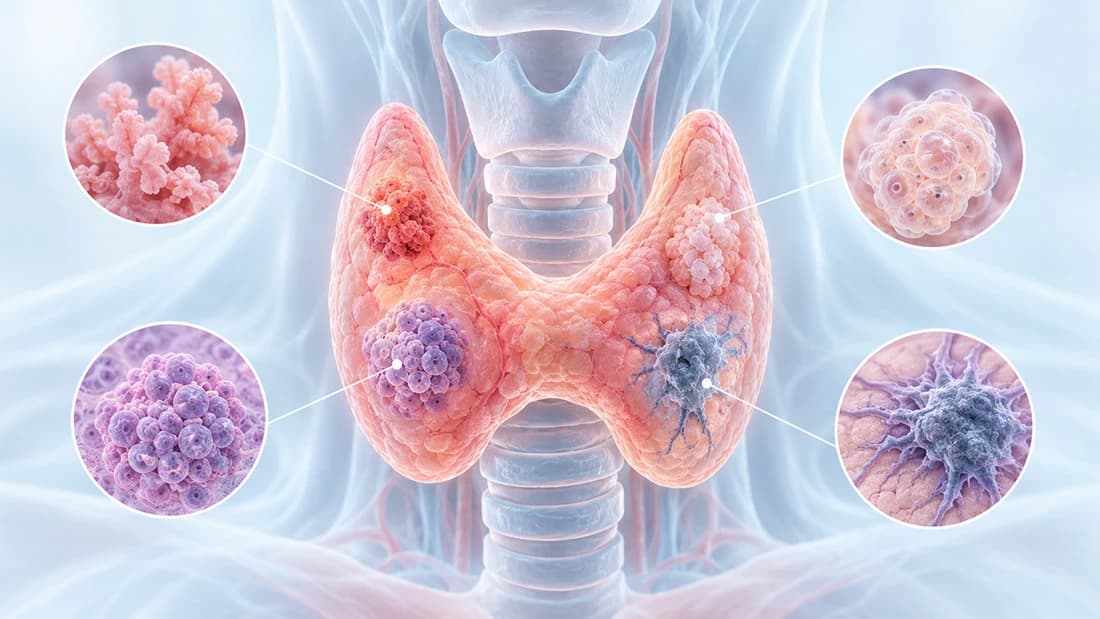
Thyroid cancer is often discussed as if it were a single illness. In reality, doctors recognize several distinct subtypes, and they don't all start in the same place. Papillary and follicular thyroid cancer form in follicular cells, the thyroid's hormone-making units. Medullary thyroid cancer, by contrast, arises from a completely separate population called parafollicular cells, or C cells, which make a different hormone called calcitonin. Anaplastic thyroid cancer, the rarest and most aggressive form, usually develops when an already-existing differentiated cancer loses its original identity over time.
This matters because the cell of origin shapes almost everything that follows: which genes malfunction, how the tumor spreads, which treatments work, and how long a person is likely to live with the disease. Understanding where each subtype comes from helps explain why a thyroid cancer diagnosis can mean very different things for different patients.
Papillary Thyroid Cancer: The Common, Usually Survivable Form
Papillary thyroid carcinoma is by far the most frequently diagnosed subtype. It tends to grow slowly, spread mainly through nearby lymph nodes rather than distant organs, and carry a generally favorable long-term outlook. A large share of papillary cancers carry a specific change in a gene called BRAF, most often a variant known as V600E. Normally BRAF acts like a relay switch, passing along signals that tell a cell when to grow. The V600E change jams that switch in the "on" position, so the cell keeps getting a growth signal even when it shouldn't.
Not every papillary cancer carries this mutation, and its presence alone doesn't determine how a given patient will do. Still, it is one of the most consistently identified drivers in this subtype, and it has become a target for some newer drugs.
Follicular Thyroid Cancer: Same Cell, Different Genetics
Follicular thyroid carcinoma also arises from follicular cells, but its genetics and behavior diverge from papillary cancer in important ways. Rather than BRAF mutations, follicular tumors are more often associated with mutations in RAS genes, or with an abnormal fusion of two genes, PAX8 and PPARG, that become stuck together as a hybrid.
Follicular cancer also tends to spread differently. Papillary cancer favors nearby lymph nodes, but follicular cancer is more inclined to enter the bloodstream and travel to distant sites such as the lungs or bones. That single difference in spreading pattern changes how doctors monitor and stage the disease.
Medullary Thyroid Cancer: A Different Cell Entirely
Medullary thyroid carcinoma starts in C cells, not follicular cells, which sets it apart biologically from the very beginning. Because C cells produce calcitonin, elevated calcitonin in the blood can serve as a marker specific to this subtype.
Medullary thyroid cancer is strongly linked to mutations in a gene called RET. In some cases, these mutations are inherited, running in families as part of a broader inherited condition that also raises the risk of other glandular tumors. In other cases, RET mutations occur only in the tumor itself, with no family pattern at all. Either way, RET appears to be the central genetic driver behind this subtype.
Anaplastic Thyroid Cancer: When a Cancer Loses Its Identity
Anaplastic thyroid carcinoma is rare, but it ranks among the most aggressive cancers known. It frequently emerges when a pre-existing papillary or follicular cancer undergoes dedifferentiation, a process in which cancer cells shed the specialized features of their original tissue and begin behaving more like primitive, fast-dividing cells. Mutations in TP53, a gene that normally helps cells repair damage or self-destruct when something goes badly wrong, are frequently found alongside this transformation.
The result is a tumor that grows quickly, invades surrounding tissue, and often resists treatments that work well against differentiated thyroid cancer.
Why the Same Treatment Doesn't Work for Every Subtype
One of the clearest differences between subtypes shows up in how they respond to radioactive iodine therapy, a treatment that exploits the thyroid's natural appetite for iodine to deliver radiation directly to cancer cells. Healthy thyroid cells, and many papillary and follicular cancer cells, carry a protein called the sodium-iodide symporter that pulls iodine in from the bloodstream. Radioactive iodine therapy works because cells absorb the radioactive version just as they would ordinary iodine, concentrating radiation exactly where it's needed, somewhat like a lock that only a particular key will open.
Medullary and anaplastic thyroid cancers generally lack this symporter, either because they never arose from iodine-handling cells to begin with, or because they lost that feature during dedifferentiation. Without a way to pull in iodine, there's little for radioactive iodine therapy to act on. That single molecular difference explains why the same treatment can be central to one subtype's care and essentially irrelevant to another's.
Dramatically Different Outlooks
These biological differences translate into some of the widest prognosis gaps in oncology. Differentiated thyroid cancers, papillary and follicular, are associated with high long-term survival for most patients. Anaplastic thyroid carcinoma sits at the opposite extreme, with median survival typically measured in months rather than years. Medullary thyroid cancer falls in between, with outcomes that vary depending on how early it's found and whether the RET mutation driving it is inherited or arose only in the tumor.
These are population-level patterns drawn from many patients followed over time. They describe general tendencies, not a forecast for any single person's case.
Why Diagnoses Have Risen So Much
Thyroid cancer diagnoses have increased substantially over recent decades, and the explanation isn't quite what it first appears to be. The rise is driven largely by greater use of imaging and more routine detection of small papillary thyroid cancers, tumors that may never have caused symptoms or threatened a person's life if left unfound. Epidemiologists Louise Davies and H. Gilbert Welch examined these incidence trends and concluded that the pattern points more toward increased detection than toward a true rise in disease. That doesn't mean detection is harmful, or that any individual diagnosis should be dismissed. It means that, at a population level, the rising numbers mostly reflect an improved ability to find small, often slow-growing tumors rather than a genuine surge in dangerous thyroid cancer.
Genetics Guiding New Treatments
Mapping out these subtype-specific mutations hasn't just explained biology, it has begun reshaping treatment. Because RET mutations drive a meaningful share of medullary thyroid cancers, and turn up in some other thyroid cancers too, drugs designed to block RET activity specifically have moved into clinical testing. In a trial led by Lori Wirth and colleagues, a RET-targeted drug called selpercatinib produced meaningful responses in patients whose tumors carried RET alterations. That result reflects a broader shift in how thyroid cancer is approached: treatment is increasingly matched to a tumor's genetic profile rather than applied the same way to everyone labeled with "thyroid cancer." Whether this kind of genetic matching will extend just as successfully to BRAF-driven or TP53-driven tumors remains an open question.
What This Means Going Forward
Thyroid cancer illustrates a pattern seen across oncology: histology and genetics matter more than a shared organ of origin. A papillary tumor driven by BRAF, a follicular tumor built around a RAS mutation or a PAX8-PPARG fusion, a medullary tumor carrying a RET mutation, and an anaplastic tumor that has lost its identity through TP53 disruption are not simple variations on one disease. They are related but genuinely distinct conditions that happen to arise in the same gland. That distinction is exactly why treatment decisions, monitoring strategies, and conversations about prognosis look so different depending on which subtype a person actually has.
Common Questions
References
- Bryan R. Haugen, Erik K. Alexander, Keith C. Bible, Gerard M. Doherty, Susan J. Mandel, Yuri E. Nikiforov, Furio Pacini, Gregory W. Randolph, Anna M. Sawka, Martin Schlumberger, Kathryn G. Schuff, Steven I. Sherman, Julie Ann Sosa, David L. Steward, R. Michael Tuttle, Leonard Wartofsky (2016). 2015 American Thyroid Association Management Guidelines for Adult Patients with Thyroid Nodules and Differentiated Thyroid Cancer: The American Thyroid Association Guidelines Task Force on Thyroid Nodules and Differentiated Thyroid Cancer
- Mingzhao Xing (2007). BRAF Mutation in Papillary Thyroid Cancer: Pathogenic Role, Molecular Bases, and Clinical Implications
- (2003). High prevalence of BRAF mutations in thyroid cancer: genetic evidence for constitutive activation of the RET/PTC-RAS-BRAF signaling pathway in papillary thyroid carcinoma.
- Yuri E. Nikiforov (2011). Molecular Diagnostics of Thyroid Tumors
- Samuel A. Wells, Sylvia L. Asa, Henning Dralle, Rossella Elisei, Douglas B. Evans, Robert F. Gagel, Nancy Lee, Andreas Machens, Jeffrey F. Moley, Furio Pacini, Friedhelm Raue, Karin Frank-Raue, Bruce Robinson, M. Sara Rosenthal, Massimo Santoro, Martin Schlumberger, Manisha Shah, Steven G. Waguespack (2015). Revised American Thyroid Association Guidelines for the Management of Medullary Thyroid Carcinoma
- Robert C Smallridge, Laura A Marlow, John A Copland (2009). Anaplastic thyroid cancer: molecular pathogenesis and emerging therapies
- Louise Davies, H. Gilbert Welch (2014). Current Thyroid Cancer Trends in the United States
- Lori J. Wirth, Eric Sherman, Bruce Robinson, Benjamin Solomon, Hyunseok Kang, Jochen Lorch, Francis Worden, Marcia Brose, Jyoti Patel, Sophie Leboulleux, Yann Godbert, Fabrice Barlesi, John C. Morris, Taofeek K. Owonikoko, Daniel S.W. Tan, Oliver Gautschi, Jared Weiss, Christelle de la Fouchardière, Mark E. Burkard, Janessa Laskin, Matthew H. Taylor, Matthias Kroiss, Jacques Medioni, Jonathan W. Goldman, Todd M. Bauer, Benjamin Levy, Viola W. Zhu, Nehal Lakhani, Victor Moreno, Kevin Ebata, Michele Nguyen, Dana Heirich, Edward Y. Zhu, Xin Huang, Luxi Yang, Jennifer Kherani, S. Michael Rothenberg, Alexander Drilon, Vivek Subbiah, Manisha H. Shah, Maria E. Cabanillas (2020). Efficacy of Selpercatinib in RET -Altered Thyroid Cancers
Team Review: This article has been reviewed by Canceria Research Team