Why Some Breast Cancers Are Called 'Triple-Negative' and What It Means for Treatment
The absence of three receptors reshapes everything about diagnosis, genetics, and the newest treatment options.
Key Takeaways
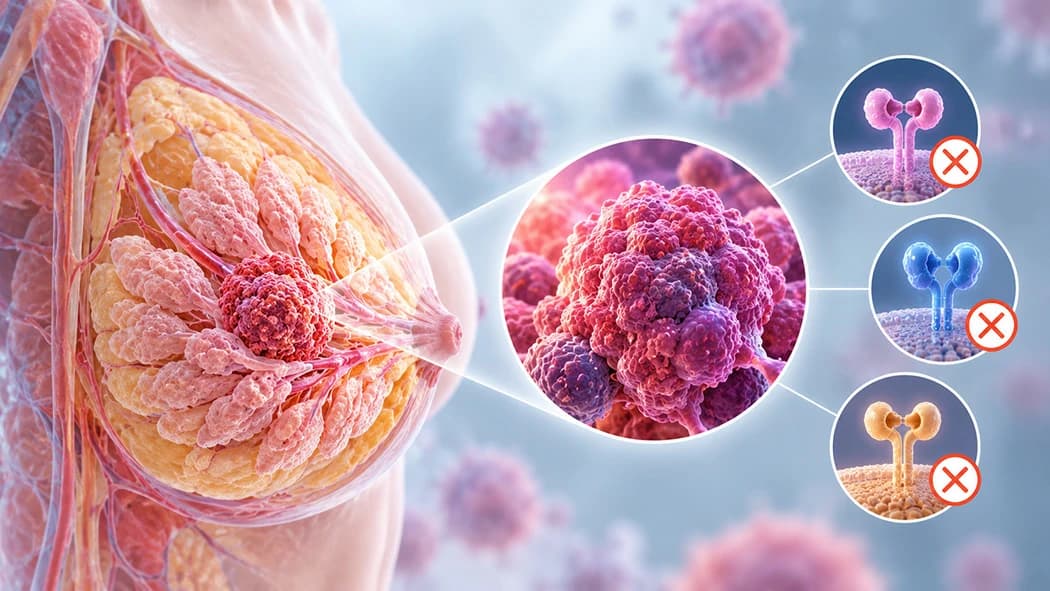
- •Triple-negative breast cancer lacks estrogen receptor, progesterone receptor, and HER2, the three targets most breast cancer drugs are built around.
- •Gene expression studies revealed that breast cancer consists of several distinct molecular subtypes, and basal-like breast cancer substantially overlaps with triple-negative disease.
- •Triple-negative breast cancer is not one uniform disease; further molecular profiling has identified multiple subtypes with different biology, though this subtyping remains mainly a research tool.
- •Triple-negative breast cancer occurs more often in younger women and in African American women, reflecting population-level patterns rather than individual risk predictions.
- •Inherited BRCA1 mutations are strongly linked to triple-negative, basal-like breast cancer, which is why genetic counseling is often recommended for these patients.
- •Triple-negative breast cancer has historically carried a higher risk of early recurrence than hormone receptor-positive disease, though outcomes vary by subtype and stage.
- •PARP inhibitors, immune checkpoint inhibitors, and antibody-drug conjugates have each shown clinical benefit in specific groups of triple-negative breast cancer patients in randomized trials.
- •None of these newer treatments work for every patient; benefit depends on a tumor's specific genetic and molecular features.
When a breast tumor is diagnosed, pathologists test it for three specific markers before anything else happens. Two are hormone receptors, estrogen receptor and progesterone receptor, proteins on the cancer cell that respond to hormone signals circulating in the body. The third is HER2, a growth-promoting protein that sits on the cell surface. If a tumor tests negative for all three, doctors call it triple-negative breast cancer. That single label carries enormous weight, because most breast cancer drugs were built to attack one of those three targets.
Why Missing Three Targets Changes Everything
Hormone receptor-positive tumors can be treated with drugs that block estrogen or shut down hormone production, cutting off a signal the cancer depends on to grow. HER2-positive tumors can be treated with drugs engineered to lock onto that specific protein. Triple-negative tumors have none of these handles. It's a bit like trying to grip a smooth, featureless rock instead of one with built-in handholds; the usual grips simply aren't there.
That absence doesn't mean the tumor is untreatable. Standard chemotherapy still works against triple-negative breast cancer, often quite effectively at first. But for decades chemotherapy was essentially the only option available, which is why triple-negative disease earned a reputation as the hardest breast cancer subtype to treat.
One Name, Many Diseases
Triple-negative is defined by what a tumor lacks, not by what it is, and that distinction turns out to matter. In 2000, a team led by Charles Perou used gene expression profiling, a technique that measures which genes are switched on inside a tumor, to show that breast cancer actually falls into several distinct molecular groups, now known as intrinsic subtypes. One of these, called basal-like breast cancer, overlaps substantially with triple-negative tumors, although the two categories aren't perfectly identical. A follow-up study confirmed that this split carried real clinical meaning, not just a statistical pattern.
A decade later, researchers pushed the classification further by analyzing gene activity across a large set of triple-negative tumors specifically. They found the group splits into several additional subtypes, each with somewhat different biology: some more active immunologically, others more dependent on particular growth signals. This finer subtyping remains mainly a research tool rather than a routine clinical test today. Still, it helps explain something doctors had long noticed, which is that triple-negative tumors don't all behave, or respond to treatment, in quite the same way.
Who Develops It, and the BRCA1 Connection
Triple-negative breast cancer isn't evenly distributed across the population. Large cohort studies have found it occurs disproportionately in younger women and appears more often among African American women than among women of other backgrounds. These are population-level patterns rather than individual predictions, so they say little about any one person's personal risk.
One contributor to this pattern is genetic. Women who inherit a mutated copy of BRCA1, a gene whose normal job is helping repair damaged DNA, are especially likely to develop triple-negative, basal-like tumors if they develop breast cancer at all. BRCA2 mutations, by contrast, more often track with hormone receptor-positive disease. Exactly why BRCA1 loss steers tumors toward this particular pattern isn't fully settled, but the association is consistent enough that genetic counseling is now routinely offered to younger triple-negative patients and those with strong family histories.
A Difficult History, and a Picture That's Changing
For much of the last few decades, a triple-negative diagnosis carried a worse short-term outlook than hormone receptor-positive disease. Cohort data gathered in the mid-2000s showed higher rates of early recurrence, meaning the cancer returning within the first few years after treatment, among triple-negative patients compared with those whose tumors carried hormone receptors. This held true even though chemotherapy generally worked well against triple-negative tumors initially.
Long-term outcomes are more nuanced than a single statistic suggests, varying by tumor subtype, stage at diagnosis, and how early the cancer is caught. The gap between triple-negative and hormone receptor-positive outcomes has also narrowed as treatment options have diversified. Lacking a hormone or HER2 target never made the cancer impossible to treat, just harder to hit with precision, and that is exactly what research over the last several years has been working to change.
New Treatments Aimed at TNBC's Weak Points
Three separate lines of research have given triple-negative patients options beyond standard chemotherapy, each exploiting a different biological vulnerability.
The first targets the DNA-repair defect created by BRCA1 and BRCA2 mutations. A class of drugs called PARP inhibitors blocks a backup DNA-repair enzyme that BRCA-mutated cells rely on more heavily once their main repair pathway is already broken. With neither repair system working, damage builds up inside the cancer cell until it dies, while normal cells, which still have one working repair pathway, tolerate the drug reasonably well. A randomized clinical trial of the PARP inhibitor olaparib showed improved outcomes in patients with metastatic breast cancer carrying inherited BRCA mutations, including triple-negative cases.
The second line of research is immunotherapy. Despite lacking hormone and HER2 targets, triple-negative tumors tend to be more visible to the immune system than other breast cancer subtypes. Drugs called immune checkpoint inhibitors, such as pembrolizumab, work by releasing a brake the immune system normally applies to itself, freeing immune cells to attack the tumor. Clinical trials combining pembrolizumab with chemotherapy showed improved outcomes for some patients with triple-negative breast cancer.
The third approach uses antibody-drug conjugates, treatments that attach a chemotherapy payload to an antibody designed to seek out a protein common on triple-negative cancer cells, delivering the drug with more precision than chemotherapy given alone. A randomized trial of the antibody-drug conjugate sacituzumab govitecan showed clinical benefit in patients with previously treated metastatic triple-negative breast cancer.
None of these treatments work for every patient. Eligibility depends on a tumor's specific genetic and molecular features, and not every triple-negative tumor carries a BRCA mutation, strong immune visibility, or the protein antibody-drug conjugates are built to find. What has genuinely changed is the premise itself. A diagnosis once defined almost entirely by what was absent is now, increasingly, being defined and treated according to what each tumor actually has.
Common Questions
References
- Charles M. Perou, Therese Sørlie, Michael B. Eisen, Matt van de Rijn, Stefanie S. Jeffrey, Christian A. Rees, Jonathan R. Pollack, Douglas T. Ross, Hilde Johnsen, Lars A. Akslen, Øystein Fluge, Alexander Pergamenschikov, Cheryl Williams, Shirley X. Zhu, Per E. Lønning, Anne-Lise Børresen-Dale, Patrick O. Brown, David Botstein (2000). Molecular portraits of human breast tumours
- Therese Sørlie, Charles M. Perou, Robert Tibshirani, Turid Aas, Stephanie Geisler, Hilde Johnsen, Trevor Hastie, Michael B. Eisen, Matt van de Rijn, Stefanie S. Jeffrey, Thor Thorsen, Hanne Quist, John C. Matese, Patrick O. Brown, David Botstein, Per Eystein Lønning, Anne-Lise Børresen-Dale (2001). Gene expression patterns of breast carcinomas distinguish tumor subclasses with clinical implications
- Brian D. Lehmann, Joshua A. Bauer, Xi Chen, Melinda E. Sanders, A. Bapsi Chakravarthy, Yu Shyr, Jennifer A. Pietenpol (2011). Identification of human triple-negative breast cancer subtypes and preclinical models for selection of targeted therapies
- Deann P. Atchley, Constance T. Albarracin, Adriana Lopez, Vicente Valero, Christopher I. Amos, Ana Maria Gonzalez-Angulo, Gabriel N. Hortobagyi, Banu K. Arun (2008). Clinical and Pathologic Characteristics of Patients With BRCA -Positive and BRCA -Negative Breast Cancer
- Lisa A. Carey, Charles M. Perou, Chad A. Livasy, Lynn G. Dressler, David Cowan, Kathleen Conway, Gamze Karaca, Melissa A. Troester, Chiu Kit Tse, Sharon Edmiston, Sandra L. Deming, Joseph Geradts, Maggie C. U. Cheang, Torsten O. Nielsen, Patricia G. Moorman, H. Shelton Earp, Robert C. Millikan (2006). Race, Breast Cancer Subtypes, and Survival in the Carolina Breast Cancer Study
- Mark Robson, Seock-Ah Im, Elżbieta Senkus, Binghe Xu, Susan M. Domchek, Norikazu Masuda, Suzette Delaloge, Wei Li, Nadine Tung, Anne Armstrong, Wenting Wu, Carsten Goessl, Sarah Runswick, Pierfranco Conte (2017). Olaparib for Metastatic Breast Cancer in Patients with a Germline BRCA Mutation
- Peter Schmid, Javier Cortes, Lajos Pusztai, Heather McArthur, Sherko Kümmel, Jonas Bergh, Carsten Denkert, Yeon Hee Park, Rina Hui, Nadia Harbeck, Masato Takahashi, Theodoros Foukakis, Peter A. Fasching, Fatima Cardoso, Michael Untch, Liyi Jia, Vassiliki Karantza, Jing Zhao, Gursel Aktan, Rebecca Dent, Joyce O’Shaughnessy (2020). Pembrolizumab for Early Triple-Negative Breast Cancer
- Aditya Bardia, Sara A. Hurvitz, Sara M. Tolaney, Delphine Loirat, Kevin Punie, Mafalda Oliveira, Adam Brufsky, Sagar D. Sardesai, Kevin Kalinsky, Amelia B. Zelnak, Robert Weaver, Tiffany Traina, Florence Dalenc, Philippe Aftimos, Filipa Lynce, Sami Diab, Javier Cortés, Joyce O’Shaughnessy, Véronique Diéras, Cristiano Ferrario, Peter Schmid, Lisa A. Carey, Luca Gianni, Martine J. Piccart, Sibylle Loibl, David M. Goldenberg, Quan Hong, Martin S. Olivo, Loretta M. Itri, Hope S. Rugo (2021). Sacituzumab Govitecan in Metastatic Triple-Negative Breast Cancer
Team Review: This article has been reviewed by Canceria Research Team