Why Pancreatic Cancer Resists Immunotherapy When Other Cancers Respond
A low mutation count, a thick fibrous shield, and the wrong kind of immune cells explain much of the gap, though rare exceptions show response is possible.
Key Takeaways
- •Checkpoint inhibitors produce durable responses in a meaningful subset of melanoma and lung cancer patients but rarely help in pancreatic cancer.
- •Pancreatic tumors generally carry fewer DNA mutations and neoantigens, making them less visible to the immune system compared to melanoma or lung cancer.
- •Tumor mutational burden correlates with response to PD-1 blockade across cancer types, and pancreatic cancer tends to fall at the low end of both measures.
- •An early trial of single-agent anti-CTLA-4 therapy showed minimal benefit for unselected pancreatic cancer patients.
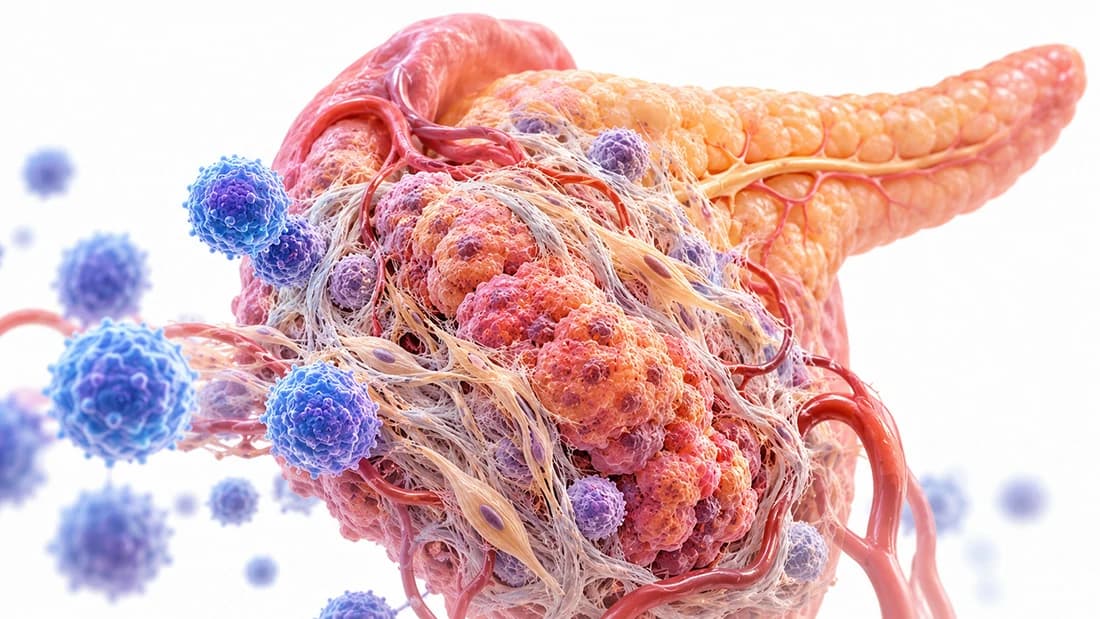
- •A dense, fibrous stroma surrounds many pancreatic tumors, physically compressing blood vessels and limiting immune cell and drug access.
- •The pancreatic tumor microenvironment is typically dominated by immune-suppressing cells rather than the cytotoxic T cells needed to kill cancer cells.
- •Rare pancreatic tumors with mismatch repair deficiency can respond strongly to PD-1 blockade, showing that tumor biology, not organ site, drives immunotherapy response.
- •Experimental strategies such as CD40 agonist therapy and stroma- or myeloid-targeting combinations are under active investigation but remain unproven as standard treatments.
Immune checkpoint inhibitors changed what doctors could tell patients with advanced melanoma or non-small cell lung cancer. In clinical trials, meaningful numbers of patients with these cancers had lasting responses to drugs that release the brakes on the immune system. Pancreatic cancer has not shared in that success. The same class of drugs, tested the same way, has produced only scattered and usually brief benefit. Understanding why reveals something important about how tumors can hide from, and actively disable, the immune system.
A Tumor the Immune System Barely Notices
One reason starts with the tumor's DNA. Cancer cells accumulate mutations as they grow, and some of those mutations produce abnormal proteins called neoantigens, fragments that look foreign enough for the immune system to notice and attack. The more mutations a tumor carries, a measure known as tumor mutational burden, the more of these foreign-looking flags it tends to display. Melanoma and lung cancer, often shaped by sun exposure or tobacco smoke, typically carry heavy mutation loads. Pancreatic ductal adenocarcinoma, the most common form of pancreatic cancer, usually does not, and research comparing mutation patterns across cancer types places it toward the low end, with correspondingly fewer neoantigens for immune cells to recognize.
That difference in mutation load lines up with a difference in drug response. Across many cancer types, tumors with a higher mutational burden tend to respond better to PD-1 blockade, the strategy behind many checkpoint inhibitors. Pancreatic cancer tends to sit at the low end of both measures: fewer mutations, and historically among the lowest response rates to this approach.
Testing the Drugs: A Disappointing Result
That prediction played out in the clinic. An early trial of a single checkpoint inhibitor targeting CTLA-4, tested in patients with advanced pancreatic cancer, produced minimal benefit for the group as a whole. This stood in sharp contrast to results already being seen with PD-1-targeting drugs in melanoma and lung cancer, where meaningful numbers of patients had durable responses. The gap suggested pancreatic cancer was not simply a slower version of the same disease, but a fundamentally different immune situation.
A Physical Wall Built From Scar-Like Tissue
A low mutation count is only part of the story. Many pancreatic tumors also surround themselves with an unusually thick layer of fibrous, scar-like tissue, known as desmoplastic stroma. This tissue can make up most of a tumor's total mass, often outweighing the cancer cells themselves. Laboratory research tracking this stroma found it dense enough to physically compress blood vessels, choking off blood supply and making it harder for immune cells, or drugs, to reach the tumor at all. It behaves less like a wall with a door than like a tightly packed crowd a cell has to shove through.
The Wrong Immune Cells Show Up
Even when immune cells reach a pancreatic tumor, they are often the wrong kind. Profiling studies of pancreatic tumors have found them crowded with cells that suppress immune attack rather than carry it out: macrophages reprogrammed to support the tumor instead of fighting it, specialized bone marrow-derived cells built to dampen immune responses, and regulatory T cells whose normal job is restraining the immune system, here redirected to protect the cancer instead. Cytotoxic T cells, the cells actually capable of killing tumor cells, are comparatively scarce. Researchers describe this pattern as a "cold" tumor, immunologically quiet, in contrast to the "hot," heavily infiltrated tumors more typical of melanoma, where checkpoint inhibitors tend to work best.
Fibroblasts That Push T Cells Away
The stroma is not just inert scaffolding. The cells that help build it, cancer-associated fibroblasts, actively signal to keep T cells at bay. Laboratory studies found that these fibroblasts release a chemical messenger called CXCL12, which appears to steer T cells toward the tumor's edges rather than letting them enter. Blocking this single signal, in mouse models, allowed a PD-L1-targeting checkpoint inhibitor to work far better than it did alone. Whether that same signal can be blocked safely and effectively in people remains an open question, but it points to the stroma as an active participant in resistance, not just a passive barrier.
When Biology Beats Location: The Exceptions
Not every pancreatic tumor behaves this way, and the exceptions are informative. A small subset of pancreatic cancers carry a defect in DNA mismatch repair, the system that normally corrects copying errors when cells divide. Tumors with this defect, wherever they arise in the body, accumulate mutations rapidly and generate large numbers of neoantigens. Clinical trial data show that mismatch repair-deficient tumors, pancreatic cancer included, can respond strongly to PD-1 blockade regardless of the organ they started in. That finding reframes the question: resistance in pancreatic cancer may be less about the pancreas itself and more about the biology a given tumor happens to have.
Quality may matter as much as quantity. Genomic analysis of rare long-term survivors of pancreatic cancer, work associated with Vinod Balachandran's research group, found their tumors carried neoantigens with distinct molecular qualities linked to stronger immune recognition. It may not simply be how many abnormal proteins a tumor makes, but how convincingly foreign those proteins look to the immune system.
Trying to Change the Battlefield
These findings have shaped experimental strategies aimed at making pancreatic tumors more visible and more vulnerable. One approach uses an antibody that activates CD40, a receptor on immune cells, to reprogram tumor-associated macrophages and loosen the surrounding stroma. In research led by Gregory Beatty's team, this strategy showed activity against pancreatic tumors in both mice and, in an early-phase human trial, when combined with chemotherapy. Other experimental strategies target suppressive myeloid cells directly, or attempt to block the chemical signals that keep T cells out of the tumor.
None of these combination approaches, pairing checkpoint inhibitors with stroma-modifying or myeloid-targeting agents, are established treatments. They remain under active investigation in clinical trials, and so far none has moved beyond that investigational stage for routine use.
Pancreatic cancer's resistance to immunotherapy turns out to have layers: a tumor that often doesn't look very foreign to begin with, a physical barrier built to keep immune cells out, and an immune environment stocked with the wrong cells for the job. Each layer alone might be surmountable. Together, they have proven difficult to overcome with the checkpoint inhibitors that work so well elsewhere. The exceptions, mismatch repair-deficient tumors and the rare long-term survivors with especially recognizable neoantigens, suggest the barrier is not absolute. Whether combination strategies can replicate that success more broadly remains one of the central open questions in pancreatic cancer research.
Common Questions
References
- Ludmil B. Alexandrov, Serena Nik-Zainal, David C. Wedge, Samuel A. J. R. Aparicio, Sam Behjati, Andrew V. Biankin, Graham R. Bignell, Niccolò Bolli, Ake Borg, Anne-Lise Børresen-Dale, Sandrine Boyault, Birgit Burkhardt, Adam P. Butler, Carlos Caldas, Helen R. Davies, Christine Desmedt, Roland Eils, Jórunn Erla Eyfjörd, John A. Foekens, Mel Greaves, Fumie Hosoda, Barbara Hutter, Tomislav Ilicic, Sandrine Imbeaud, Marcin Imielinski, Natalie Jäger, David T. W. Jones, David Jones, Stian Knappskog, Marcel Kool, Sunil R. Lakhani, Carlos López-Otín, Sancha Martin, Nikhil C. Munshi, Hiromi Nakamura, Paul A. Northcott, Marina Pajic, Elli Papaemmanuil, Angelo Paradiso, John V. Pearson, Xose S. Puente, Keiran Raine, Manasa Ramakrishna, Andrea L. Richardson, Julia Richter, Philip Rosenstiel, Matthias Schlesner, Ton N. Schumacher, Paul N. Span, Jon W. Teague, Yasushi Totoki, Andrew N. J. Tutt, Rafael Valdés-Mas, Marit M. van Buuren, Laura van ’t Veer, Anne Vincent-Salomon, Nicola Waddell, Lucy R. Yates, Jessica Zucman-Rossi, P. Andrew Futreal, Ultan McDermott, Peter Lichter, Matthew Meyerson, Sean M. Grimmond, Reiner Siebert, Elías Campo, Tatsuhiro Shibata, Stefan M. Pfister, Peter J. Campbell, Michael R. Stratton (2013). Signatures of mutational processes in human cancer
- Mark Yarchoan, Alexander Hopkins, Elizabeth M. Jaffee (2017). Tumor Mutational Burden and Response Rate to PD-1 Inhibition
- Richard E. Royal, Catherine Levy, Keli Turner, Aarti Mathur, Marybeth Hughes, Udai S. Kammula, Richard M. Sherry, Suzanne L. Topalian, James C. Yang, Israel Lowy, Steven A. Rosenberg (2010). Phase 2 Trial of Single Agent Ipilimumab (Anti-CTLA-4) for Locally Advanced or Metastatic Pancreatic Adenocarcinoma
- (2012). Enzymatic targeting of the stroma ablates physical barriers to treatment of pancreatic ductal adenocarcinoma.
- Carolyn E. Clark, Sunil R. Hingorani, Rosemarie Mick, Chelsea Combs, David A. Tuveson, Robert H. Vonderheide (2007). Dynamics of the Immune Reaction to Pancreatic Cancer from Inception to Invasion
- Won Jin Ho, Elizabeth M. Jaffee, Lei Zheng (2020). The tumour microenvironment in pancreatic cancer — clinical challenges and opportunities
- Christine Feig, James O. Jones, Matthew Kraman, Richard J. B. Wells, Andrew Deonarine, Derek S. Chan, Claire M. Connell, Edward W. Roberts, Qi Zhao, Otavia L. Caballero, Sarah A. Teichmann, Tobias Janowitz, Duncan I. Jodrell, David A. Tuveson, Douglas T. Fearon (2013). Targeting CXCL12 from FAP-expressing carcinoma-associated fibroblasts synergizes with anti–PD-L1 immunotherapy in pancreatic cancer
- Dung T. Le, Jennifer N. Durham, Kellie N. Smith, Hao Wang, Bjarne R. Bartlett, Laveet K. Aulakh, Steve Lu, Holly Kemberling, Cara Wilt, Brandon S. Luber, Fay Wong, Nilofer S. Azad, Agnieszka A. Rucki, Dan Laheru, Ross Donehower, Atif Zaheer, George A. Fisher, Todd S. Crocenzi, James J. Lee, Tim F. Greten, Austin G. Duffy, Kristen K. Ciombor, Aleksandra D. Eyring, Bao H. Lam, Andrew Joe, S. Peter Kang, Matthias Holdhoff, Ludmila Danilova, Leslie Cope, Christian Meyer, Shibin Zhou, Richard M. Goldberg, Deborah K. Armstrong, Katherine M. Bever, Amanda N. Fader, Janis Taube, Franck Housseau, David Spetzler, Nianqing Xiao, Drew M. Pardoll, Nickolas Papadopoulos, Kenneth W. Kinzler, James R. Eshleman, Bert Vogelstein, Robert A. Anders, Luis A. Diaz (2017). Mismatch repair deficiency predicts response of solid tumors to PD-1 blockade
- Vinod P. Balachandran, Marta Łuksza, Julia N. Zhao, Vladimir Makarov, John Alec Moral, Romain Remark, Brian Herbst, Gokce Askan, Umesh Bhanot, Yasin Senbabaoglu, Daniel K. Wells, Charles Ian Ormsby Cary, Olivera Grbovic-Huezo, Marc Attiyeh, Benjamin Medina, Jennifer Zhang, Jennifer Loo, Joseph Saglimbeni, Mohsen Abu-Akeel, Roberta Zappasodi, Nadeem Riaz, Martin Smoragiewicz, Z. Larkin Kelley, Olca Basturk, Mithat Gönen, Arnold J. Levine, Peter J. Allen, Douglas T. Fearon, Miriam Merad, Sacha Gnjatic, Christine A. Iacobuzio-Donahue, Jedd D. Wolchok, Ronald P. DeMatteo, Timothy A. Chan, Benjamin D. Greenbaum, Taha Merghoub, Steven D. Leach (2017). Identification of unique neoantigen qualities in long-term survivors of pancreatic cancer
- Gregory L. Beatty, Elena G. Chiorean, Matthew P. Fishman, Babak Saboury, Ursina R. Teitelbaum, Weijing Sun, Richard D. Huhn, Wenru Song, Dongguang Li, Leslie L. Sharp, Drew A. Torigian, Peter J. O’Dwyer, Robert H. Vonderheide (2011). CD40 Agonists Alter Tumor Stroma and Show Efficacy Against Pancreatic Carcinoma in Mice and Humans
- Suzanne L. Topalian, F. Stephen Hodi, Julie R. Brahmer, Scott N. Gettinger, David C. Smith, David F. McDermott, John D. Powderly, Richard D. Carvajal, Jeffrey A. Sosman, Michael B. Atkins, Philip D. Leming, David R. Spigel, Scott J. Antonia, Leora Horn, Charles G. Drake, Drew M. Pardoll, Lieping Chen, William H. Sharfman, Robert A. Anders, Janis M. Taube, Tracee L. McMiller, Haiying Xu, Alan J. Korman, Maria Jure-Kunkel, Shruti Agrawal, Daniel McDonald, Georgia D. Kollia, Ashok Gupta, Jon M. Wigginton, Mario Sznol (2012). Safety, Activity, and Immune Correlates of Anti–PD-1 Antibody in Cancer
- Adham S. Bear, Robert H. Vonderheide, Mark H. O'Hara (2020). Challenges and Opportunities for Pancreatic Cancer Immunotherapy
Team Review: This article has been reviewed by Canceria Research Team