Durable Complete Response to Nivolumab in High-LDH Mucosal Melanoma
A treatment-naive mucosal melanoma patient with LDH nearly seven times normal achieved a durable complete response to nivolumab, an outcome not explained by evidence linking high LDH or low mutational burden to poorer anti-PD-1 response.
Case Overview
- Case ID
- CS-006
- Cancer Type
- Mucosal Melanoma
- Stage
- Advanced/metastatic (unresectable or metastatic), treatment-naive at enrollment
- Age Range
- Not reported
- Sex
- Not reported
- Observation Period
- From CheckMate 066 trial enrollment through durable complete response and subsequent follow-up (exact duration not specified)
- Primary Focus
- Durable complete response to nivolumab monotherapy in BRAF wild-type mucosal melanoma despite markedly elevated baseline LDH
Patient Information
This case concerns a patient with treatment-naive, metastatic mucosal melanoma enrolled in the CheckMate 066 clinical trial. The tumor was BRAF wild-type, meaning it lacked mutations in the BRAF gene that are targetable with BRAF-inhibitor drugs used in some other melanomas. At baseline, serum lactate dehydrogenase (LDH), a routinely measured blood enzyme often elevated in rapidly growing or metabolically active tumors, was approximately seven times the upper limit of normal. Age and sex were not specified in the available case information.
Clinical Presentation
The patient presented with advanced, unresectable or metastatic mucosal melanoma prior to any systemic treatment. Mucosal melanoma arises from melanocytes in mucosal surfaces, such as sinonasal, oral, or anogenital tissue, rather than skin, and is a biologically distinct and less common melanoma subtype. Baseline LDH was markedly elevated, approximately seven times the upper limit of normal, at trial enrollment.
Diagnostic Assessment
Diagnosis was mucosal melanoma confirmed as BRAF wild-type by molecular testing, which determined eligibility for the CheckMate 066 trial, a study of nivolumab in previously untreated metastatic melanoma. Serum LDH was measured at baseline and periodically during follow-up as a routine laboratory marker alongside radiographic response assessment.
Treatment & Clinical Context
The patient received nivolumab monotherapy, a PD-1 immune checkpoint inhibitor, as part of the CheckMate 066 clinical trial. No prior systemic cancer treatment had been given. The patient experienced mild immune-related adverse events, graded 1-2 in severity, consisting of vitiligo (patchy loss of skin pigmentation) and rash, both recognized as on-target effects of immune checkpoint inhibition rather than dose-limiting toxicities.
Clinical Findings
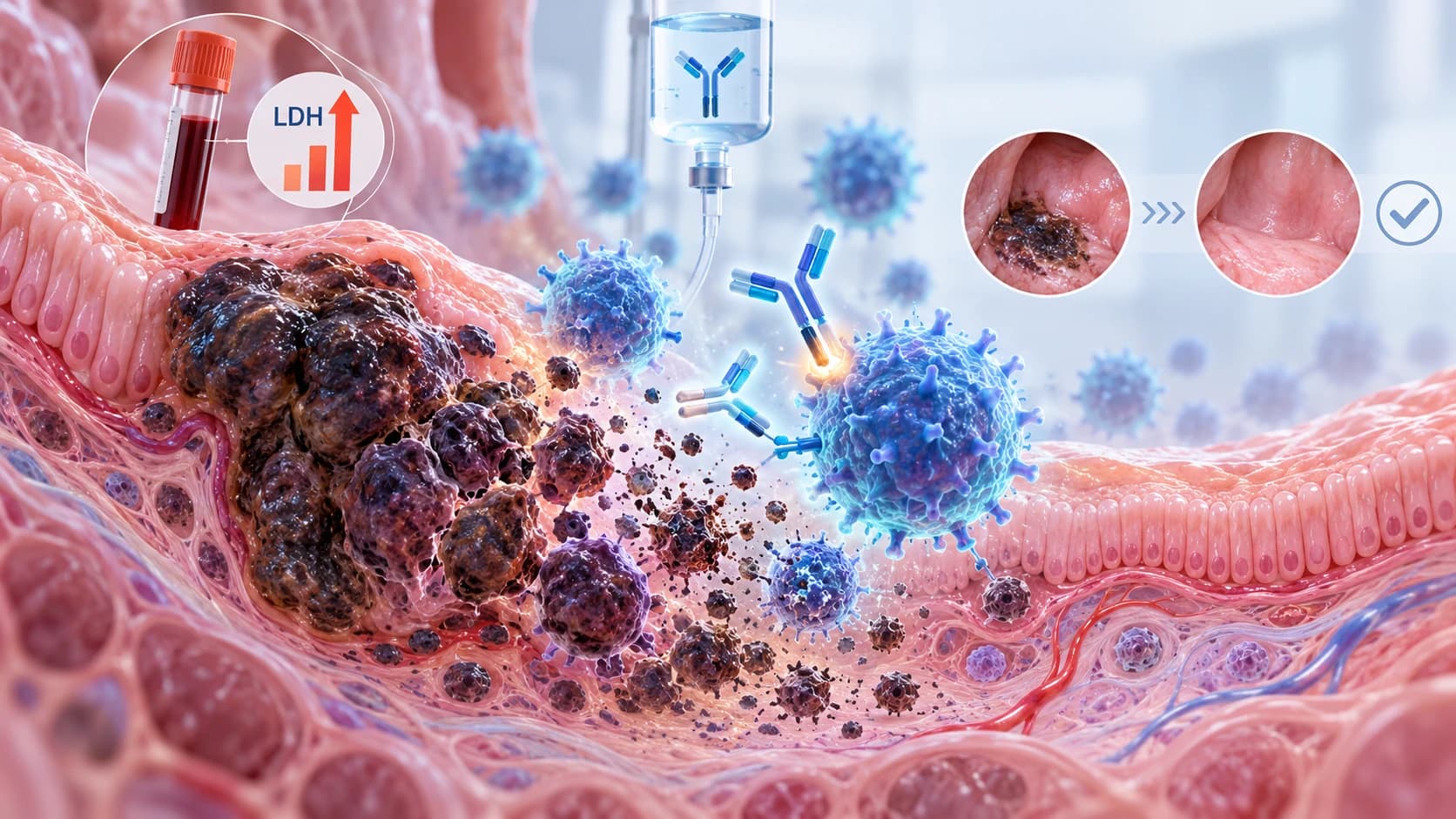
Within two months of starting nivolumab, serum LDH dropped markedly, coinciding with an already-evident partial response on imaging. The partial response was followed by a durable complete response. LDH levels remained low throughout the remainder of follow-up, consistent with the ongoing complete response.
Follow-up & Outcomes
The patient's complete response was reported as durable over the observation period, with LDH remaining low throughout, consistent with sustained disease control. Grade 1-2 vitiligo and rash persisted as the only reported adverse events, with no higher-grade toxicity or treatment discontinuation for toxicity reported.
Interpretation
This case documents a treatment-naive mucosal melanoma patient with markedly elevated baseline LDH who achieved a durable complete response to nivolumab monotherapy, with LDH normalizing in parallel with early tumor response. Read against the limited evidence assembled for this case, the outcome runs against two plausible biological expectations rather than confirming them. First, mucosal melanoma generally carries a lower tumor mutational burden than cutaneous melanoma, and lower neoantigen load has been associated with reduced durability of anti-PD-1-induced T cell responses -- a relationship that would predict a shorter-lived response than the complete, durable response observed here. Second, in vitro evidence suggests that tumor-derived lactate can suppress cytotoxic T lymphocyte and NK cell function. However, elevated serum LDH does not directly establish increased tumor lactate production or immune suppression in this patient. Therefore, these experimental findings cannot reliably predict this patient's response to nivolumab. Neither mechanism, as described in the available evidence, explains why this tumor responded so favorably. An alternative framework from melanoma resistance research points to determinants independent of mutational burden or LDH: intact interferon-gamma signaling, preserved beta-2-microglobulin needed for antigen presentation, and adequate T cell infiltration have each been linked to response versus primary resistance to PD-1 blockade. None of these factors were directly measured in this patient, so this remains a plausible but untested explanation for the discordance between pessimistic baseline markers and the favorable outcome that followed.
Discussion
CheckMate 066 was a randomized trial of nivolumab versus chemotherapy in previously untreated, BRAF wild-type metastatic melanoma; mucosal melanoma patients represent a small subset within such cutaneous-melanoma-dominated trials, and subtype-specific outcome data are correspondingly sparse. This case is notable primarily because it combines two features, very high baseline LDH and mucosal histology, each individually associated in separate strands of evidence with a lower likelihood of robust or durable checkpoint inhibitor response, yet the patient achieved a complete and durable response. The evidence assembled here does not resolve why; it instead highlights that the mechanisms proposed to explain melanoma's heterogeneous response to anti-PD-1 therapy, including tumor-mutational-burden-driven neoantigen load, lactate-mediated immune suppression, interferon-gamma pathway integrity, antigen presentation machinery, and T cell infiltration, were developed largely in cutaneous melanoma cohorts or in vitro systems, with untested applicability to mucosal melanoma or to this patient specifically. The rapid, early fall in LDH coinciding with radiographic partial response is consistent with LDH functioning as a surrogate marker of tumor burden in this patient, a pattern commonly observed when LDH elevation reflects tumor bulk rather than a fixed biological trait predicting treatment failure; however, no evidence reviewed for this case directly investigated the mechanistic link between anti-PD-1 activity and LDH kinetics. The mild, grade 1-2 immune-related adverse events are consistent with on-target immune activation but were not evaluated in the available evidence as predictors of response in this case. This case functions as a documented instance in which markers conventionally associated with less favorable prognosis did not predict outcome, without the evidence base available here explaining the discrepancy.
Limitations
This analysis is based on a single published case within a larger clinical trial, and case-level findings cannot establish generalizable relationships between baseline LDH, tumor mutational burden, and treatment response; the patient represents one data point relative to population-level trial results. Demographic details such as age and sex were not reported in the available case information. The evidence reviewed came from a small set of mechanistic and clinical studies conducted largely in cutaneous melanoma or in vitro systems rather than mucosal melanoma specifically, and none of the proposed mechanisms were directly tested in this patient. This secondary analysis relied on a predefined, limited evidence search and cannot rule out additional mechanisms or supporting studies outside that scope.
Timeline
Baseline — Enrollment in CheckMate 066 trial; metastatic mucosal melanoma, BRAF wild-type, LDH approximately seven times upper limit of normal
Within 2 months of treatment start — LDH levels dropped markedly; partial response already evident
During treatment course — Partial response followed by durable complete response
Throughout follow-up — LDH levels remained low, consistent with ongoing complete response; grade 1-2 immune-related adverse events (vitiligo, rash) observed
References
- 1.
- 2.Mutational landscape determines sensitivity to PD-1 blockade in non–small cell lung cancer
Lower tumor mutational burden in mucosal melanoma is associated with reduced neoantigen load, which could theoretically limit the magnitude and durability of anti-PD-1-induced T cell responses.
- 3.LDHA-Associated Lactic Acid Production Blunts Tumor Immunosurveillance by T and NK Cells
Tumor lactate accumulation inhibits cytotoxic T lymphocyte function and NK cell activity, potentially reducing checkpoint inhibitor efficacy in high-LDH tumors.
- 4.Genetic Basis for Clinical Response to CTLA-4 Blockade in Melanoma.
Primary resistance to PD-1 blockade in melanoma can arise from loss of IFN-gamma signaling pathway components, beta-2-microglobulin loss, or lack of T cell infiltration, independent of mutational burden.
Keywords