How Glucose and Insulin Signals Fuel Tumor Growth
Inside the molecular pathways, from PI3K-AKT to AMPK, that connect blood sugar, insulin, and cancer-driving genes to tumor growth
Key Takeaways
- •Many cancer cells rely heavily on glycolysis, converting glucose to lactate even when oxygen is available, a pattern called the Warburg effect that largely supplies building blocks for rapid growth rather than just energy.
- •Insulin and IGF-1 activate the PI3K-AKT signaling pathway, promoting glucose uptake, cell growth, and resistance to cell death; this signaling is normal physiology that becomes cancer-relevant mainly when it is dysregulated.
- •mTOR acts as a central hub that integrates growth factor signals and nutrient availability, and many tumors find ways to keep this growth switch locked in the 'on' position.
- •AMPK functions as an energy-sensing brake that normally opposes mTOR-driven growth, and the LKB1-AMPK pathway behaves as a tumor suppressor in some contexts.
- •Oncogenes such as MYC and KRAS can directly rewire glucose and glutamine metabolism, actively reprogramming fuel use rather than simply responding to outside hormonal signals.
- •HIF-1α links low-oxygen conditions inside tumors to increased glucose transport and glycolysis, and its signaling overlaps with growth-promoting pathways.
- •Population studies associate hyperinsulinemia, type 2 diabetes, and obesity with higher risk or worse prognosis for some cancers, but causality and the underlying mechanisms in humans are still being investigated.
- •Observational data link the diabetes drug metformin to lower cancer incidence in some studies, but this association does not establish it as a proven cancer treatment.
Doctors can sometimes see a tumor's appetite for sugar before they can see the tumor itself. A scan called FDG-PET imaging works by injecting a radioactive, glucose-like tracer into the bloodstream. Many tumors soak up far more of it than the normal tissue around them, which is what makes them light up on the scan. That hunger for glucose is not just a curiosity. It reflects a set of molecular signals that link how a cell senses fuel and growth cues to whether a tumor grows at all.
That observation raises a chain of questions researchers have worked through for decades. Why do cancer cells process glucose so differently? What role does insulin, a hormone most people associate with diabetes, play in tumor growth? And how do the mutated genes that drive cancer plug into this metabolic picture? The answers involve a small set of molecular switches that normally keep growth and energy use in careful balance.
Why Many Tumors Burn Sugar the Inefficient Way
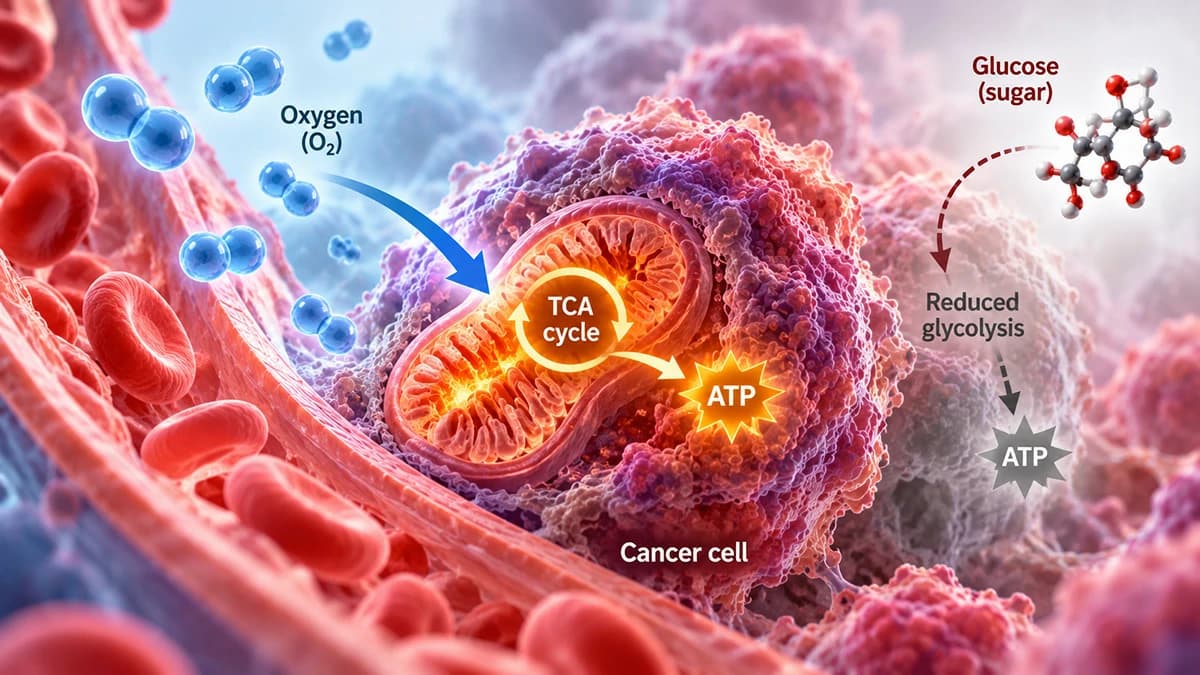
Healthy cells mostly generate energy through oxidative phosphorylation, a process that uses oxygen to extract a large amount of energy from each glucose molecule. Many cancer cells instead lean heavily on glycolysis, breaking glucose down into lactate even when oxygen is plentiful. This pattern is called the Warburg effect, named after Otto Warburg, who first described cancer cells behaving this way decades ago. On paper it looks wasteful, since glycolysis alone yields far less energy per glucose molecule than the oxygen-based route.
The explanation that has gained the most support is that rapidly dividing cells need more than energy. They need raw materials: the building blocks for new DNA, membranes, and proteins. Glycolysis happens to generate many of the intermediate molecules those building processes require, so a cell racing to divide may get more long-term value from channeling glucose into construction than from burning it completely for fuel. It is a bit like a factory gearing up for expansion, which often needs more raw materials flowing in than finished power output.
This heavy glycolytic traffic has a side effect. The lactate produced builds up and can acidify the tissue immediately surrounding a tumor. That shift in the local chemical environment may further influence how a tumor interacts with nearby healthy tissue, though exactly how much this contributes to tumor progression is still being worked out.
Growth Signals: How Insulin and IGF-1 Push Cells Forward
Insulin is best known for regulating blood sugar, but its job is broader than that. It tells cells to take up glucose and prompts them to grow and store energy. A related hormone, insulin-like growth factor-1, or IGF-1, acts through similar machinery and is an even stronger driver of cell growth and survival. Both are essential, ordinary parts of human physiology, not something inherently harmful.
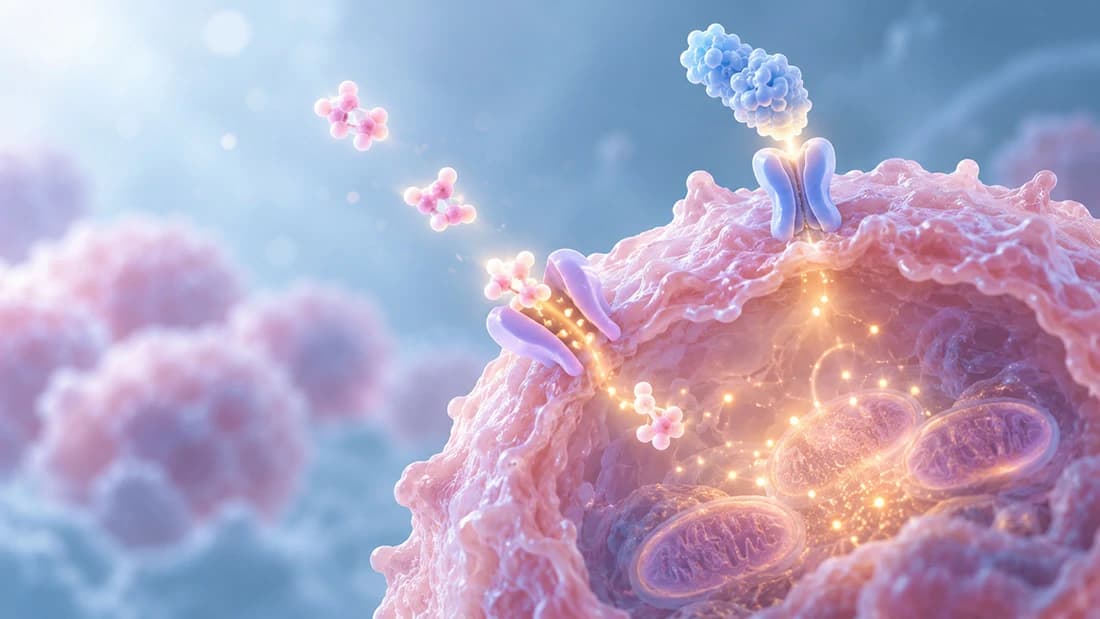
When insulin or IGF-1 binds its receptor on a cell's surface, it switches on a chain of signaling proteins known as PI3K-AKT. Once active, this pathway tells the cell to pull in more glucose, grow larger, and resist the internal signals that would normally trigger it to die when damaged or no longer needed. Research summarized by Michael Pollak and others has outlined how this same signaling, when persistently overactive, can support the survival of abnormal cells rather than normal ones.
Some cancer cells also carry altered patterns of insulin and IGF-1 receptors on their surface, including receptor combinations not typically seen in healthy tissue. These variations can make certain tumor cells more sensitive to growth signals circulating in the blood than ordinary cells would be. The underlying biology is normal; it is the cell's response to it that has gone off course.
mTOR: The Cell's Growth Decision Point
All of that signaling eventually converges on a protein called mTOR, which functions like a central decision point for the cell. mTOR gathers two kinds of information at once: growth factor signals arriving through PI3K-AKT, and direct readouts of whether enough nutrients and energy are on hand. When both answers say yes, mTOR pushes the cell to build new proteins, fats, and other material needed for growth and division.
This integration matters for tumor biology because many cancers find ways to keep this switch locked toward "grow," regardless of what the rest of the body's signals would otherwise suggest. Because insulin and IGF-1 both feed into mTOR through PI3K-AKT, chronically elevated insulin signaling can reinforce that same growth-forward state, which is one reason researchers have paid close attention to this hormone in the context of cancer biology.
AMPK: A Built-in Brake on Growth
If mTOR works like an accelerator, AMPK works like the brake sharing the same pedal space. AMPK is a cellular energy sensor: when a cell's energy reserves run low, AMPK switches on and does largely the opposite of mTOR, slowing growth and favoring energy-conserving processes instead. This relationship runs through what researchers call the LKB1-AMPK pathway, which in some contexts behaves as a genuine tumor suppressor.
The practical consequence is that a healthy cell under energy stress is supposed to pause its growth plans until conditions improve. Tumors that lose or weaken this brake pathway can keep growing even when fuel is scarce, which helps explain why disruptions to AMPK signaling show up in some cancers. The existence of this brake is also part of why AMPK has drawn interest as a possible point of intervention, a thread picked up again later.
When Cancer-Driving Genes Rewrite the Metabolic Rules
Tumors do not only respond passively to hormones circulating from elsewhere in the body. Many actively rewrite their own metabolism through mutated genes. MYC, a gene that becomes abnormally active in a wide range of cancers, directly turns up the genes needed for glycolysis and for breaking down the amino acid glutamine, supplying both energy and raw material for runaway growth.
KRAS, another frequently mutated gene, reshapes glucose handling in a different way. In pancreatic tumor models, a KRAS mutation locked in an "on" position redirected glucose-derived carbon into pathways that build new cellular material rather than simple energy output, a metabolic rewiring the tumors depended on to survive. Separately, tumors often outgrow their own blood supply, creating pockets of low oxygen. A protein called HIF-1α becomes active under those conditions and turns on genes for glucose transporters and glycolytic enzymes, deepening a tumor's reliance on glycolysis. HIF-1α does not act in isolation either; it interacts with the same growth-promoting signaling discussed above, so oxygen sensing and growth signaling often overlap rather than operate as separate systems.
Taken together, this altered handling of glucose, whether driven by oncogenes, growth hormones, or low oxygen, is now considered one of cancer's core hallmarks, alongside features like uncontrolled proliferation and resistance to cell death. It is not a side effect of tumor growth. It is part of what makes that growth possible.
What Population Studies Suggest About Insulin, Diabetes, and Cancer Risk
Given this biology, a natural question follows: does chronically elevated insulin, or a condition like type 2 diabetes or obesity, actually affect cancer risk in people? Epidemiological studies have found associations between hyperinsulinemia, type 2 diabetes, and obesity and an increased risk, or worse prognosis, for certain cancers. These are population-level patterns, not proof of a direct cause-and-effect chain in any individual.
The relationship is genuinely complex. It would be a mistake to read this as evidence that eating sugar or carbohydrates directly causes cancer; that overstates what the data show. What the associations do suggest is that chronic metabolic conditions marked by persistently elevated insulin may interact with the same growth-signaling pathways described above, though the exact mechanisms connecting them in humans remain an active area of research rather than settled fact.
The Metformin Question: A Research Lead, Not a Treatment
Because AMPK naturally counters mTOR-driven growth, researchers have taken a particular interest in drugs that influence this axis. Metformin, a widely used diabetes medication that affects AMPK-related signaling, has been linked in observational studies of people with diabetes to lower rates of cancer diagnosis or death.
That association motivated a wave of preclinical and clinical research, but observational data of this kind cannot establish that metformin itself causes those lower rates; people who respond well to diabetes treatment may differ from others in ways that also affect cancer risk. Commentary from researchers in the field has been explicit that this evidence marks the beginning of an investigation, not its conclusion. Metformin is not an established cancer treatment, and nothing in this research supports changing diabetes management on the basis of cancer biology without a physician's guidance.
Where the Evidence Currently Stands
The picture that emerges is one of overlapping systems rather than a single faulty switch. Insulin and IGF-1 signaling, the PI3K-AKT-mTOR growth pathway, the AMPK brake, and oncogenes like MYC and KRAS all intersect around the same basic question: should this cell use its available fuel to grow right now? In cancer, that question tends to get answered "yes" far more often than it should.
What remains genuinely open is how far this molecular picture translates into tools that change outcomes for patients. Epidemiological links between metabolism and cancer are real but do not by themselves prove a treatable cause. Metabolic drugs like metformin remain a promising research lead rather than a proven therapy. The mechanisms are increasingly well mapped; what to do with that map clinically is still being written.
Common Questions
References
- Matthew G. Vander Heiden, Lewis C. Cantley, Craig B. Thompson (2009). Understanding the Warburg Effect: The Metabolic Requirements of Cell Proliferation
- Robert A. Gatenby, Robert J. Gillies (2004). Why do cancers have high aerobic glycolysis?
- Michael Pollak (2008). Insulin and insulin-like growth factor signalling in neoplasia
- Antonino Belfiore, Francesco Frasca, Giuseppe Pandini, Laura Sciacca, Riccardo Vigneri (2009). Insulin Receptor Isoforms and Insulin Receptor/Insulin-Like Growth Factor Receptor Hybrids in Physiology and Disease
- Mathieu Laplante, David M. Sabatini (2012). mTOR Signaling in Growth Control and Disease
- David B. Shackelford, Reuben J. Shaw (2009). The LKB1–AMPK pathway: metabolism and growth control in tumour suppression
- Chi V. Dang (2012). MYC on the Path to Cancer
- Haoqiang Ying, Alec C. Kimmelman, Costas A. Lyssiotis, Sujun Hua, Gerald C. Chu, Eliot Fletcher-Sananikone, Jason W. Locasale, Jaekyoung Son, Hailei Zhang, Jonathan L. Coloff, Haiyan Yan, Wei Wang, Shujuan Chen, Andrea Viale, Hongwu Zheng, Ji-hye Paik, Carol Lim, Alexander R. Guimaraes, Eric S. Martin, Jeffery Chang, Aram F. Hezel, Samuel R. Perry, Jian Hu, Boyi Gan, Yonghong Xiao, John M. Asara, Ralph Weissleder, Y. Alan Wang, Lynda Chin, Lewis C. Cantley, Ronald A. DePinho (2012). Oncogenic Kras Maintains Pancreatic Tumors through Regulation of Anabolic Glucose Metabolism
- Gregg L Semenza (2010). HIF-1: upstream and downstream of cancer metabolism
- Douglas Hanahan, Robert A. Weinberg (2011). Hallmarks of Cancer: The Next Generation
- Rob A. Cairns, Isaac S. Harris, Tak W. Mak (2011). Regulation of cancer cell metabolism
- Ralph J. DeBerardinis, Navdeep S. Chandel (2016). Fundamentals of cancer metabolism
- Emily Jane Gallagher, Derek LeRoith (2015). Obesity and Diabetes: The Increased Risk of Cancer and Cancer-Related Mortality
- Josie M M Evans, Louise A Donnelly, Alistair M Emslie-Smith, Dario R Alessi, Andrew D Morris (2005). Metformin and reduced risk of cancer in diabetic patients
- Michael N. Pollak (2012). Investigating Metformin for Cancer Prevention and Treatment: The End of the Beginning
Team Review: This article has been reviewed by Canceria Research Team