How Prostate Cancer Rewires Its Metabolism as It Grows
From androgen-driven fat production to insulin signaling and the metabolic toll of hormone therapy, what the research actually shows
Key Takeaways
- •Early prostate cancer does not strongly rely on the classic Warburg effect seen in many other cancers; it shifts toward oxidative phosphorylation and lipid-based metabolism as it progresses.
- •PTEN loss and the resulting activation of the PI3K/AKT/mTOR growth pathway are documented genomic drivers in a significant subset of prostate cancers.
- •Androgen receptor signaling actively promotes fat synthesis, making lipid metabolism a central, hormone-linked feature of prostate cancer growth.
- •Higher circulating IGF-1 levels and obesity are both epidemiologically associated with increased prostate cancer risk and more aggressive disease.
- •Carbohydrate restriction has slowed prostate tumor growth in animal studies linked to insulin and IGF-1 changes, but this has not been tested in human patients.
- •Metformin shows antitumor effects in cell and animal studies through AMPK activation, but a clinical benefit for prostate cancer patients remains unproven.
- •Statin use is associated with lower rates of advanced prostate cancer in epidemiological studies, though this association does not prove a protective effect.
- •Androgen deprivation therapy, a standard treatment, reliably triggers metabolic syndrome-like changes including insulin resistance, weight gain, and altered lipid levels.
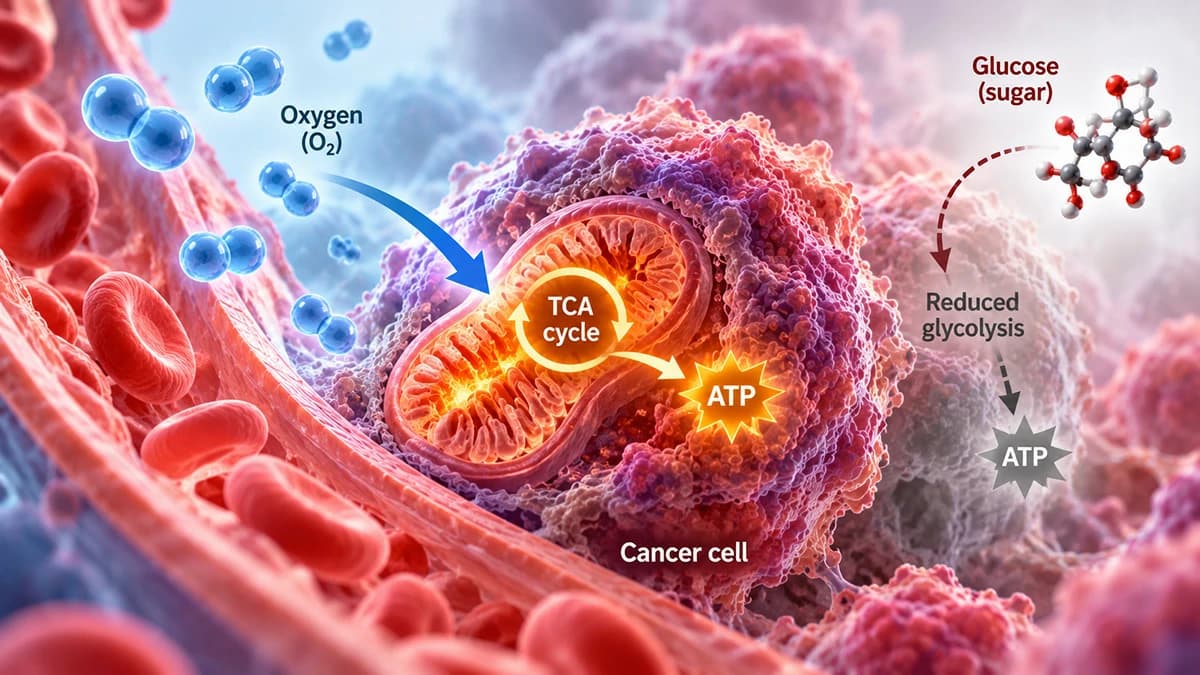
Many tumors switch their fuel strategy early on, burning sugar even when oxygen is plentiful. That pattern, called the Warburg effect, has become almost a signature of cancer cells. Prostate cancer appears to follow a different path, at least at the start.
Research comparing tumor metabolism across stages suggests that early prostate cancer does not lean heavily on this sugar-burning shortcut. Instead, the disease tends to rely on standard oxygen-based energy production, the same system healthy cells use. As the cancer advances, it increasingly draws on fat as a fuel and building material, a shift that becomes more pronounced in later, more aggressive disease.
This matters because a single metabolic story does not fit all prostate cancer. A treatment idea built around disrupting sugar metabolism, something that might make sense for a glucose-hungry tumor elsewhere in the body, may have little relevance to an early prostate tumor running mostly on oxygen and fat.
PTEN Loss and an Overactive Growth Pathway
Underneath this shifting fuel use sits a genetic switch. A sizable share of prostate cancers lose a working copy of a gene called PTEN, whose normal job is to put the brakes on a cell's internal growth machinery. Without that brake, a chain of signaling proteins known as the PI3K/AKT/mTOR pathway becomes chronically overactive.
Genomic profiling of human prostate tumors has identified PTEN loss and PI3K/AKT/mTOR activation as one of the more common driving abnormalities in the disease, present in a significant subset of cases, particularly in later-stage or more aggressive tumors. This pathway doesn't just tell cells to grow and divide. It also reprograms how a cell handles nutrients, favoring the lipid-heavy, oxidative metabolism described above.
The relationship runs both directions. Laboratory work has shown that when PTEN is lost, signaling through the androgen receptor, the same receptor targeted by hormone therapy, adjusts itself through a feedback loop with this growth pathway. That interaction helps explain why some PTEN-deficient tumors respond differently to hormone-based treatment, though the clinical implications are still being worked out.
Androgens and the Lipid Connection
Testosterone and related hormones, acting through the androgen receptor, do more than drive cell division in the prostate. They also instruct cells to build new fat molecules from scratch, a process that normally supports growth. In prostate cancer, that instruction seems to get amplified.
Studies of androgen signaling describe it as promoting fatty acid production and broader lipid metabolism, making this fat-building process a central feature of how prostate cancer cells grow rather than a side effect of it. In practice, the lipid shift seen in progressing tumors isn't a separate event. It appears tightly coupled to the hormonal signal that keeps most prostate cancer cells growing in the first place. That coupling is one reason lipid metabolism keeps surfacing as a research target, even though no lipid-targeted drug has become standard care.
Insulin, IGF-1, and Why Body Weight Matters
A hormone called IGF-1, short for insulin-like growth factor-1, circulates in the blood and promotes cell growth throughout the body. A landmark prospective study found that men with higher blood levels of IGF-1 had a greater risk of developing prostate cancer, one of the earlier pieces of evidence tying a growth-signaling hormone to the disease rather than diet or lifestyle alone.
Obesity complicates this picture further. Excess body fat changes insulin levels, IGF-1 availability, and androgen metabolism all at once, and a review of the epidemiological evidence found that obesity tracks with a higher risk of aggressive or fatal prostate cancer specifically, not just a higher risk of diagnosis overall. The exact combination of mechanisms behind that link isn't fully settled, but insulin and IGF-1 signaling are consistently part of the explanation researchers point to.
What Carbohydrate Restriction Does in Animal Studies
If insulin and IGF-1 feed prostate cancer growth, an obvious question follows: does cutting carbohydrates, which lowers insulin, slow the disease? Animal research has tested this directly. In mice with prostate tumors, restricting dietary carbohydrates slowed tumor growth, and the effect was linked to changes in the insulin and IGF-1 signaling axis described above.
That finding is genuinely interesting, but it comes from animal models, not from men with prostate cancer. A ketogenic diet, the very-low-carbohydrate, high-fat eating pattern often discussed in this context, has not been established as a treatment for prostate cancer in humans. The jump from "slows tumors in mice" to "helps patients" is exactly the gap that separates a promising research lead from a proven therapy.
Metformin, Statins, and the Search for Repurposed Drugs
Two already-approved drugs keep coming up in prostate cancer metabolism research, largely because of what they do to the pathways already described. Metformin, a widely used diabetes medication, activates a cellular energy sensor called AMPK, which generally acts as a counterweight to the PI3K/AKT/mTOR growth pathway. Laboratory studies have shown that metformin can slow prostate cancer cell growth, in part by reducing a protein needed for cells to divide, and these effects have held up in both cell culture and animal experiments.
Whether that translates into a clinical benefit for men who already have prostate cancer is a separate, unresolved question. The laboratory evidence is consistent; evidence of a meaningful effect on human prostate cancer outcomes is not yet established.
Statins, the cholesterol-lowering drugs taken by millions of people, have drawn similar interest because cholesterol is a raw material the body uses to make androgens. A large epidemiological study found that statin users had a lower risk of being diagnosed with advanced prostate cancer compared to non-users. That's an association, observed in a population over time, not evidence from a controlled trial, so it can't rule out other explanations, such as statin users differing from non-users in ways that also affect cancer risk.
The Metabolic Cost of Hormone Therapy
Androgen deprivation therapy, the hormone-lowering treatment used widely in prostate cancer, works by cutting off the signal described throughout this article. That success comes with a metabolic price. Clinical research following men on long-term androgen deprivation therapy documented the emergence of metabolic syndrome, a cluster of changes including insulin resistance, weight gain, and unfavorable shifts in blood lipid levels.
This creates a somewhat circular situation worth sitting with. A treatment aimed at starving the cancer of its hormonal fuel can, as a side effect, push a patient's body toward exactly the kind of insulin resistance that research elsewhere links to more aggressive disease. That doesn't mean the therapy is working against itself in every patient, but it's part of why metabolic monitoring during hormone therapy has become a more active area of clinical attention.
Separating What's Established from What's Still Experimental
Pulling these threads together, a few things are well supported. PTEN loss and overactive PI3K/AKT/mTOR signaling are documented genomic features of a meaningful share of prostate cancers. Androgen signaling is tied to increased fat synthesis. Higher IGF-1 levels and obesity are linked to prostate cancer risk and aggressiveness. Hormone therapy reliably produces metabolic side effects that matter for a patient's overall health.
What remains experimental is the leap from these mechanisms to a metabolic therapy a patient could use today. Carbohydrate restriction has only been tested in animal models of prostate cancer. Metformin's antitumor effects are strong in the lab but unproven in prostate cancer patients. Statins show an intriguing epidemiological association, not a demonstrated treatment effect. None of these approaches have been established as alternatives, or additions, to standard prostate cancer care, and none should be adopted without discussing them with the clinician managing that care. The science describing how prostate cancer cells handle fuel is genuinely advancing. Turning that understanding into a treatment that helps patients is still a work in progress.
Common Questions
References
- Matthew G. Vander Heiden, Lewis C. Cantley, Craig B. Thompson (2009). Understanding the Warburg Effect: The Metabolic Requirements of Cell Proliferation
- Barry S. Taylor, Nikolaus Schultz, Haley Hieronymus, Anuradha Gopalan, Yonghong Xiao, Brett S. Carver, Vivek K. Arora, Poorvi Kaushik, Ethan Cerami, Boris Reva, Yevgeniy Antipin, Nicholas Mitsiades, Thomas Landers, Igor Dolgalev, John E. Major, Manda Wilson, Nicholas D. Socci, Alex E. Lash, Adriana Heguy, James A. Eastham, Howard I. Scher, Victor E. Reuter, Peter T. Scardino, Chris Sander, Charles L. Sawyers, William L. Gerald (2010). Integrative Genomic Profiling of Human Prostate Cancer
- (2011). Reciprocal feedback regulation of PI3K and androgen receptor signaling in PTEN-deficient prostate cancer.
- Johannes V. Swinnen, Hannelore Heemers, Tine Van de Sande, Ellen De Schrijver, Koen Brusselmans, Walter Heyns, Guido Verhoeven (2004). Androgens, lipogenesis and prostate cancer
- J.M. Chan, M.J. Stampfer, E. Giovannucci, P.H. Gann, J. Ma, P. Wilkinson, C.H. Hennekens, M. Pollak (1998). Plasma Insulin-Like Growth Factor-I and Prostate Cancer Risk: A Prospective Study
- (2008). Carbohydrate restriction, prostate cancer growth, and the insulin-like growth factor axis.
- I Ben Sahra, K Laurent, A Loubat, S Giorgetti-Peraldi, P Colosetti, P Auberger, J F Tanti, Y Le Marchand-Brustel, F Bost (2008). The antidiabetic drug metformin exerts an antitumoral effect in vitro and in vivo through a decrease of cyclin D1 level
- Elizabeth A. Platz, Michael F. Leitzmann, Kala Visvanathan, Eric B. Rimm, Meir J. Stampfer, Walter C. Willett, Edward Giovannucci (2006). Statin Drugs and Risk of Advanced Prostate Cancer
- Emma H. Allott, Elizabeth M. Masko, Stephen J. Freedland (2013). Obesity and Prostate Cancer: Weighing the Evidence
- Milena Braga-Basaria, Adrian S. Dobs, Denis C. Muller, Michael A. Carducci, Majnu John, Josephine Egan, Shehzad Basaria (2006). Metabolic Syndrome in Men With Prostate Cancer Undergoing Long-Term Androgen-Deprivation Therapy
Team Review: This article has been reviewed by Canceria Research Team