How Cancer Cells Rewire Their Mitochondria to Grow, Spread, and Survive Treatment
A look at why tumors change the way they use energy, and why that switch isn't simply a sign of broken mitochondria.
Key Takeaways
- •Many cancer cells rely heavily on glycolysis for energy even when oxygen is available, a pattern known as the Warburg effect, first described by Otto Warburg in the 1950s.
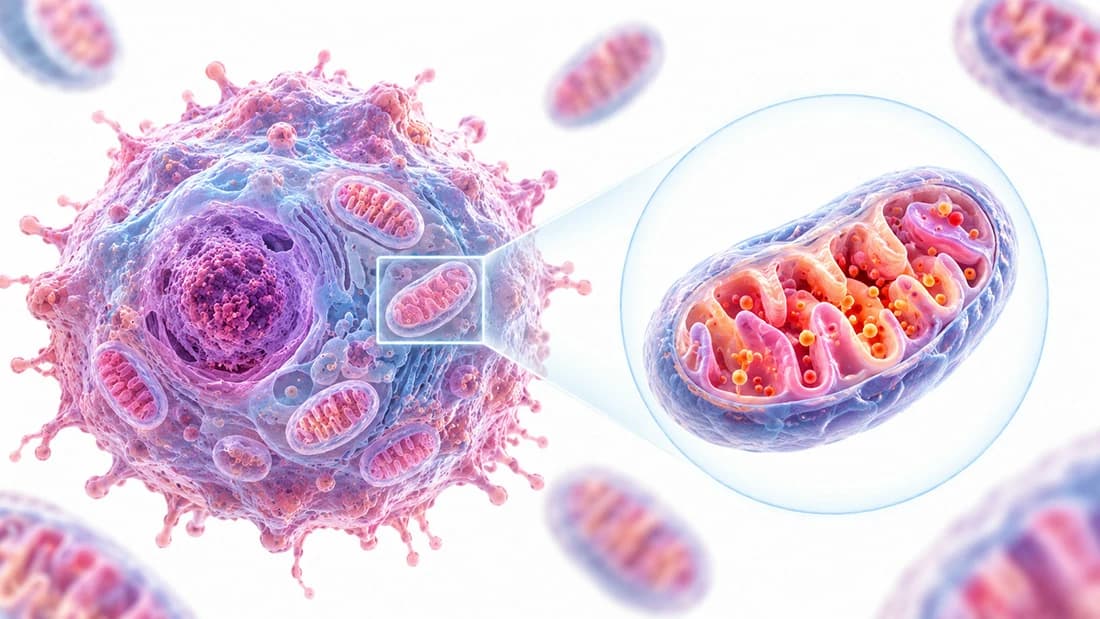
- •Mitochondria in cancer cells are generally repurposed rather than broken, continuing to support cell structure and signaling even as a tumor shifts its energy strategy toward glycolysis.
- •Mitochondria control a built-in cell death process called apoptosis, and cancer cells often evolve ways to block this process so they keep dividing.
- •Mitochondria constantly split apart and fuse together, a process called mitochondrial dynamics that helps cancer cells adapt to stress and changing conditions.
- •Laboratory studies show mitochondria and mitochondrial DNA can sometimes transfer between cells, which can restore energy production and reduce sensitivity to chemotherapy in experimental models.
- •Some cancer cells, including certain cancer stem cell populations, depend more on mitochondrial respiration than glycolysis, particularly under treatment pressure.
- •Increased mitochondrial activity and biogenesis have been linked to cancer cells' ability to survive and spread to distant tissues during metastasis.
- •Mitochondrial reactive oxygen species can both damage cells and act as growth-promoting signals, making their role in cancer highly dependent on concentration and context.
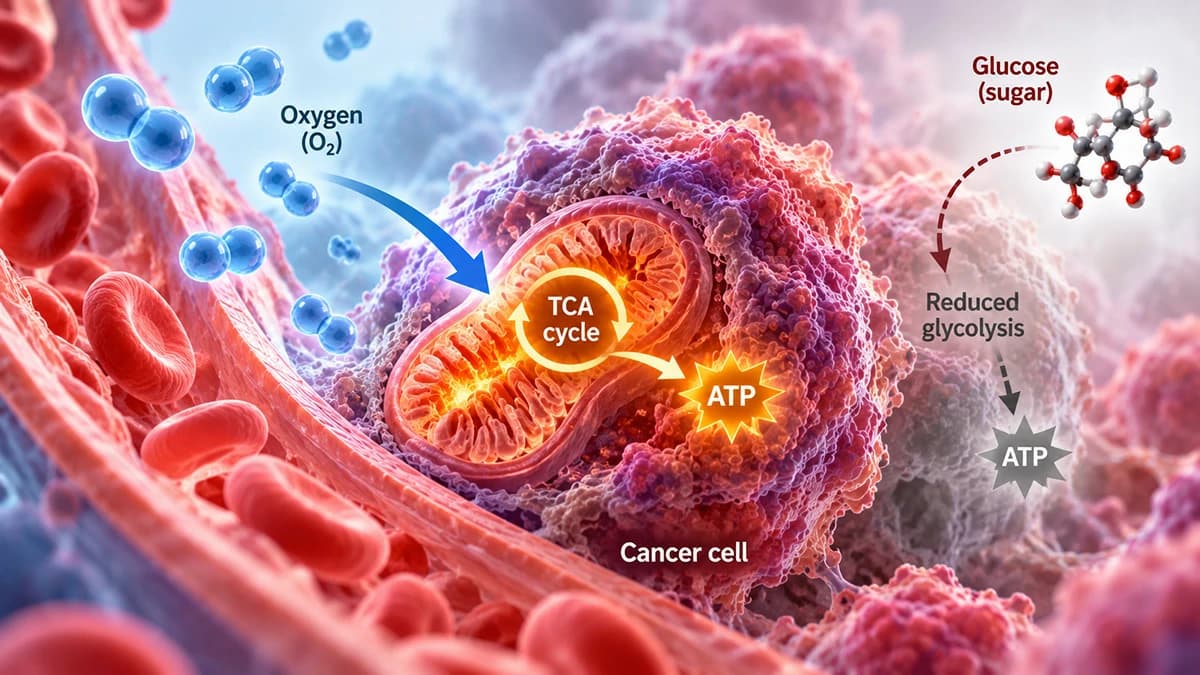
Most cells make the bulk of their energy inside mitochondria, the small structures long nicknamed the cell's power plants. Normally, a cell only ferments sugar for quick energy when oxygen is scarce, the way a sprinter leans on a quick burst of anaerobic effort rather than steady aerobic pacing. Cancer cells often behave differently. Even with plenty of oxygen around, many tumors still run mostly on this faster but less efficient pathway, called glycolysis. This pattern was first described by Otto Warburg in the 1950s and is now known as the Warburg effect.
For decades, that observation suggested something had gone wrong inside the mitochondria of these cells. Later work complicated that picture considerably. Researchers showed that aerobic glycolysis isn't just about energy at all. It also supplies the raw materials a rapidly dividing cell needs to build new DNA, proteins, and membranes, so a growing tumor cell needs building blocks as much as fuel, and glycolysis happens to supply both faster than mitochondrial respiration, or oxidative phosphorylation (OXPHOS), can.
Repurposed, Not Broken
Calling mitochondria "broken" in cancer cells misses what's actually happening in most cases. Many tumors retain mitochondria fully capable of oxidative phosphorylation; they simply shift how much they lean on it. This rebalancing of energy pathways is now considered one of the defining features of cancer biology, alongside better-known traits like uncontrolled division and resistance to cell death. Metabolism, in other words, isn't a side effect of cancer. It's one of the ways a tumor organizes itself to keep growing.
The Switch That Decides Whether a Cell Lives or Dies
Mitochondria do far more than generate energy. They also control a built-in self-destruct process called apoptosis, which normally clears out damaged or unwanted cells before they can cause harm. When a cell's mitochondria release certain internal proteins into the surrounding cytoplasm, that release sets off a chain reaction that dismantles the cell from the inside. Cancer cells frequently find ways to block this release, keeping the self-destruct switch turned off.
That's part of why damaged cells that should die instead keep dividing. It also helps explain why some cancer treatments, which work partly by triggering apoptosis, lose effectiveness once a tumor has found a way around this particular checkpoint.
Mitochondria in Motion
Mitochondria aren't fixed, static objects sitting inside a cell. They constantly split apart and fuse back together, a process known as mitochondrial dynamics. This fission and fusion lets a cell repair damaged mitochondrial segments, redistribute them during division, and adjust how much energy it produces under stress. In cancer cells, this flexibility appears to support both proliferation and survival, giving tumors another way to adapt as conditions change, such as when oxygen or nutrients become scarce deep inside a growing mass.
Borrowing Power From Neighboring Cells
One of the more surprising findings in this field is that mitochondria aren't always confined to the cell that made them. Experiments have shown that whole mitochondria, and even mitochondrial DNA (mtDNA), the small separate set of genetic instructions mitochondria carry, can move between cells. In laboratory studies, cancer cells that had lost their own mtDNA regained the ability to respire, and to form tumors, after acquiring mitochondrial genetic material from surrounding cells.
Other experiments found that cancer cells can pull mitochondria directly from nearby blood vessel cells through tiny tube-like bridges connecting the two, a transfer that measurably reduced the cancer cells' sensitivity to chemotherapy. These findings are striking, but they come mainly from cell culture and animal models. Whether this kind of transfer happens at a meaningful scale in human tumors, and how much it contributes to treatment resistance in patients, is still being worked out.
When Mitochondria Become Essential Again
Not every cancer cell leans the same way. Some populations, including certain cancer stem cells, a subset of tumor cells thought to drive relapse and resist therapy, rely more heavily on oxidative phosphorylation rather than glycolysis. In pancreatic cancer models, tumor cells that survived after a key cancer-driving gene was deliberately shut off turned out to depend heavily on mitochondrial function just to stay alive.
Separate work on pancreatic cancer stem cells found that these cells can shift their metabolic strategy back and forth, leaning more on mitochondrial respiration under some conditions and more on glycolysis under others. That back-and-forth flexibility, sometimes called metabolic plasticity, may make these particular cells harder to kill with treatments built around a single assumed fuel source.
Fueling the Spread
Mitochondria also appear to play a role once cancer cells leave the original tumor and travel elsewhere in the body, a process called metastasis. Research has linked increased mitochondrial biogenesis, the building of new mitochondria, along with higher oxidative phosphorylation activity, to cancer cells' ability to survive that journey and establish new growths in distant tissue. For at least some cancer cells, functioning mitochondria aren't a liability to be downplayed. They look more like an asset actively recruited to support spread.
A Molecule That Cuts Both Ways
Mitochondria naturally produce reactive oxygen species (ROS) as a byproduct of generating energy. In large amounts, ROS damage DNA, proteins, and cell membranes, which is part of why this kind of oxidative stress is generally considered harmful. But at lower, controlled levels, the same molecules act as signals, nudging cells toward growth and survival rather than damage.
In cancer, this dual identity matters quite a bit. Moderate ROS levels can support tumor growth, while pushing ROS beyond what a cell can tolerate may trigger damage or death instead. That tension is why mitochondrial ROS have been described as both a tool tumors exploit and a potential weak point, depending on the dose and the surrounding cellular context.
What the Bigger Picture Suggests
Taken together, this research treats mitochondria as active participants in cancer, not passive bystanders or simply malfunctioning machinery. They help decide whether a cell lives or dies, adjust their shape and number under stress, occasionally move between cells, and support both the growth of a primary tumor and its spread elsewhere.
Because mitochondrial behavior varies so much between cancer types, and even between cells within the same tumor, there's no single story that applies everywhere. Some tumors lean almost entirely on glycolysis; others clearly need working mitochondria to survive. That variability is exactly why mitochondria have drawn interest as a possible treatment target, though this work remains largely experimental.
Approaches aimed at disrupting cancer cell metabolism, including mitochondrial function, are being studied in laboratories and animal models, not yet established as routine patient treatments. Dietary strategies such as fasting or ketogenic eating are sometimes discussed in this context, but current evidence does not support treating them as proven cancer therapies. What is clearer is the conceptual shift itself: understanding how a tumor manages its energy and its mitochondria has become central to understanding how it grows, resists treatment, and spreads.
Common Questions
References
- Otto Warburg (1956). On the Origin of Cancer Cells
- Matthew G. Vander Heiden, Lewis C. Cantley, Craig B. Thompson (2009). Understanding the Warburg Effect: The Metabolic Requirements of Cell Proliferation
- Douglas R. Green, John C. Reed (1998). Mitochondria and Apoptosis
- Richard J. Youle, Alexander M. van der Bliek (2012). Mitochondrial Fission, Fusion, and Stress
- An S. Tan, James W. Baty, Lan-Feng Dong, Ayenachew Bezawork-Geleta, Berwini Endaya, Jacob Goodwin, Martina Bajzikova, Jaromira Kovarova, Martin Peterka, Bing Yan, Elham Alizadeh Pesdar, Margarita Sobol, Anatolyj Filimonenko, Shani Stuart, Magdalena Vondrusova, Katarina Kluckova, Karishma Sachaphibulkij, Jakub Rohlena, Pavel Hozak, Jaroslav Truksa, David Eccles, Larisa M. Haupt, Lyn R. Griffiths, Jiri Neuzil, Michael V. Berridge (2015). Mitochondrial Genome Acquisition Restores Respiratory Function and Tumorigenic Potential of Cancer Cells without Mitochondrial DNA
- (2013). Preferential transfer of mitochondria from endothelial to cancer cells through tunneling nanotubes modulates chemoresistance.
- (2014). Oncogene ablation-resistant pancreatic cancer cells depend on mitochondrial function.
- Patricia Sancho, Emma Burgos-Ramos, Alejandra Tavera, Tony Bou Kheir, Petra Jagust, Matthieu Schoenhals, David Barneda, Katherine Sellers, Ramon Campos-Olivas, Osvaldo Graña, Catarina R. Viera, Mariia Yuneva, Bruno Sainz, Christopher Heeschen (2015). MYC/PGC-1α Balance Determines the Metabolic Phenotype and Plasticity of Pancreatic Cancer Stem Cells
- Valerie S. LeBleu, Joyce T. O’Connell, Karina N. Gonzalez Herrera, Harriet Wikman, Klaus Pantel, Marcia C. Haigis, Fernanda Machado de Carvalho, Aline Damascena, Ludmilla Thome Domingos Chinen, Rafael M. Rocha, John M. Asara, Raghu Kalluri (2014). PGC-1α mediates mitochondrial biogenesis and oxidative phosphorylation in cancer cells to promote metastasis
- Simran S. Sabharwal, Paul T. Schumacker (2014). Mitochondrial ROS in cancer: initiators, amplifiers or an Achilles' heel?
- Douglas Hanahan, Robert A. Weinberg (2011). Hallmarks of Cancer: The Next Generation
- Ralph J. DeBerardinis, Navdeep S. Chandel (2016). Fundamentals of cancer metabolism
Team Review: This article has been reviewed by Canceria Research Team